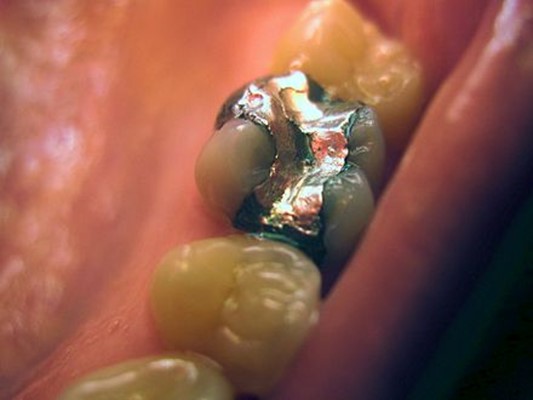

How are dental amalgams made
An amalgam is an alloy of mercury with one or more other metals. Most dental amalgams are called silver amalgams since silver is the principal constituent that reacts with mercury. The kinetics of reactions between mercury and silver are not appropriate for clinical use, so that the silver is provided as an alloy with other elements. This alloy is often referred to as a dental amalgam alloy or, collectively, they are known as ‘alloys for dental amalgam’ (ISO 1995). There are several types of dental amalgam alloy, all involving tin and most having some copper and, to a lesser extent, zinc. Some of the dental amalgam alloys themselves contain a little mercury to facilitate the amalgamation reaction. A conventional dental amalgam alloy will contain between 67% and 74% silver, with 25-28% tin, and up to 6% copper, 2% zinc and 3% mercury. The so-called dispersion type amalgam alloys have around 70% silver, 16% tin and 13% copper. A further, quite different, group of amalgam alloys may contain up to 30% copper, and are known as high-copper content amalgam alloys. In addition, again being very different, so-called copper amalgams which contained approximately 30% copper and 70% mercury were once used, but these are no longer recommended.<br />The amalgam alloys are mixed with mercury before clinical placement at a 1 to 1 weight- ratio. The mercury content of a finished dental amalgam restoration is therefore approximately 50% by weight.<br />In the conventional dental amalgam alloys, the ratio of silver to tin results in a crystal structure that is essentially the intermetallic compound Ag3Sn, referred to as the gamma (γ) phase. The exact percentage of this phase controls the kinetics of the amalgamation reaction and many properties of the resulting amalgam structure. With the higher copper dispersion alloys, the microstructure is usually a mixture of the gamma phase with the eutectic silver-copper phase.<br />Different manufacturers present the amalgam alloy in different formats, although they are usually made available as fine particles, either spherical or irregular in shape, with particle sizes around 25-35 microns. Although there are also several different ways of dispensing the liquid mercury and the solid amalgam alloy, this is usually achieved by means of a sealed, compartmentalised capsule, with the alloy in one part and the mercury in the other, the membrane between the two being broken during the process of mixing in a mechanical amalgamator. This is an important point since a major route for exposure to metallic mercury during hand mixing, as carried out until a few decades ago, is eliminated during this process. Nevertheless, exposure certainly does occur during the next phases of placement, where the setting amalgam is placed into the prepared tooth cavity and condensed, or compressed, firmly within the cavity. During this process, the structure of the amalgam is optimised by this compression, causing excess mercury to rise to the surface, from where it is removed. The properties of the amalgam restoration will depend on the perfection of this technique, the elimination of as much excess mercury as possible being essential.<br />The metallurgical characteristics of the amalgamation process are very important. With the conventional amalgam alloy, the reaction between the Ag3Sn (γ) phase and the mercury results in the formation of the γ1 phase, which is a body-centred cubic mercury - silver phase with a mercury-silver ratio between 3:2 and 8:5, and the γ2 phase, a hexagonal tin-mercury phase of mercury - tin ratio between 1:6 and 1:8. The reaction does not go to completion and some 30% of the set amalgam consists of un-reacted Ag3Sn (γ) phase. There will be, as noted above, some retained mercury, the majority of which is removed by the dentist during condensation; much of the remainder continues to react, very slowly, with the Ag3Sn (γ) phase. It is emphasised that the set amalgam contains about 50% mercury and it will be seen that the majority of this mercury in the amalgam is contained in the γ1 phase, with a minority in the γ2. These metallurgical principles of dental amalgam are well established and have been discussed in detail in standard dental textbooks and reference documents (for example, Anusavice 2003).<br /><br />بواسطة م.م. فاطمة صفاء فاهم