SAN (storage area network)
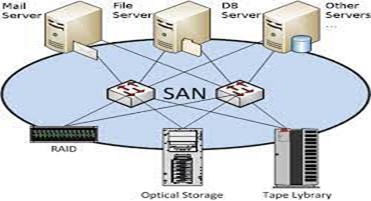
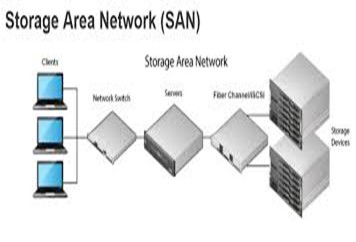
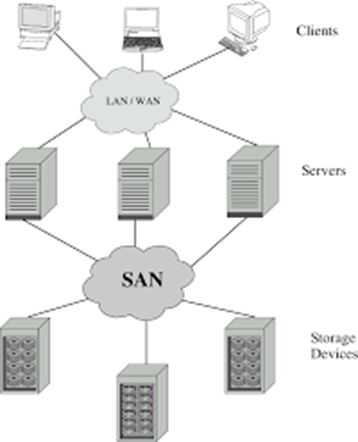
is a network of storage devices that can be accessed by multiple servers or computers, providing a shared pool of storage space. Each computer on the network can access storage on the SAN as though they were local disks connected directly to the computer A computer network that provides access to embedded data storage at the block level. Storage networks are primarily used to improve the accessibility of storage devices, such as disk arrays and tape libraries, to servers so that the devices appear on the operating system as locally attached devices. A storage network (SAN) is typically a network dedicated to storage devices that cannot be accessed through a LAN by other devices, preventing LAN traffic from interfering with data transmission[1].<br />In the early 2000s, the cost and complexity of Storage Networks (SANs) declined to levels that would allow for wider adoption across enterprise and small and medium business environments.<br />SAN does not provide file abstraction, only block-level operations. However, file systems built on top of Storage Networks (SANs) provide file-level access, and are known as shared disk file systems[2] ..<br /><br /> <br />Storage structures<br />Storage Networks (SANs), sometimes referred to as the network behind the servers, were historically developed from a centralized data storage model, but with their own data network. Storage networks, in their simplest form, are a network dedicated to storing data. Storage Networks (SANs) allow in addition to data storage, automatic data backup and storage monitoring in addition to the backup process[3].<br /> <br /> A Storage Network (SAN) is a combination of hardware and software. It originated from a data-centric mainframe architecture, where clients in a network can connect to many servers that store different types of data. To expand storage capacity as data volume increases, direct accessory storage (DAS) has been developed, where only disk arrays or a group of disks (jaypods) are attached to servers. In this architecture, storage devices can be added to increase storage capacity. However, the server through which it is connected to the storage devices is a single point of failure, and a large portion of LAN bandwidth is used to access, store, and back up data. To solve the problem of a single point of failure, a shared live extension storage architecture was implemented, where many servers can access the same cache device[3].<br /><br />Storage network properties<br />Quality of Service (Qos): connections of more than 8 gigabit over optical fibers that provide speeds suitable for information exchange.<br />Uptime: Storage networks provide a multi-source tool that helps in ensuring that information is always available, even in light of partial interruptions or failures. This is done through repetitive storage of the same information.<br />Compatibility: Storage networks can handle clients with different operating systems: Unix, Windows...<br />Variable yield: The network yield is proportional to demand and according to storage resource[3]<br /> <br />Sources and references<br />1- Jon Tate, Pall Beck, Hector Hugo Ibarra, Shanmuganathan Kumaravel & Libor Miklas (2017), "Introduction to Storage Area Networks" (PDF), Red Books, IBM. Archived from the original (PDF) on January 01, 2020.<br />2- NIIT (2002), Special Edition: Using Storage Area Networks, Que Publishing,<br />3- Storage Area Networks For Dummies, John Wiley & Sons, 2009,<br /><br /><br />By: MSc Noor Haider Obaid