The Structure of Carbon Nanotubes
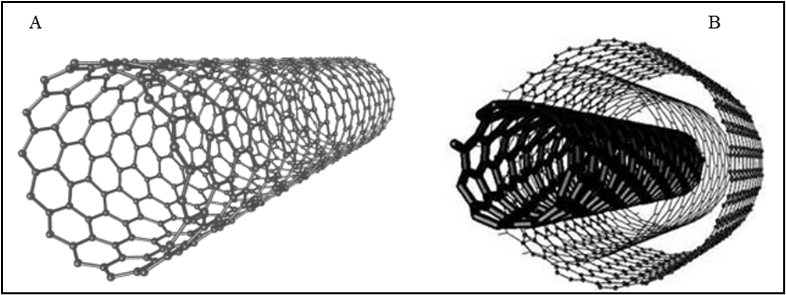
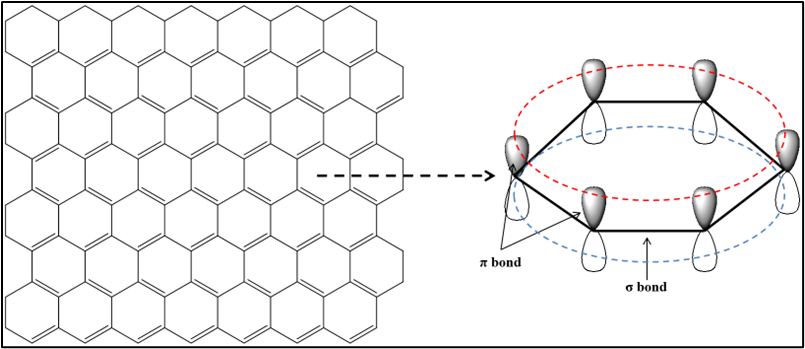
CNTs consist of carbon atoms that are structured in layers of graphene rolled into seamless cylinders. Each carbon atom of graphene is symmetrically bound to three other carbon atoms, one atom thick, which in turn form hexagonal rings, as shown in. The bonding mechanism in CNTs system is similar to that of graphite. When carbon atoms combine to form graphite, sp2 hybridization occurs. In this process, one orbital and two p orbitals combine to produce three hybrid sp2 orbitals at 120○ to each other within a plane. This inplane bond is referred to as a σ bond. This is a strong covalent bond that binds the atoms in the plane, and results in the high stiffness and high strength of CNTs. The remaining p orbital is perpendicular to the plane of the σ bonds. It contributes mainly to the interlayer interaction and is called the π bond. These delocalized π bonds interact with the other π bonds on the neighboring layer. This interlayer interaction of pairs of atom on neighboring layers is much weaker than a σ bond.<br /><br />CNTs can be classified into two main groups: single-walled and multi-walled. A carbon nanotube that consists of only one layer of graphene is usually called a single-walled carbon nanotube (SWCNTs). The multi-walled carbon nanotubes (MWCNTs) consist of several layers of graphene shaped into concentric cylinders, which are bound together by van der Waals forces. The diameter of SWNTs ranges from 0.4 nm to 5.0 nm and their lengths are usually several micrometers. The structure of SWCNTs is further complicated by the strong van der Waals interaction along the length axis, and as a result they form ropes and are hardly ever found in the form of single individual tubes. Such ropes or bundles of SWCNTs are usually 10-30 nm wide and contain several tens of individual nanotubes, and thus prevent their dispersion in water. On the other hand, MWCNTs form in a range of diameters, typically between 2-25 nm inside and 20-50 nm outside. The distance between the layers is 0.34 nm, which is slightly larger than in graphite, which is 0.335 nm due to geometrical constraints caused by the curvature.<br /><br /> <br />Basic hexagonal bonding structure for one graphite layer (the graphene sheet); carbon nuclei shown as filled circles; out of plane π bonds represented as delocalized (dotted line); and σ bonds connecting the C nuclei inplane.<br /><br /><br /> <br />The structures of CNTs: (A) SWNTs consisting of a single graphene layer; (B) MWNTs consisting of many graphene layers. <br /><br /><br /><br /> By: MSc Halla Thamer Mohammed