Viral Zoonosis
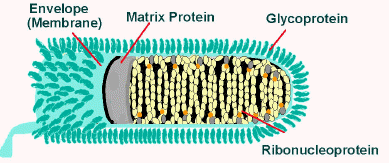
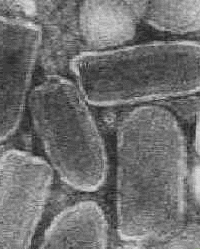
Zooneses are diseases of vertebrate animals that can be transmitted to man: either directly or indirectly through an insect vector. <br /> When an insect vector is involved, the disease is also known as an arboviral disease. <br /> However, not all arboviral diseases are zoonosis: where the transmission cycle takes place exclusively between insect vector and human e.g. dengue and urban yellow fever.<br /> Examples of viral zoonoses that can be transmitted to man directly include rabies, hantaviruses, lassa and ebola fevers.<br /><br /><br />:Rabies Virus<br /> member of the Lyassavirus of the Rhabdoviridae.<br /> ssRNA enveloped virus, characteristic bullet-shaped appearance with 6-7 nm spike projections.<br /> virion 130-240nm * 80nm<br /> -ve stranded RNA codes for 5 proteins; G, M, N, L, S<br /> Exceedingly wide range of hosts.<br /> There are 5 other members of Lyassavirus : Mokola, Lagosbat, Duvenhage, EBL-1, and EBL-2.<br /> Duvenhage and EBL-2 have been associated with human rabies.<br /><br /><br /><br /><br /><br /><br /><br /><br /> <br /><br /><br /><br /><br /><br /><br /><br /><br />(Rabies Structure)<br />Epidemiology:<br />Rabies is a zoonosis which is prevalent in wildlife. The main animals involved differs from continent to continent.<br />Europe fox, bats<br />Middle East wolf, dog <br />Asia dog<br />Africa dog, mongoose, antelope<br />N America foxes, skunks, raccoons, insectivorous bats<br />S America dog, vampire bats<br /><br /> :Pathogenesis<br /> The commonest mode of transmission in man is by the bite of a rabid animal, usually a dog. Rabies is an acute infection of the CNS which is almost invariably fatal. <br /> Following inoculation, the virus replicates in the striated or connective tissue at the site of inoculation and enters the peripheral nerves through the neuromuscular junction. <br /> It then spreads to the CNS in the endoneurium of the Schwann cells. <br /> Terminally, there is widespread CNS involvement but few neurons infected with the virus show structural abnormalities. The nature of the profound disorder is still not understood. <br /><br />Laboratory Diagnosis <br /> Histopathology - Negri bodies are pathognomonic of rabies. However, Negri bodies are only present in 71% of cases.<br /> Rapid virus antigen detection - in recent years, virus antigen detection by IF had become widely used. Corneal impressions or neck skin biopsy are taken. The Direct Fluorescent Antibody test (DFA) is commonly used.<br /> Virus cultivation - The most definitive means of diagnosis is by virus cultivation from saliva and infected tissue. Cell cultures may be used or more commonly, the specimen is inoculated intracerebrally into infant mice. Because of the difficulties involved, this is rarely offered by diagnostic laboratories.<br /> Serology - circulating antibodies appear slowly in the course of infection but they are usually present by the time of onset of clinical symptoms.<br /><br />Management and Prevention:<br /> Pre-exposure prophylaxis - Inactivated rabies vaccine may be administered to persons at increased risk of being exposed to rabies e.g. vets, animal handlers, laboratory workers etc.<br /> Post-exposure prophylaxis - In cases of animal bites, dogs and cats in a rabies endemic area should be held for 10 days for observation. If signs develop, they should be killed and their tissue.<br /> Wild animals are not observed but if captured, the animal should be killed and examined. The essential components of postexposure prophylaxis are the local treatment of wounds and active and passive immunization.<br /> Once rabies is established, there is nothing much that could be done except intensive supportive care. To date, only 2 persons with proven rabies have survived.<br /> <br />Rabies Vaccines:<br />The vaccines which are available for humans are present are inactivated whole virus vaccines.<br /> Nervous Tissue Preparation <br /> Duck Embryo Vaccine <br /> Human Diploid Cell Vaccine (HDCV) <br /> Other Cell culture Vaccines - because of the expense of HDCV, other cell culture vaccines are being developed for developing countries. However recent data suggests that a much reduced dose of HDCV given intradermally may be just be effective. <br /><br />Control of Rabies<br /> Urban - canine rabies accounts for more than 99% of all human rabies. Control measures against canine rabies include;<br /> stray dog control.<br /> Vaccination of dogs <br /> quarantine of imported animals<br /> Wildlife - this is much more difficult to control than canine rabies. However, there are on-going trials in Europe where bait containing rabies vaccine is given to foxes. Success had been reported in Switzerland.<br /><br /><br />MSc Ola Abdullah Mahdi