prism
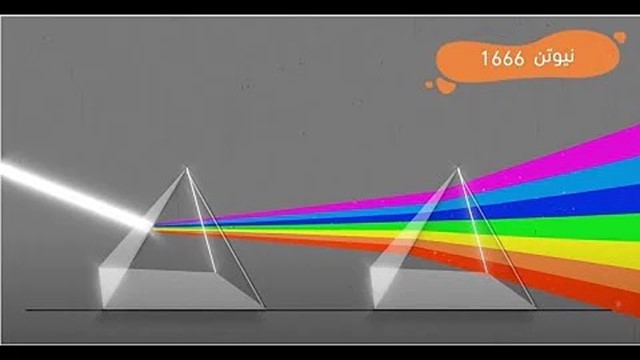
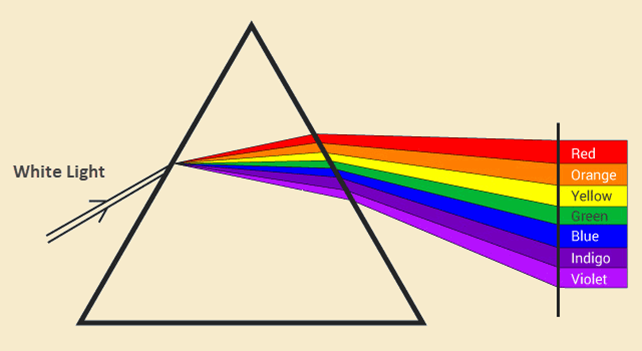
In optics, a prism is a transparent medium like glass, bounded by two plane faces that intersect according to a straight line called the prism, the base of the prism being the face opposite the letter.<br />Prism angle (A) is the angle opposite the base. The reason for the decomposition of white light into its different colors as it passes through the prism is because the speed of light in the prism material differs from its speed in the air.<br />This leads to the refraction of the light ray when it enters the medium (glass) at different angles of refraction, so that the refraction of red light is smaller than the refraction of blue, so they separate from each other (see the figure), and the red and blue beams come out of the prism separately.<br />Since white light, such as sunlight, contains a range of colors that include infrared, red, yellow, green in its degrees, cyan and blue in its degrees, to ultraviolet and ultraviolet rays, all those light colors are separated from each other by the action of the prism, due to the difference in the refractive index of each color in the prism, and we get on the so-called optical spectrum.<br />The prism is used in the process of analyzing light into the colors of the spectrum (the colors of the rainbow), and since each of the chemical elements has its own light spectrum, such as a fingerprint for humans, this light spectrum is emitted from the element when its atoms are excited by high heat, for example, it appears after its analysis Behind the prism, in the form of parallel lines of light, the element can be identified.<br /><br />MSc Hawraa Abdalkareem