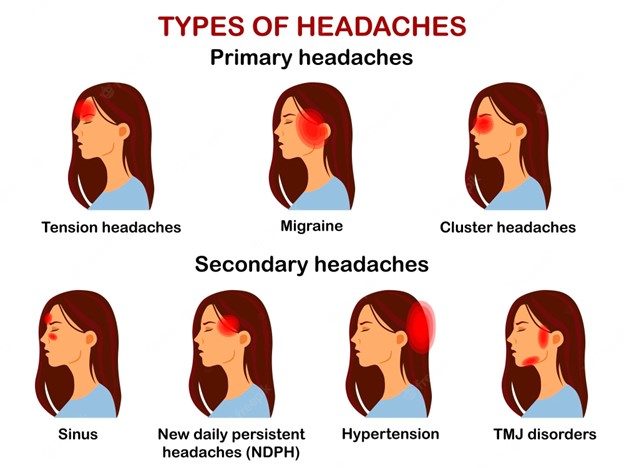
Headache Types
We classify headaches as either:<br /> primary (meaning no other condition is the cause) <br />secondary (meaning it is the result of another cause). More than 300 medical conditions have headache as a symptom, but most headaches are primary and benign and are successfully diagnosed and managed. <br />There are many types of headaches, which vary widely in terms of causes, intensity, and duration. The types of headaches we see most often are as follows.<br />Tension Headache: This mild-intensity headache often feels like you have pressure or a tight band around your head. This headache can cause increased sensitivity to light or sound, as well as nausea. Generally, tension headaches involve both sides of the head and can last hours to days. This is the most common headache and is not disabling. <br />Exertional Headaches: Exertional headaches are closely related to a physical activity. Typically, these headaches have a rapid build-up to severe intensity during the triggering event and vary in duration. Activities that can trigger exertional headaches include coughing, sneezing, running, having a bowel movement, and sexual intercourse. Occasionally these types of headaches are associated with a more serious problem and should always be discussed with a physician.<br />Migranes: A migraine is often a one-sided, throbbing headache of moderate or severe intensity. It usually lasts 4 to 72 hours and can be associated with light and sound sensitivity, nausea, and vomiting. These headaches usually begin when you are in your teens or twenties. Typically, there is someone else in the family with a history of migraine. Migraines are sometimes accompanied by aura, flashing lights, zigzag lines, loss of vision, or tingling sensations.<br />Chronic Migraine: Chronic migraines are headaches that occur 15 or more days a month for more than three months in a row. Some of these headaches have typical characteristics of a migraine, however not all of them feel like a migraine. Risk factors for developing chronic migraine from episodic attacks include overuse of medication taken for attacks as well as obesity, anxiety, and depression.<br />Menstrual Migraine: Generally, menstrual migraines occur right before, during, or immediately after a woman's period, and are triggered by shifts in estrogen.<br />Cluster Headache: This rare type of headache is characterized by severe one-sided pain, usually behind the eye or around the temple. These headaches are associated with eye tearing, eyelid drooping, nasal congestion, or runny nose. Each headache lasts typically 30 to 45 minutes and often recurs at least once during the day, often at similar times of the day. They are called cluster headaches because the attacks come in clusters for days, weeks, or months, followed by remission for months or even years. Cluster headaches affect mostly men and can present with such severe pain that sufferers have inflicted harm on themselves and even considered suicide.<br />Primary Stabbing Headache: Primary stabbing headaches, sometimes known as “jabs and jolts” headaches, often affect people who have migraine or cluster headaches. These headaches may feel like a sharp jab in a specific location on the head and last only for a few seconds, sometimes repeating a few times in a row. The pain can stay in one area or can move to another part of the head.<br />Trigeminal Neuralgia: Trigeminal neuralgia is facial pain usually over the cheek or jaw that feels like an electric shock. It can occur hundreds of times a day, and often people are very sensitive to touch in that area. Even touching the face, chewing, talking, or feeling the wind blow against the face can trigger an attack. Trigeminal neuralgia can be misdiagnosed as a tooth-related problem. It can be caused by a blood vessel that touches and irritates the trigeminal nerve, which is responsible for sensation in the face.<br />Cervicogenic headaches (cervical spine related), the cause in cervical spine. <br /><br />By: Dr. Mohammed Sami Hassan