Trans abdominal plane block
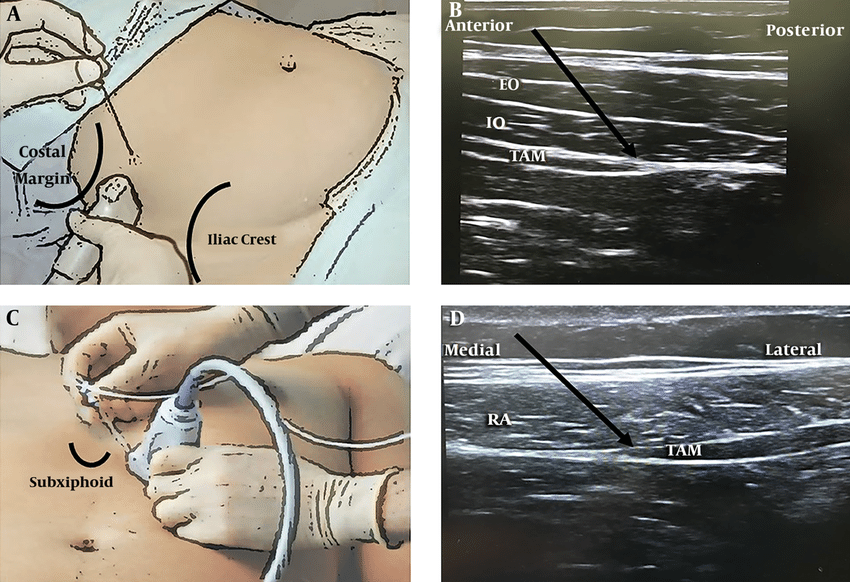
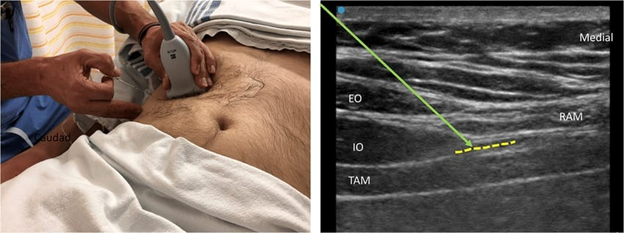
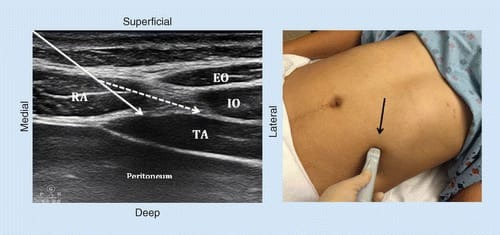
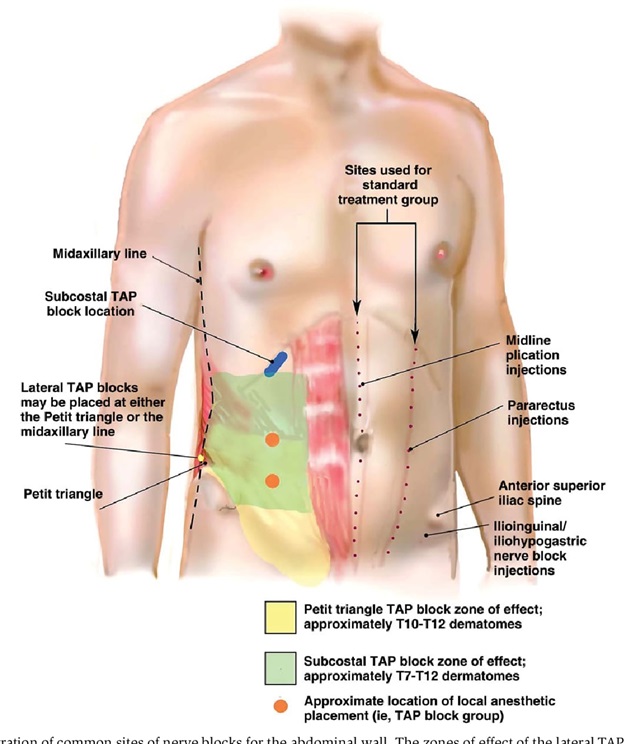
TAB block<br />The tranversus abdominis plane (TAP) block has become one of the most common truncal blocks performed for postoperative analgesia after abdominal surgeries. <br />Regional anesthesia for abdominal wall procedures can be performed using a variety of peripheral nerve blocks. These blocks are typically ultrasound (US) guided and involves injecting a local anesthetic (LA) solution into interfascial planes. US-guided transversus abdominis plane (TAP) block implicates the injection of LA in between the transversus abdominis (TA) and internal oblique (IO) muscles. The TAP block can also be targeted using anatomical landmarks at the level of the Petit triangle. <br />Regional anesthesia for abdominal wall procedures can be performed using a variety of peripheral nerve blocks. These blocks are typically ultrasound (US) guided and involves injecting a local anesthetic (LA) solution into interfascial planes. US-guided transversus abdominis plane (TAP) block implicates the injection of LA in between the transversus abdominis (TA) and internal oblique (IO) muscles. The TAP block can also be targeted using anatomical landmarks at the level of the Petit triangle. <br /> <br />Bilateral TAP blocks are used for midline and transverse abdominal incisions, such as umbilical or ventral hernia repair, cesarean deliveries, hysterectomy, and prostatectomy. TAP blocks are part of multimodal pain management for abdominal surgeries, which adds analgesic benefit to the patients, reducing postoperative opioid requirements. <br />TAP block are usually placed intraoperatively, either before surgical incision or at the end of the procedure before emergence from anesthesia. The efficacy of the TAP block is dependent on the spread of LA across the interfacial plane. <br />The TAP anatomical compartment is a plane that is located between the internal oblique and transversus abdominis muscles and contains the T6–L1 thoracolumbar nerves .<br />The anterior cutaneous nerve from the T6–T11 segments gives rise to intercostal (IC) nerves, which supply sensitivity to the skin and muscles of the anterior abdominal wall. The T9–T11 IC and T12 subcostal (SC) nerves penetrate the transversus abdominis plane compartment posterior to the midaxillary line .<br /> <br />Indications<br />Provide analgesia after an abdominal wall procedure in a variety of abdominal surgeries are the indications of the TAP block. The TAP block can be performed for open abdominal surgeries as well as laparoscopic procedures. The TAP block is an easier and less risky substitute for epidural anesthesia in postoperative pain control for abdominal surgeries.<br />Contraindications<br />This procedure is contraindicated in the following scenarios:<br /><br />Patient refusal<br />Infection over the site of of injection<br />Allergy to local anesthetics <br />Caution should be maintained in patients that are on therapeutic anticoagulation, pregnant and, where anatomical landmarks are difficult to distinguish (like very thin patients, elderly, or deconditioned).<br /><br />Equipment<br />The following are the necessary materials to perform a TAP block .<br />Ultrasound machine with a linear transducer. (Sometimes a curvilinear transducer might be needed, if the patient is obese or if performing a posterior approach)<br />Sterile ultrasound probe cover sleeve<br />Sterile ultrasound gel<br />Sterile towels<br />Sterile gloves<br />Antiseptic for skin disinfection, such as chlorhexidine 2%<br />Nerve block needle (50-mm to 100-mm, 20-gauge to 21-gauge needle) with tubing<br />Two 20-mL syringes containing the local anesthetic solution<br />Local Anesthetic Agent: Ropivacaine, Bupivacaine or Liposomal Bupivacaine<br />One 5ml syringe containing lidocaine for skin local anesthesia (if the patient is awake)<br />Basic physiological monitors: EKG, pulse oximeter and blood pressure monitor<br />If performing the block in an awake patient: A 5-ml syringe with needle for skin infiltration with Lidocaine 1% local anesthetic<br />Complications<br />Complications related to TAP blocks are rare. Some complications have been reported including:<br /><br />Bowel perforation<br />Hematoma<br />Liver/Spleen laceration<br />Intrahepatic injection<br />Intraperitoneal injection of local anesthetic<br />Retroperitoneal hematoma due to vascular injury<br />Transient femoral nerve blockage<br />Local infection<br />Intravascular injection<br />Local Anesthetic systemic toxicity<br />TAP block provide analgesia for 12 hours at least , it can reach to 24 or 36 hours according to efficiency of the medicine has been used & professional hand that applicate it . <br /><br />By Dr. Amassi Yakdhan