
Humidifiers
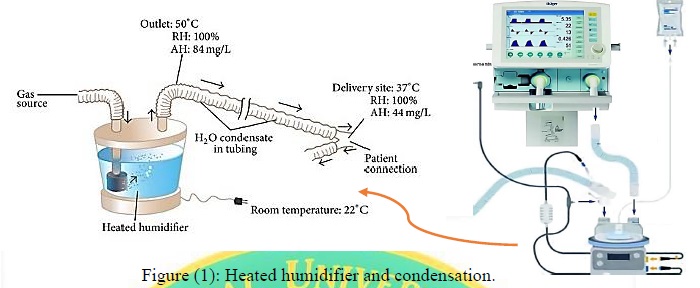
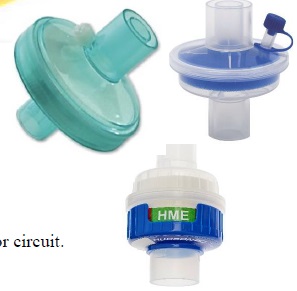
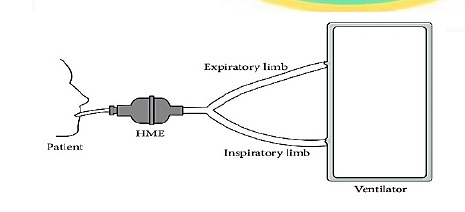
Humidifiers are devices that add molecules of water to gas. They are classified as active or passive based on the presence of external sources of heat and water (active humidifiers), or the utilization of patients' own temperature and hydration to achieve humidification in successive breaths (passive humidifiers).<br />Characteristics of the ideal humidifier<br />- Capable of providing adequate levels of humidification.<br />- Has low resistance to flow and low dead space.<br />- Provides microbiological protection to the patient.<br />- Maintenance of body temperature.<br />- Safe and convenient to use.<br />- Economical.<br />Active Humidifiers<br />Active humidifiers act by allowing air passage inside a heated water reservoir. These devices are placed in the inspiratory limb of the ventilator circuit, proximal to the ventilator. After the air is loaded with water vapor in the reservoir, it travels along the inspiratory limb to the patient's airway.<br />Components of Active Humidifiers<br />1. It contains a disposable reservoir of water with an inlet and outlet for inspired gases. Heated sterile water partly fills the container.<br />2. A thermostatically controlled heating element with temperature sensors, both in the reservoir and in the breathing system, is located close to the patient.<br />3. Tubing is used to deliver the humidified and warm gases to the patient. It should be as short as possible. A water trap is positioned between the patient and the humidifier along the tubing. The trap is positioned lower than the level of the patient.<br /><br />Passive Humidifiers<br />Heat and Moisture Exchangers (HMEs) Heat and moisture exchangers are also called artificial noses because they mimic the action of nasal cavity in gas humidification. They operate on the same physical principle, as they contain a condenser element, which retains moisture from every exhaled breath and returns it back to the next inspired breath. Unlike heat humidifiers, which are placed in the inspiratory limb of the circuit, these devices are placed between the Y piece and the patient. This may increase resistance to airflow not only during inspiration, but also during the expiratory phase.<br />Components of Passive Humidifiers<br />1. Two ports that are designed to accept 15- and 22- mm size tubing's and connections.<br />2. The head contains a medium, which can be:<br />a. hydrophobic (water repelling).<br />b. hygroscopic (water retaining).<br />c. combined hygroscopic–hydrophobic to provide best<br />efficiency.<br /><br />By: B.M.T. Montadher Talib<br />