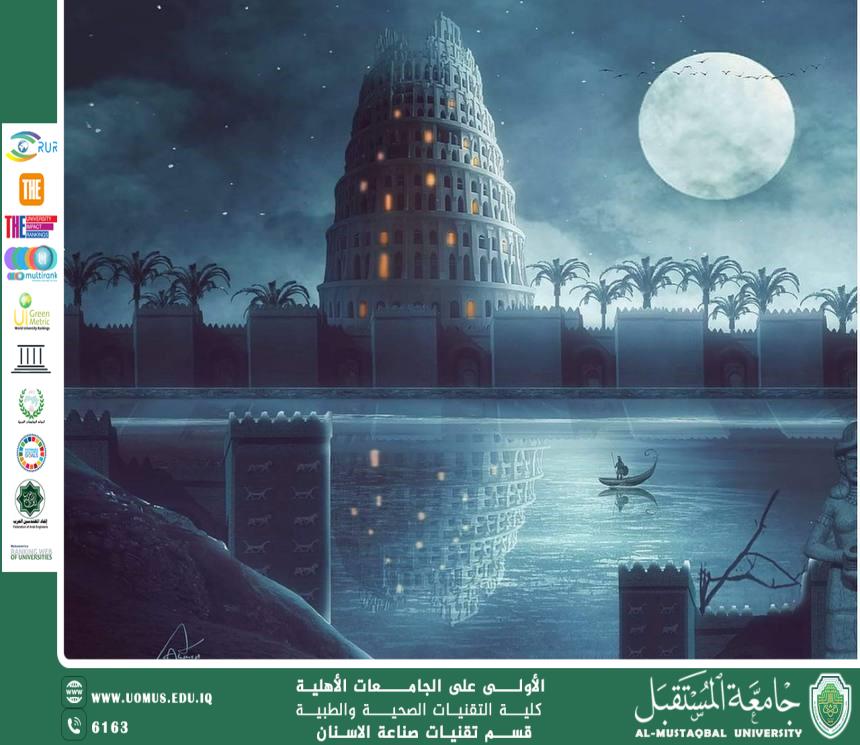
مقالة علمية للسيدة ( نور مهند عباس ) بعنوان ( Babylon )
<br />first emerged as a small town in southern Mesopotamia. It was mentioned in records of the Akkadian Empire under Sargon of Akkad (c. 2334–2279 BCE). During the rule of the Third Dynasty of Ur (2112–2004 BCE), Babylon grew but remained a minor city. However, its fortunes changed with the arrival of the Amorites, a Semitic people who established control over the region.<br /><br />⸻<br /><br />. The Old Babylonian Empire (1792–1595 BCE)<br /><br />The true rise of Babylon began under King Hammurabi (r. 1792–1750 BCE). He transformed Babylon into the dominant power of Mesopotamia, uniting various city-states under his rule. His most famous contribution was the Code of Hammurabi, one of the earliest and most comprehensive legal codes in history, covering laws on trade, marriage, crime, and property rights.<br /><br />Cultural and Scientific Achievements:<br /> • Babylonian scholars excelled in astronomy, mathematics, and literature.<br /> • They developed a base-60 numerical system, which influenced modern timekeeping (60 seconds per minute, 60 minutes per hour).<br /> • The city became a center for religious and literary works, with temples dedicated to Marduk, the supreme god of Babylon.<br /><br />Despite its advancements, the Old Babylonian Empire fell when the Hittites invaded and sacked the city in 1595 BCE, leading to a period of foreign rule.<br /><br />⸻<br /><br />. Kassite Rule and the Neo-Assyrian Period ( 1595–626 BCE )<br /><br />After the fall of Hammurabi’s empire, Babylon came under Kassite rule (1595–1155 BCE). The Kassites stabilized the region and made Babylon a cultural and religious center. Babylonian religious traditions, especially the worship of Marduk, continued to flourish.<br /><br />From the 9th to 7th century BCE, Babylon was under the control of the Neo-Assyrian Empire. While Assyrian rulers sometimes respected Babylon’s status, tensions arose, leading to revolts.<br /> • In 689 BCE, King Sennacherib of Assyria destroyed Babylon after a rebellion.<br /> • However, his successor, Esarhaddon (r. 681–669 BCE), rebuilt the city, recognizing its importance.<br /><br />Babylon remained an essential center of Mesopotamian culture, waiting for its next golden age.<br /><br />⸻<br /><br />. The Neo-Babylonian Empire (626–539 BCE): The Golden Age<br /><br />The greatest period of Babylon’s history began with the fall of the Assyrian Empire. King Nabopolassar (r. 626–605 BCE) led the Chaldean revolt against the Assyrians and established the Neo-Babylonian Empire. His son, Nebuchadnezzar II (r. 605–562 BCE), brought Babylon to its peak.<br /><br />Achievements of Nebuchadnezzar II:<br /> • Military Expansion: He conquered Jerusalem in 586 BCE, destroying the First Temple and exiling the Jewish population (the Babylonian Captivity).<br /> • Architectural Wonders: He rebuilt Babylon with massive walls, temples, and palaces.<br /> • The Hanging Gardens of Babylon: Though debated, ancient sources describe these gardens as one of the Seven Wonders of the Ancient World.<br /><br />Babylon became a city of immense wealth and beauty, but after Nebuchadnezzar’s death, weak rulers and political instability led to its decline.<br /><br />⸻<br /><br />. The Persian Conquest (539 BCE) and Later Periods<br /><br />In 539 BCE, Cyrus the Great of Persia conquered Babylon without significant destruction. He allowed religious tolerance and permitted exiled peoples, such as the Jews, to return to their homelands. Babylon became an important administrative center under the Achaemenid Persian Empire.<br /><br />Later, in 331 BCE, Alexander the Great captured Babylon and planned to make it the capital of his vast empire. However, after his death in 323 BCE, his successors (the Seleucid Empire) shifted focus to new cities, leading to Babylon’s gradual decline.<br /><br />⸻<br /><br />. The Decline and Legacy of Babylon<br /><br />By the first century CE, Babylon had been largely abandoned. Despite its fall, its legacy endures:<br /><br />Cultural and Scientific Contributions:<br /> • Law and Governance: Hammurabi’s Code influenced later legal systems.<br /> • Astronomy and Mathematics: Babylonian scholars made lasting contributions to timekeeping and star mapping.<br /> • Architecture and Urban Planning: The city’s grandeur inspired future civilizations<br /><br />AL-Mustaqbal The first university in Iraq