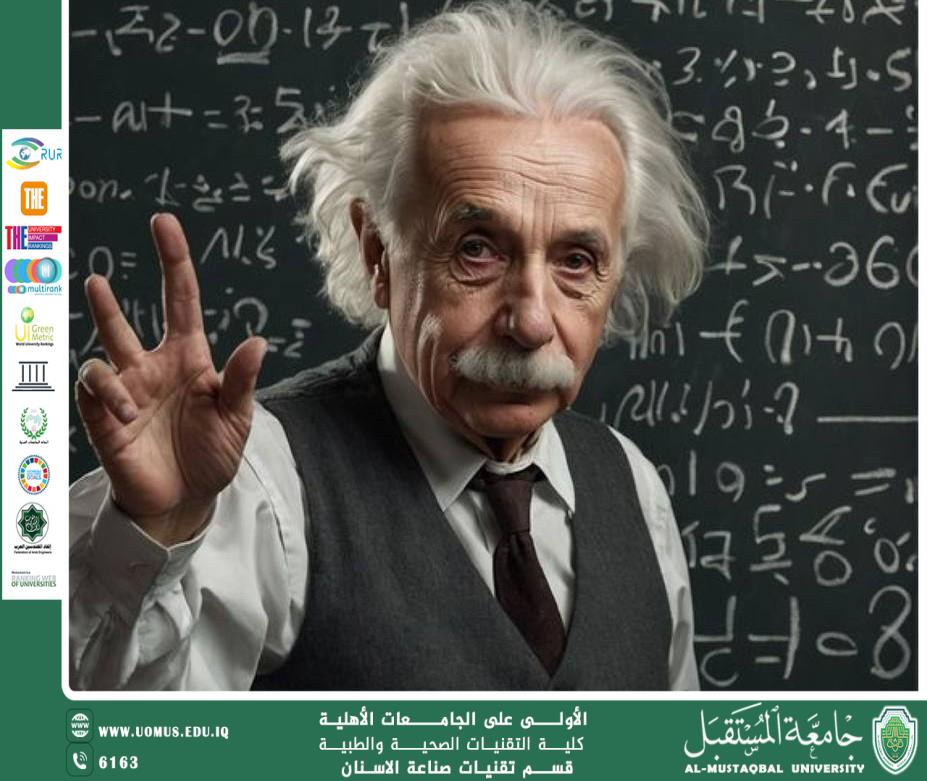
مقالة علمية للدكتوره نور مهند عباس بعنوان. Albert Einstein
تحقيقا للهدف الرابع من اهداف التنمية المستدامة قام قسم تقنيات صناعة الاسنان بعمل مقالة علمية بعنوان <br />Albert Einstein تحت اشراف د. نور مهند عباس وذلك يوم الاثنين الموافق 24/3/2025 وتضمن المقالة :<br /><br />Albert Einstein (1879–1955) was a German-born physicist whose groundbreaking theories revolutionized our understanding of the universe. Best known for his theory of relativity, Einstein made significant contributions to quantum mechanics, statistical physics, and cosmology. His equation E=mc² became one of the most famous scientific formulas, influencing the development of nuclear energy.<br /><br />⸻<br /><br />1. Early Life and Education<br /><br />1.1 Childhood and Interest in Science<br /> • Born on March 14, 1879, in Ulm, Germany.<br /> • Showed an early interest in mathematics and physics.<br /> • Moved to Switzerland and attended the Swiss Federal Polytechnic School in Zurich.<br /><br />1.2 Struggles and Academic Journey<br /> • Faced difficulties in securing a teaching job after graduation.<br /> • Worked as a patent examiner in Bern, where he developed key scientific ideas.<br /><br />⸻<br /><br />2. Scientific Contributions<br /><br />2.1 Special Theory of Relativity (1905)<br /> • Published in 1905, also known as Einstein’s “miracle year” (Annus Mirabilis).<br /> • Introduced the concept that time and space are relative.<br /> • Led to the famous equation E=mc², showing the relationship between energy and mass.<br /><br />2.2 General Theory of Relativity (1915)<br /> • Extended special relativity to include gravity.<br /> • Proposed that mass bends space-time, explaining gravity more accurately than Newton’s laws.<br /> • Confirmed in 1919 when astronomers observed light bending around the Sun during a solar eclipse.<br /><br />2.3 Contributions to Quantum Mechanics<br /> • Photoelectric Effect (1905): Showed that light behaves as particles (photons), winning him the Nobel Prize in Physics (1921).<br /> • Contributed to the development of wave-particle duality in quantum theory.<br /><br />2.4 Einstein’s Later Work and Unified Field Theory<br /> • Attempted to unify gravity, electromagnetism, and quantum mechanics, though without success.<br /> • Opposed some interpretations of quantum mechanics, famously saying, “God does not play dice with the universe.”<br /><br />⸻<br /><br />3. Impact on World History<br /><br />3.1 Political and Social Influence<br /> • Advocated for pacifism and civil rights.<br /> • Fled Nazi Germany in 1933 and moved to the United States.<br /> • Warned President Franklin D. Roosevelt about Nazi Germany’s potential to develop atomic weapons, influencing the Manhattan Project.<br /><br />3.2 Views on Nuclear Weapons<br /> • Regretted the use of atomic bombs on Hiroshima and Nagasaki.<br /> • Became an advocate for nuclear disarmament and world peace.<br /><br />⸻<br /><br />4. Personal Life and Legacy<br /><br />4.1 Later Years and Death<br /> • Became a professor at Princeton University.<br /> • Continued working on scientific problems until his death on April 18, 1955.<br /><br />4.2 Legacy in Science and Culture<br /> • Considered one of the greatest scientific minds in history.<br /> • His work laid the foundation for modern cosmology, astrophysics, and quantum theory.<br /> • His name remains synonymous with genius<br />جامعة المستقبل الجامعة الاولى في العراق .<br /><br />