
م.م دعاء ساهي حسون ...الغدة الدرقية
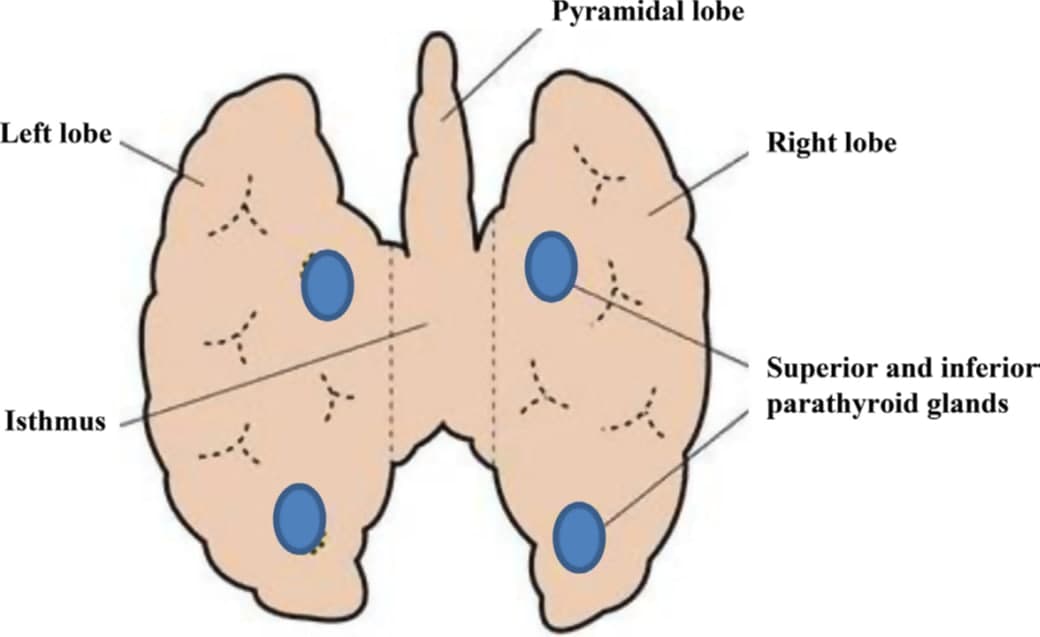
The Thyroid gland<br />The thyroid gland (Fig. 1) and its hormones play multifaceted roles in organ development and in the homeostatic control of fundamental physiological mechanisms such as body growth and energy expenditure in all vertebrates.<br /><br /><br /><br /> <br />Fig. 1 Thyroid gland position<br /><br /><br /><br /><br /><br /><br />• The Thyroid<br />is the only endocrine gland in which a large quantity of secretory product is stored. Moreover, storage is outside the cells, in the colloid of the follicle lumen, which is also unusual. There is sufficient hormone in follicles to supply the body for up to 3 months with no additional synthesis.<br /> It synthesizes the thyroid hormones thyroxine (tetra-iodothyronine or T4) and tri-iodothyronine (T3), which help control the basal metabolic rate in cells throughout the body, as well as the polypeptide hormone calcitonin <br /><br />• Embryology<br />The thyroid gland is the first endocrine gland to develop in humans. The thyroid gland originates from a diverticulum located in the median ventral wall of the pharynx (called the thyroid diverticulum).<br />During the fourth week of embryonic development, an endodermal thickening (thyroid placode) appears in the midline floor of the primitive pharynx between the first and second pharyngeal pouches, dorsal to the aortic sac.<br /> This primitive thyroid tissue is hollow at first, but soon becomes<br />solid (thyroid bud) and penetrates the underlying mesenchymal tissue. <br />Its descending anteriorly through the thyroglossal duct to the hyoid bone and laryngeal cartilages in order to reach the lower neck.<br />As the thyroid tissue migrates downward, it passes just anteriorly to the hyoid bone and laryngeal cartilages.<br />The thyroid gland is initially spherical and then assumes a more bi-lobed configuration as it enlarges; a major increase regards its lateral portions (lobes) in comparison to the median connecting portion (isthmus) <br /><br /><br /><br />• Anatomy<br />The thyroid gland is a highly vascularized organ located anteriorly in the neck between the C5 and T1 vertebrae, deep in the platysma, sternothyroid, and sternohyoid muscles. <br />The thyroid weight 15–20 g and weight more in men than in women, the thyroid weight approximately 1 g in a newborn and increases by about 1 g/year until age 15.<br /> It is an H-shaped, soft and reddish parenchymal organ, consisting of two lobes (left and right) and one isthmus that binds them together (Fig. 2). Each lobe is approximately 4 cm in length, 2 cm in width, and 2–3 cm in thickness. The isthmus measures about 2 cm in width, 2 cm in height, and 2–6 mm in thickness.<br /><br /><br />Fig. 2 Macroscopic posterior view of the thyroid.<br /><br /> <br />The superior extremity (called the superior horn) lies lateral to the inferior constrictor muscle and posterior to the sternothyroid muscle, while the inferior part (inferior horn) extends to the levels of the fifth or sixth tracheal ring. <br />In the posterolateral section, the gland overlaps the carotid sheath and its components. <br />About 50% of individuals present a pyramidal lobe (Morgagni’s or Lalouette’s pyramid),arising from either lobe or the superior portion of the isthmus and directed upward, usually to the left (Fig. 2)<br /> <br />The thyroid gland is covered by a fibrous capsule from<br />which septa extend into the parenchyma, dividing it into lobules and carrying blood vessels, nerves, and lymphatic's. <br />Follicles are densely packed together, separated from one another only by sparse reticular connective tissue although this stroma is very well vascularized with fenestrated capillaries for transfer of released hormone to the blood.<br /><br />The posterior layer of the thyroid capsule is thick.<br />Posteriorly, the middle layer of the deep cervical fascia condenses to form the posterior suspensory ligament of Berry, connecting the thyroid lobes to the cricoid cartilage and the first two tracheal rings.<br /> In the posterior surface of the lateral lobes are located the parathyroid glands; <br />normally there are four (two superior and two inferior), and these are roundish, and about the size of a grain of rice(Fig. 2).<br />