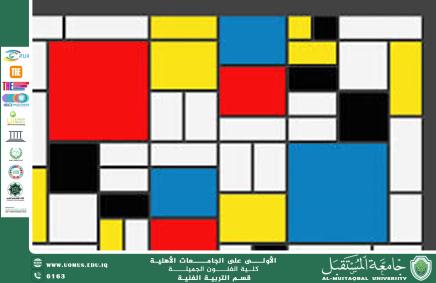

"The Abstract Artist and Visual Language" By Dr. Hamza Alawi Musarbat
28/12/2025 Share :
Although the terms abstract, non-representational, and abstract expressionist are all used to describe paintings that do not belong to reality, there is a difference. If an artist begins with a subject from reality, the artwork is considered abstract. If the artist creates it without reference to reality, the work is considered non-representational or non-objective. Non-representational art can also be called abstract expressionism, which expresses a feeling or emotion—unseen things. The artist uses form, color, and line to express an emotion, feeling, or any other concept. However, the term abstract is the most widely used and accepted for all art that does not belong to reality.
Non-representational/abstract artists are individuals whose talent utilizes a visual language. Just as you hear musical notes combined to create a pleasant song, non-representational painters use a visual vocabulary consisting of six basic elements: color, form, texture, line, shape, and value. They tell a story without words.
Non-representational art doesn't represent anything we see. It's not based on reality. It doesn't refer to the natural world. Instead, the artist uses colors, shapes, patterns, and gestural signs to convey an idea or feeling. They rely on intuition to guide them through the painting process as each painting evolves over time.
Therefore, their paintings are open to interpretation. When you look at a painting, does it evoke an idea or a feeling in you? Do you like the colors, or do you feel that they are "speaking" to you in some way? The non-representational artist wants you to have a visual experience, much like the experience you might enjoy if you close your eyes while listening to a beautiful song. Many songs mean something to you when you listen to them. Look at abstract art with the same open mind. You don't need to know exactly what the artist is saying or what the painting is supposed to be about in order to appreciate it.
Most non-representational/abstract artists paint very well, have a good sense of composition, and understand how color works and what colors say. Most of them can create realistic paintings that anyone can understand and relate to because they are recognizable—something familiar to you. An abstract artist gives you a part of themselves when they paint an abstract painting. It's not just paint splattered on canvas. Most non-representational artists know what they're doing and draw on a lifetime of experience, knowledge, skill, and intuition to convey an idea or feeling.
The artist wants their art to speak to you on a personal level and doesn't need any explanation. Art is an experience. Let go of the need to see something in the painting. It is what it is; just enjoy how you feel when you look at it. Take some time and look at the whole painting, let it take your mind somewhere, and enjoy the journey. Art allows you to define what it's about. It's a personal experience. The person standing next to you might have a completely different response and feel different emotions. Artists might love the painting for a completely different reason—they might love the colors, the composition, or the form. Perhaps it speaks to them in a different way. This is the beauty of non-representational or abstract art. It's up to the individual to give it their own interpretation. Non-representational art doesn't begin with "something" or a subject from which a distinct abstract vision is formed. Instead, it's "nothing"—but what the artist intended it to be and what the viewer perceives
Almustaqbal University, The First University in Iraq