Scientific Article by Lecturer Haider Mutlaq Musa Title: Ultraviolet-Visible (UV-Vis) Spectroscopy Technique and Its Role in Chemical Analysis
29/12/2025 Share :
Ultraviolet-Visible (UV-Vis) spectroscopy is a fundamental technique in analytical chemistry, widely used to determine the concentrations of chemical substances in various solutions. This technique is characterized by its simplicity, speed, and acceptable accuracy, making it an important tool in educational, research, and industrial laboratories. It relies on measuring the absorption of electromagnetic radiation by a substance within the ultraviolet and visible regions, which is directly related to the substance's structure and concentration.
Firstly: The Working Principle of UV-Vis Technique
The UV-Vis technique is based on the absorption of light radiation by molecules at specific wavelengths, leading to the transition of electrons from lower to higher energy levels. The intensity of light is measured before and after it passes through the sample, and the resulting absorption is calculated. This absorption is directly proportional to the concentration of the substance according to the Beer-Lambert Law.
Secondly: Types of UV-Vis Instruments
1. Single Beam Instrument
Relies on the passage of a single light beam through the sample after calibrating the instrument using a blank solution. It is characterized by its simplicity and low cost, but it requires frequent calibration.
2. Double Beam Instrument
Relies on splitting the light beam into two beams; one passes through the sample and the other through the blank simultaneously. This increases the accuracy of results and reduces the effect of fluctuations in light source intensity.
Thirdly: Steps for Conducting Analysis Using UV-Vis
1. Turn on the instrument and allow it to stabilize.
2. Select the appropriate wavelength for the substance to be analyzed.
3. Calibrate the instrument using the blank solution.
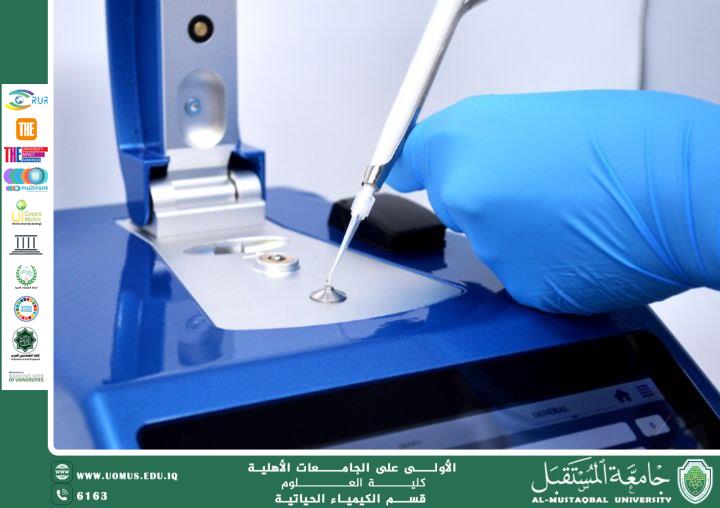
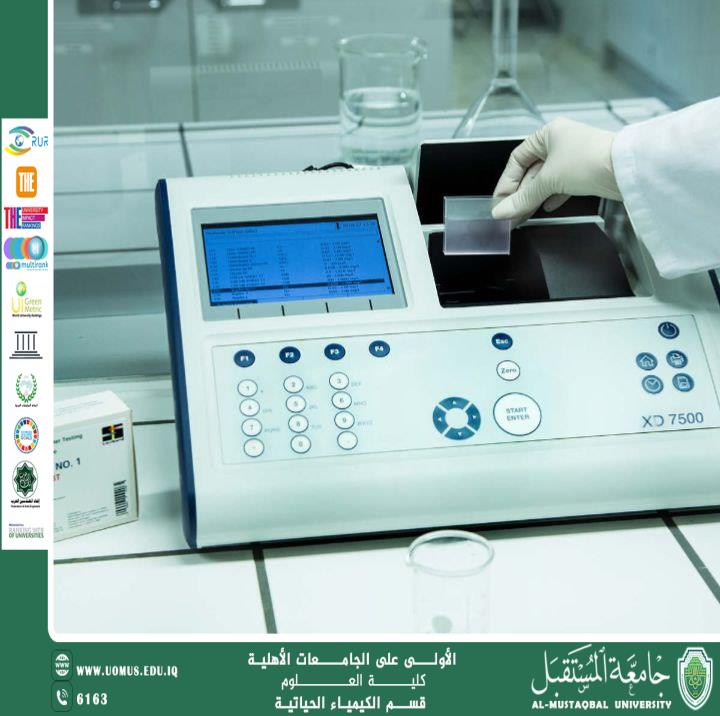
4. Place the sample inside the cuvette.
5. Measure the absorbance or transmittance.
6. Calculate the concentration based on the Beer-Lambert Law or a calibration curve.
Fourthly: Advantages of the UV-Vis Technique
· Ease and speed of analysis.
· Low cost compared to advanced techniques.
· Suitable for routine quantitative analysis.
· Requires small sample quantities.
Fifthly: Applications of UV-Vis in Analytical Chemistry
· Determining the concentration of organic and inorganic compounds.
· Pharmaceutical analysis in drug industries.
· Measuring pollutants in water.
· Monitoring chemical reactions.
· Educational analyses in university laboratories.
Sixthly: Factors Affecting Measurement Accuracy
· Purity of the solvent used.
· Cleanliness of the cuvette and absence of scratches.
· Accuracy of wavelength selection.
· Stability of the light source.
· Correct application of the Beer-Lambert Law.
Conclusion
UV-Vis spectroscopy remains one of the most common techniques in analytical chemistry due to its simplicity and speed in obtaining results. Despite the existence of more advanced techniques, UV-Vis continues to be an effective and fundamental tool for quantitative analysis, scientific research, and university education
Al-Mustaqbal University
Ranked First among Private Iraqi Universities