ELISA Technique: Principle and Diagnostic and Biological Applications Prepared by: Asst. Lecturer Abbas Hamza Khudair Department of Biochemistry – College of Science – University of Al-Mustaqbal
30/12/2025 Share :
The Enzyme-Linked Immunosorbent Assay (ELISA) is one of the most widely used immunological techniques in medical and research laboratories due to its high accuracy, excellent sensitivity, and ease of application. This technique relies on the specific interaction between antigens and antibodies to detect biomolecules quantitatively or qualitatively in biological samples.
Basic Principle of ELISA:
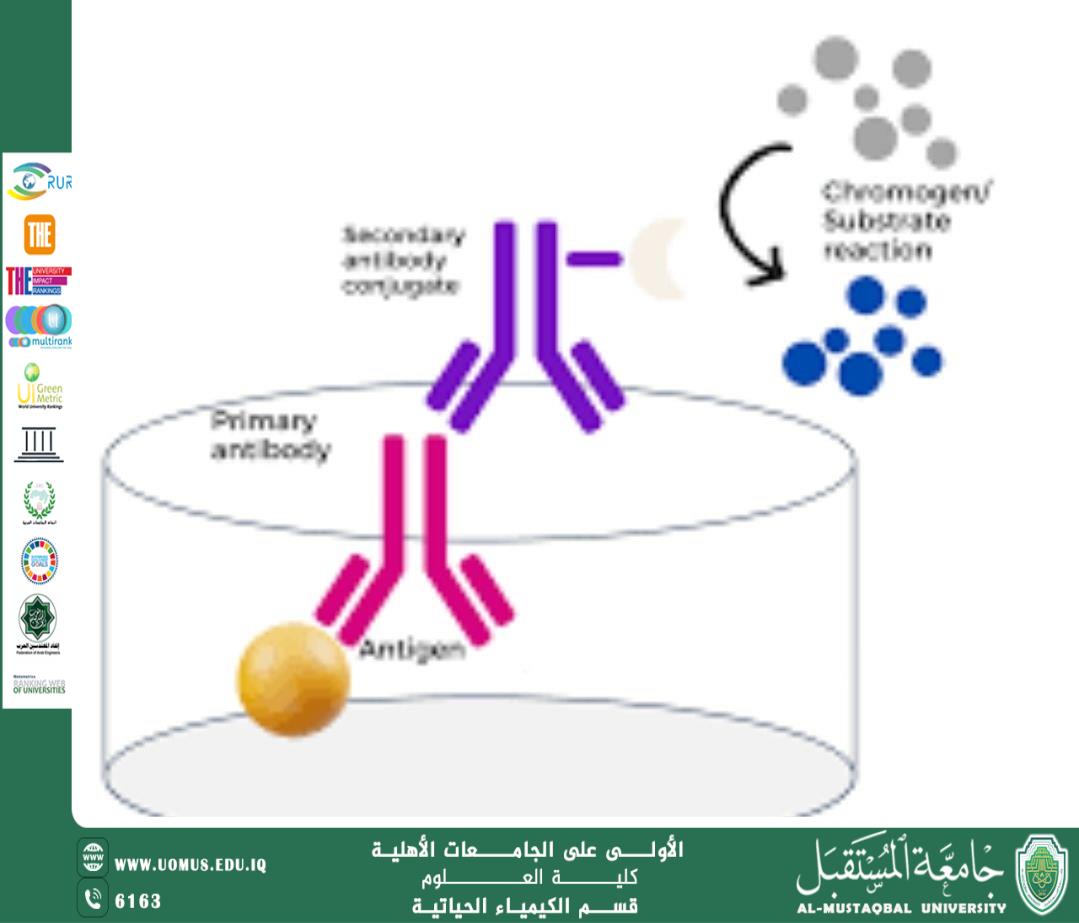
ELISA is based on linking one component of the immune reaction (antigen or antibody) to an enzyme. Upon adding the enzyme-specific substrate, a colorimetric reaction occurs, which can be measured using an ELISA plate reader. The intensity of the developed color is directly proportional to the concentration of the target molecule in the sample.
Types of ELISA:
Direct ELISA:
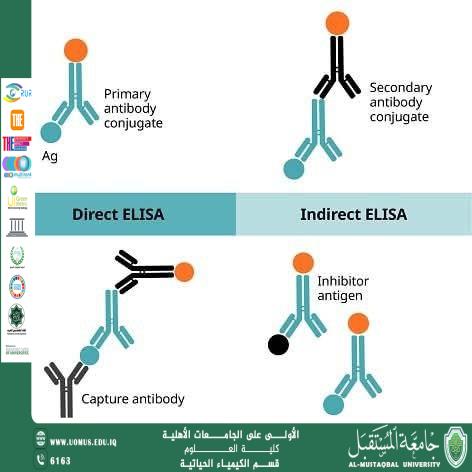
A single enzyme-linked antibody is used to detect the antigen directly. This method is rapid and involves fewer steps but has lower sensitivity.
Indirect ELISA:
Used to detect antibodies in a sample. It relies on a primary antibody (not enzyme-linked) and a secondary enzyme-linked antibody, which enhances sensitivity.
Sandwich ELISA:
One of the most accurate types, in which the antigen is “sandwiched” between two antibodies (capture and detection antibodies). It is commonly used for measuring proteins, cytokines, and hormones.
Competitive ELISA:
Based on the competition between the sample antigen and a labeled antigen. It is frequently used to measure small molecules such as hormones and drugs.
Steps of Performing an ELISA Test:
Coating the plate with antigen or antibody
Adding the sample containing the target molecule
Adding the enzyme-linked antibody
Washing the plate to remove nonspecific binding
Adding the substrate
Measuring the colorimetric reaction using an ELISA reader
Biological and Medical Applications of ELISA:
ELISA is widely applied in:
Diagnosis of infectious diseases (e.g., HIV, HBV, HCV)
Measurement of hormones (e.g., insulin, TSH, cortisol)
Evaluation of cytokines and inflammatory factors
Diagnosis of autoimmune diseases
Molecular and clinical research
Advantages of ELISA:
High sensitivity and specificity
Quantitative analysis capability
Suitable for routine and research testing
Ability to process a large number of samples simultaneously
Limitations of ELISA:
Requires accurate calibration
Risk of false-positive results if washing is inadequate
Results may be affected by the quality of antibodies used
Conclusion:
ELISA represents a cornerstone in modern immunological testing and has significantly contributed to advances in medical diagnostics and research. A thorough understanding of the principle, types, and applications of ELISA is essential for students of biochemistry and medical sciences, given its pivotal role in clinical analyses and research studies.
University of Al-Mustaqbal – First among Iraqi Private Universities