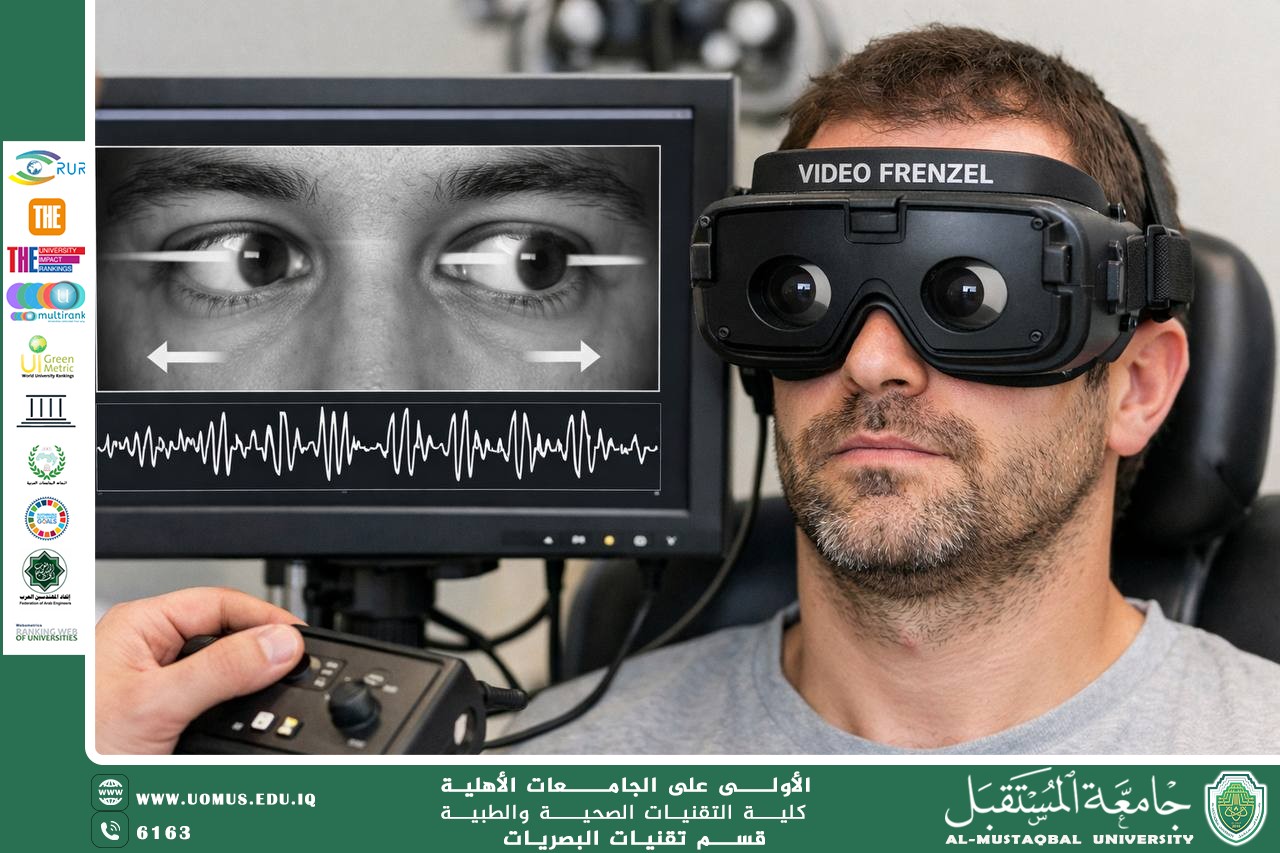

A tool for examining the eye of a patient with nystagmA Scientific Article by the Head of the Optometry Technologies Department Asst. Prof. Dr. Munther Samin Shukr
03/01/2026 Share :
It is a device used to examine ocular nystagmus, which is an involuntary horizontal eye movement. This movement may be either fast, meaning it has equal speed in both directions (also known as pendular nystagmus), or slow horizontal movement, which is usually a result of reduced central vision.
The device is used to determine the required examinations for patients and to help in planning their treatment after being examined by an optometrist or an ophthalmologist.
The device was locally manufactured using self-available resources from plastic material due to its light weight. It has a length of 230 mm and a thickness of 4 mm (2 mm for each part). The device consists of the following components:
• Fogging lens:
A lens with a diameter of 20 mm, used to relax the ciliary muscles in cases of nystagmus. It acts as an occluder when placed in front of the left eye while examining the right eye, especially when nystagmus movement is almost absent in both eyes.
• Interpupillary distance measuring ruler:
Used to measure the distance from the center of the first lens to the center of the second lens, measured in millimeters (mm). The examination is performed after the eye becomes relatively stable and by using the fogging lens.
• Visual acuity improvement test:
A circular disc with 17 pinholes, each with a diameter of 1 mm, also available in a smaller size suitable for children (pinhead size). It is used during functional examination of refractive errors and works by focusing light rays onto the retina. The function of this disc is to determine the degree of improvement in visual acuity.
• Slit disc:
Used to detect astigmatism of low degrees and determine its axis. It is used by covering one eye and placing the disc in front of the other eye. If visual acuity improves, this indicates the presence of astigmatism with the same axis.
• Plano lenses:
Lenses that provide no refractive correction. They are used as protective equipment to shield the eyes from external injuries and are also used during examination to assess the accuracy of the patient’s responses.
• Occluder:
The occluder is used to examine the patient’s eyes to determine whether there is any visual deviation and to assess whether one eye is working harder than the other. One eye is covered while the other eye focuses forward on an object inside the room Public Health:
1. Ministry of Health (Ministry of Health and Welfare).
2. Ministry of Education (Ministry of Education) in cooperation with the Ministry of Health and Welfare.
3. Ministry of Labor and Social Affairs (Ministry of Labor and Welfare).
4. Private Health Sector.
University of Al-Mustaqbal – The First and Leading Private University