Scientific Article for the Department Course By: Asst. Prof. Mohammed Abdullah Jasim Title: The Electromagnetic Spectrum
07/01/2026 Share :
Introduction
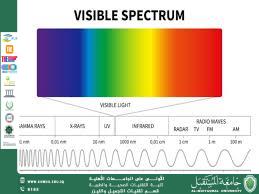
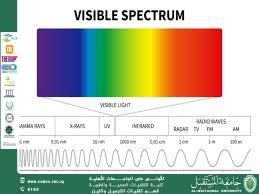
Visible light represents only a small portion of a much broader range of electromagnetic waves known as the electromagnetic spectrum. This spectrum includes all possible electromagnetic wavelengths, extending from the longest radio waves to the shortest and most energetic gamma rays. All electromagnetic waves travel through a vacuum at the same speed — the speed of light — and differ only in wavelength, frequency, and therefore in energy.
Components of the Electromagnetic Spectrum
1. Radio Waves
Radio waves occupy the longest wavelengths in the spectrum, ranging from kilometers to millimeters. They are widely used in radio and television broadcasting, wireless communication systems, mobile networks, and radar technologies.
2. Microwaves
Microwaves have wavelengths ranging from millimeters to centimeters. Their applications include microwave ovens, satellite communication systems, radar devices, and wireless internet networks.
3. Infrared Radiation (IR)
Infrared radiation extends from micrometers to millimeters in wavelength. It is used in remote-control devices, thermal imaging, night-vision systems, optical fiber communication, and heating technologies.
4. Visible Light
Visible light covers a narrow wavelength range from approximately 400 nanometers (violet) to 700 nanometers (red). It is the only region of the spectrum detectable by the human eye. Colors are perceived based on the absorption and reflection of specific wavelengths.
5. Ultraviolet Radiation (UV)
Ultraviolet radiation has wavelengths between 10 and 400 nanometers. It is applied in sterilization processes, counterfeit detection, and certain dermatological treatments; however, excessive exposure can cause biological damage such as sunburn.
6. X-Rays
X-rays possess very short wavelengths ranging from 0.01 to 10 nanometers. They play a central role in medical imaging, airport security screening, and high-energy astronomical research.
7. Gamma Rays
Gamma rays have the shortest wavelengths and the highest energy in the spectrum. They originate from nuclear reactions and cosmic events such as supernovae, and are used in cancer radiotherapy and industrial sterilization. Due to their high energy, uncontrolled exposure poses serious health risks.
Conclusion
The electromagnetic spectrum forms a fundamental basis for understanding light, energy, and modern technological applications. It underpins advancements in medicine, communications, industry, and scientific research. While its benefits are significant, some regions of the spectrum require careful and controlled handling to ensure safety and environmental protection.
AL_mustaqbal University is the first university in Iraq