
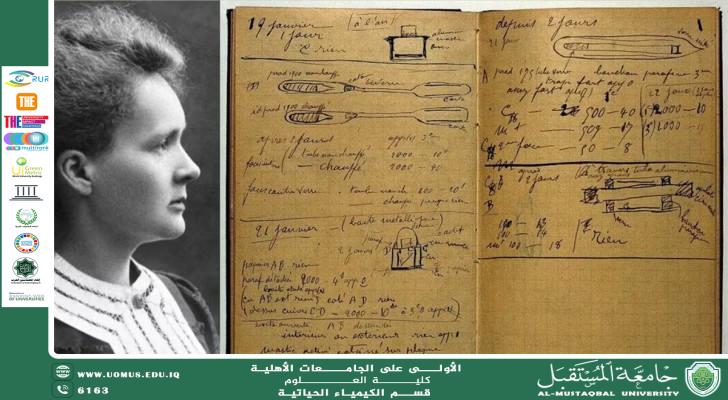
Marie Curie: Pioneer of Science and Radioactivity Prepared by:Lecturer M.Sc. Zahraa Hazem Hamed Department of Chemistry – College of Science – Al-Mustaqbal University
11/01/2026 Share :
Marie Curie is regarded as one of the greatest scientific figures in history and a symbol of determination and scientific excellence. She was not only a woman who carved her path in a time when science was dominated by men, but also a scientist whose contributions profoundly advanced physics and chemistry, transforming humanity’s understanding of radioactivity and its applications.
Marie Curie was born in 1867 in Poland and faced difficult circumstances from an early age, both economically and socially. However, her passion for science drove her to travel to France, where she studied at the Sorbonne University in Paris. Despite harsh living conditions and life pressures, she excelled academically, marking the true beginning of her scientific journey.
Her research focused on the phenomenon of radioactivity, a term she was the first to introduce scientifically. Together with her husband, Pierre Curie, she discovered two new elements: polonium, which she named after her homeland Poland, and radium, a highly radioactive element. These discoveries opened new horizons in understanding atomic structure and the energy contained within matter.
Marie Curie received the Nobel Prize in Physics in 1903, shared with her husband and the scientist Henri Becquerel. She later won the Nobel Prize in Chemistry in 1911 independently, becoming the first person in history to receive two Nobel Prizes in two different scientific fields. This achievement reflects the depth and lasting impact of her scientific work.
Her contributions were not limited to theoretical science; they extended to practical applications, particularly in medicine. Her research played a key role in the development of radiation therapy for cancer treatment. During World War I, she also helped equip mobile medical units with X-ray technology to treat wounded soldiers.
Despite her remarkable achievements, Marie Curie paid a high price for her dedication to science. Prolonged exposure to radiation led to aplastic anemia, which caused her death in 1934. Nevertheless, her scientific legacy remains alive, continuing to inspire scientists and researchers, especially women in scientific fields.