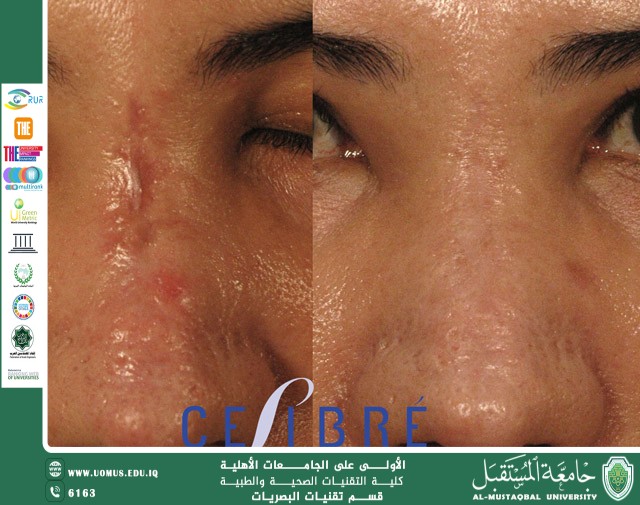
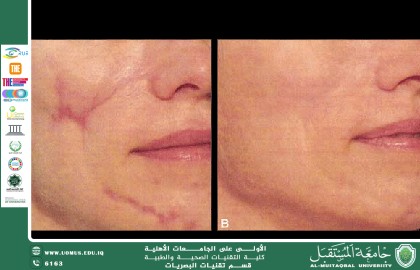
(The Effect of Laser Therapy in the Treatment of Skin Scars)A Scientific Article by Instructor Tamara Nihad Abbas Entitled
11/01/2026 Share :
Introduction
Skin scars are among the common problems resulting from wounds, burns, surgical procedures, or acne, and they may negatively affect the psychological and aesthetic appearance of the affected individual. With the rapid advancement in medical technologies, laser therapy has become one of the most effective modern methods for improving the appearance of skin scars. This technique is based on the interaction between laser beams and skin tissues to stimulate regeneration and repair processes.
Concept of Skin Scars
A skin scar is fibrous tissue that forms during the wound-healing process and differs in structure and elasticity from normal skin. Scars are classified into several types, such as atrophic (depressed) scars, hypertrophic scars, and keloid scars. The choice of treatment depends on the type and depth of the scar.
Principle of Laser Action in Scar Treatment
Laser treatment of scars relies on delivering light beams with specific wavelengths that penetrate the skin layers to varying depths. These beams produce a controlled thermal effect that leads to:
Stimulation of new collagen production
Improvement of skin elasticity
Removal of damaged superficial skin layers
Reorganization of skin tissues
Types of Lasers Used in Scar Treatment
Fractional Laser
This type treats small fractions of the skin while leaving surrounding healthy areas intact, which helps accelerate the healing process. It is widely used for treating acne scars.
Carbon Dioxide Laser (CO₂ Laser)
It is considered one of the most effective lasers for treating deep scars; however, it requires a longer recovery period.
Erbium Laser (Er:YAG)
This laser is characterized by high precision and less thermal effect, making it suitable for treating superficial to moderate scars.
Benefits of Laser Treatment for Scars
Improvement of skin texture and appearance
Reduction in scar depth and pigmentation
Stimulation of cellular regeneration
Long-lasting results compared to some traditional treatments
Possible Side Effects
Despite the effectiveness of laser therapy, some temporary side effects may occur, such as:
Skin redness
Mild swelling
Temporary peeling
Sensitivity to sunlight
These effects usually subside within days to weeks when medical instructions are properly followed.
Role of Laser in Modern Cosmetic Treatment
Laser technology has become an essential part of cosmetic dermatology. It is used not only for scar treatment but also for pigmentation removal, skin tightening, and treatment of aging signs, making it a versatile and highly efficient technique.
Conclusion
Laser therapy is considered one of the modern and effective techniques for improving the appearance of skin scars. It contributes to skin renewal and stimulates collagen production, leading to noticeable cosmetic results. However, the success of treatment depends on selecting the appropriate laser type, the expertise of the specialist physician, and the nature of the scar.
University of Al-Mustaqbal – The First and Leading Private University