Article by the Head of the Department Prof. Dr. Nasser Abdul-Hassan Nasser The Tragedy of Thalidomide: Regulatory Dimensions and the Role of Stereochemistry in Explaining Embryonic Toxicity
16/02/2026 Share :
estabraq Arif, [2/15/2026 10:49 PM]
اكتب
الموضوع
الموضوع
Article by the Head of the Department Prof. Dr. Nasser Abdul-Hassan Nasser
The Tragedy of Thalidomide: Regulatory Dimensions and the Role of Stereochemistry in Explaining Embryonic Toxicity
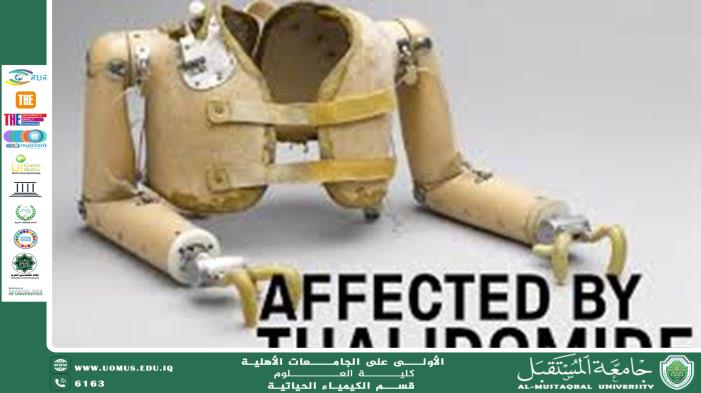
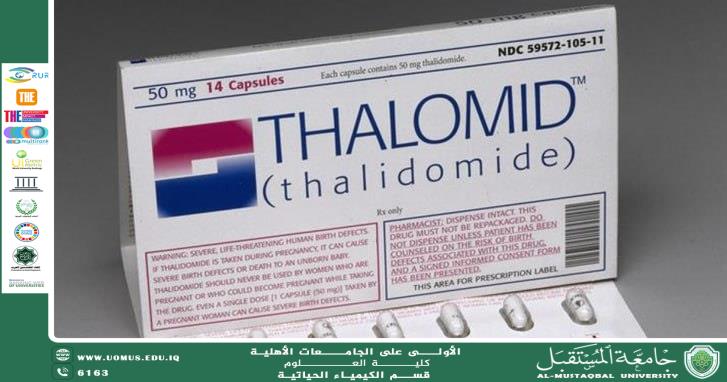
Thalidomide represents one of the most prominent historical examples of pharmaceutical failure that led to fundamental transformations in global drug approval systems. The drug was introduced in the late 1950s as a sedative and treatment for morning sickness during pregnancy, before it was discovered to be associated with severe congenital malformations, particularly limb shortening or absence (phocomelia).
This article aims to analyze the scientific and regulatory errors that accompanied the distribution of the drug, focusing on the decisive role of stereochemistry in explaining its embryonic toxicity and how this tragedy contributed to reshaping the concepts of drug safety evaluation.
After World War II, the pharmaceutical industry experienced rapid expansion accompanied by intensive marketing of new compounds without completing the safety standards required today. In this context, thalidomide was developed in 1954 by Chemie Grünenthal and introduced to the market in 1957 as a safe drug with a wide therapeutic margin.
However, its use by pregnant women during the early weeks of pregnancy was linked to the birth of thousands of children with severe congenital malformations, revealing profound gaps in pre-marketing toxicity assessment systems.
First: Aspects of Scientific and Regulatory Failure
1. Inadequate preclinical studies
Insufficient studies were conducted to evaluate teratogenic effects, and the animal models used at the time did not include appropriate developmental toxicity testing.
2. Absence of effective pharmacovigilance systems
There was no systematic framework for detecting early signals of congenital abnormalities and linking them to the drug.
3. Marketing without prescription requirements in some countries
Easy availability of the drug increased its widespread use, especially among pregnant women.
4. Weak regulatory requirements at the time
Before the 1962 amendments in the United States, proof of efficacy and safety was not required under strict standards as it is today. The stance of FDA reviewer Frances Oldham Kelsey played a crucial role in preventing its approval in the United States due to insufficient safety data.
Second: The Decisive Role of Stereochemistry in Toxicity
Thalidomide is a classical example demonstrating the importance of stereochemistry in pharmacological activity. The molecule contains a chiral center, allowing it to exist in two mirror-image enantiomeric forms:
(R)-thalidomide: possesses the sedative effect.
(S)-thalidomide: associated with embryonic toxicity.
At the time of its initial marketing, regulatory attention to stereoisomeric differences was limited, and the drug was sold as a racemic mixture.
Later studies showed that the S-enantiomer is responsible for teratogenic effects, interfering with embryonic development, particularly limb formation, by affecting angiogenesis and the regulation of growth factors.
The complexity lies in the fact that thalidomide undergoes in vivo racemization, meaning the two enantiomers can interconvert inside the body, making administration of a single enantiomer insufficient to prevent toxicity.
This historical event established a fundamental principle in modern drug development: stereoisomers must be studied separately in terms of efficacy and toxicity.
Third: Global Impact of the Tragedy
The disaster led to:
Strengthening drug registration laws worldwide
Mandating teratogenicity studies in at least two animal species
Developing pharmacovigilance systems
Requiring proof of efficacy in addition to safety
Increasing emphasis on stereochemical analysis in pharmaceutical development
Consequently, the tragedy became a turning point in regulatory pharmacology.
Fourth: Thalidomide Between Past and Present
Despite its historical reputation, thalidomide was later reintroduced under strict regulations for treating certain conditions such as multiple myeloma and specific immune disorders, within tightly controlled programs that strictly prevent its use during pregnancy.
Conclusion
The tragedy of thalidomide reveals that the failure was neither purely chemical nor purely regulatory, but rather the result of an interaction between inadequate preclinical testing, weak oversight systems, and insufficient recognition of the importance of stereochemistry in determining efficacy and toxicity.
This incident helped redefine drug development standards and confirmed that studying the three-dimensional structure of pharmaceutical compounds is not merely theoretical, but a decisive factor in protecting public health.
Al-Mustaqbal University ranks first among private universities in Iraq.