"Scientific article by Miss Noor alhuda Azmi Hasan entitled: Angiosperms and Their Economic Importance"
28/02/2026 Share :
Angiosperms, or flowering plants, are the most widespread and diverse group of plants on Earth. They are scientifically known as Angiosperms and represent the majority of existing plant species. Their success is due to their advanced structural and reproductive characteristics, which enable them to adapt to various environmental conditions.
General characteristics of angiosperms
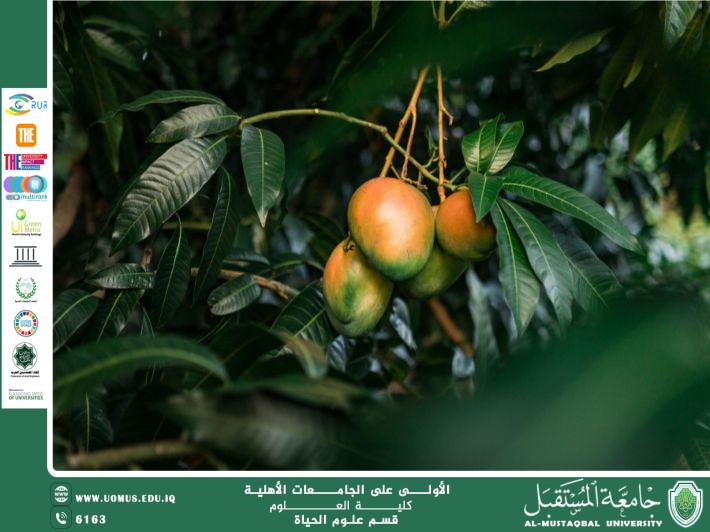
Angiosperms are distinguished by producing flowers, which are the reproductive organs of the plant. A typical flower consists of male parts called stamens, which produce pollen grains, and female parts called the pistil, which contains the ovary and ovules. After pollination and fertilization, the ovule develops into a seed, and the ovary develops into a fruit. The fruit protects the seeds and helps in their dispersal by wind, water, or animals.
Angiosperms also possess highly developed vascular tissues, including xylem, which transports water and minerals from the roots to the rest of the plant, and phloem, which transports food produced during photosynthesis to all plant parts.
Reproduction in angiosperms
The reproductive process begins with pollination, which is the transfer of pollen grains from the anther to the stigma. Pollination can occur through wind, insects, animals, or water. After pollination, fertilization takes place, leading to the formation of the embryo and the endosperm, which provides nourishment for the developing embryo. Under suitable environmental conditions such as water, oxygen, and proper temperature, the seed germinates and grows into a new plant.
Economic importance
Angiosperms are extremely important economically, as they are the primary source of human food, including cereals such as wheat, rice, and maize, as well as fruits and vegetables. They also provide raw materials for various industries, including medicines, oils, fibers such as cotton, and wood used in construction and furniture manufacturing.
Ecological importance
Ecologically, angiosperms play a vital role in maintaining environmental balance. They produce oxygen through photosynthesis and absorb carbon dioxide, helping regulate the Earth's climate. They also provide food and habitat for many organisms, including insects, birds, and animals. Additionally, their roots help stabilize the soil and prevent erosion, contributing to ecosystem stability.
Classification of angiosperms
Angiosperms are divided into two main groups:
Monocotyledons (Monocots): such as wheat, maize, and onion. Their seeds contain one cotyledon, and their leaves usually have parallel venation.
Dicotyledons (Dicots): such as beans, roses, and apple trees. Their seeds contain two cotyledons, and their leaves typically have net-like venation.
الهدف الرابع : التعليم الجيد