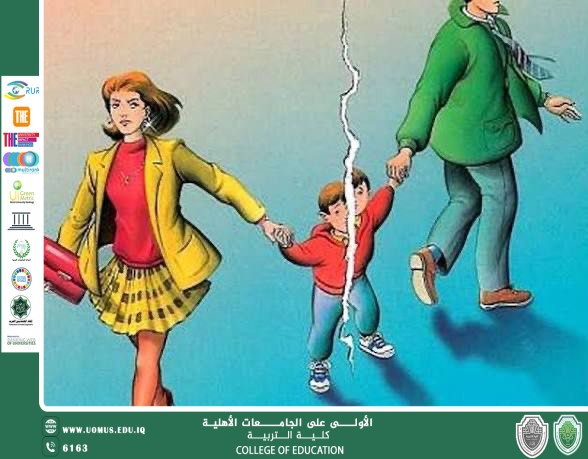


The Repercussions of Family Disintegration on the Value System: Strategies for Restoration and Community Empowerment
15/03/2026 Share :
Family disintegration represents one of the most serious challenges facing contemporary societies. It is not merely a physical or legal separation between parents; rather, it is a fracture in the core unit that provides society with stability and strength. Addressing this phenomenon requires a comprehensive vision that integrates intellectual awareness with institutional action, through the following strategic axes:
First: Value-Based Strategy and Ethical Foundations
Addressing family disintegration begins with returning to foundational values. Religious and human values emphasize the sanctity of family bonds. A disruption in individuals’ value systems is a primary cause of the disappearance of constructive dialogue. Therefore, reinforcing concepts such as affection, mercy, and mutual responsibility constitutes the first line of defense in protecting families from collapse and preserving the cohesion of the social fabric.
Second: Family Awareness (Cognitive and Preventive Empowerment)
Knowledge is the most powerful tool for preventing family breakdown. This pillar focuses on preparing young people who are about to marry and equipping them with the psychological and social skills needed to manage crises. Through educational and pedagogical curricula, a culture of “containment” rather than “confrontation” can be cultivated, building societal awareness that family stability ultimately contributes to national stability.
Third: Executive Initiatives and Institutional Support
Practical intervention is manifested in activating the role of family and social counseling centers that provide psychological and legal support for struggling families. Digital platforms and university initiatives also play an important role in creating spaces for dialogue that help resolve disputes before they reach the stage of separation, while establishing safety networks that guarantee the rights of children and women in cases of family disintegration, thereby reducing negative consequences.
Fourth: Individual Responsibility and Collective Awareness
Every individual in society carries an ethical responsibility to protect the family institution. A conscious citizen rejects passivity and contributes to spreading values of tolerance and reconciliation. The success of family legislation largely depends on the presence of a collective conscience that values human relationships and views family cohesion as a national duty that cannot be compromised.
Conclusion and Recommendations:
Protecting society from family disintegration requires adopting strategies that support a balance between rights and responsibilities, and integrating family culture into academic and community programs. A strong family remains the fundamental guarantee for raising a balanced generation capable of contribution and civilizational development.
Written by:
Assistant Lecturer Rola Saad Habib
#College_of_Education
#Al_Mustaqbal_University