
A Scientific Article by Lecturer M.M. Zeinab Nadhim Aziz Entitled: Areca Palm
25/03/2026 Share :
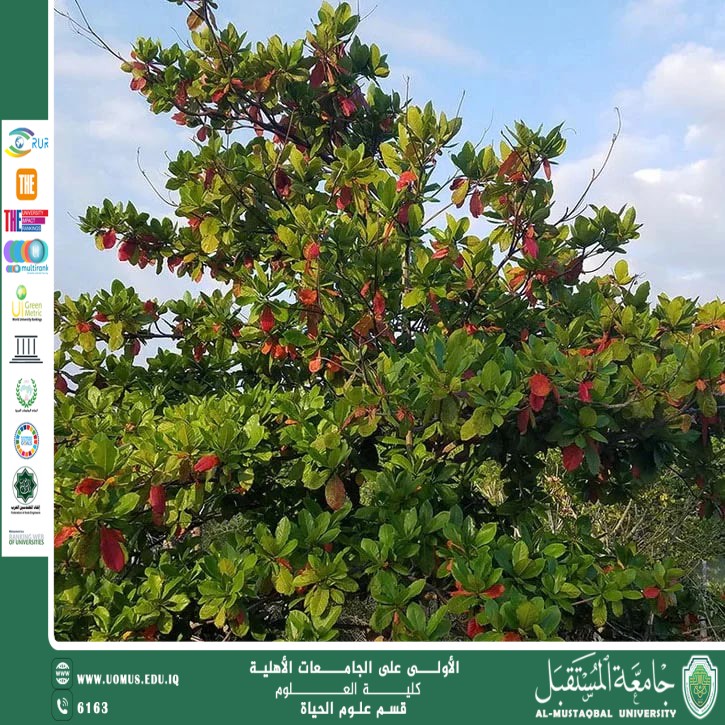
The Indian Almond Tree, scientifically known as Terminalia catappa, is a large tropical tree commonly cultivated in coastal areas and public gardens. It is renowned for its large leaves, which change color from green to red and orange during the dry season, adding natural beauty to the environment. It is also called the “Indian Almond Tree” due to its edible nuts in some regions.
Botanical Description:
The Indian Almond Tree is an evergreen tree that typically reaches a height of 20 meters, with a wide crown and large, oval-shaped leaves. Its flowers are small and inconspicuous but cluster on the branches. The fruits are hard, oval nuts containing edible seeds, characterized by a thick shell.
Environment and Cultivation Methods:
The Indian Almond Tree grows well in tropical and subtropical regions and tolerates sandy and saline soils, making it common in coastal areas. It is usually propagated from seeds and requires regular watering initially until established; afterward, it can rely on rainfall. It can also withstand direct sunlight.
Importance of the Indian Almond Tree:
Used as an ornamental plant and shade tree in gardens and streets.
Adds natural color to the environment when the leaves change color.
Its fallen leaves can be used to produce natural organic compost.
Some parts of the tree, such as the nuts, have nutritional and medicinal uses.
Conclusion:
The Indian Almond Tree is a distinctive tropical tree that combines beauty and utility, providing wide shade and attractive colors in gardens and coastal areas. Its resilience to harsh environmental conditions makes it an ideal choice for cultivation in tropical and temperate regions.
Al-Mustaqbal University is the First University in Iraq
الهدف الرابع : التعليم الجيد