Cover Test — Eye Alignment Examination
28/03/2026 Share :
What is the Cover Test?
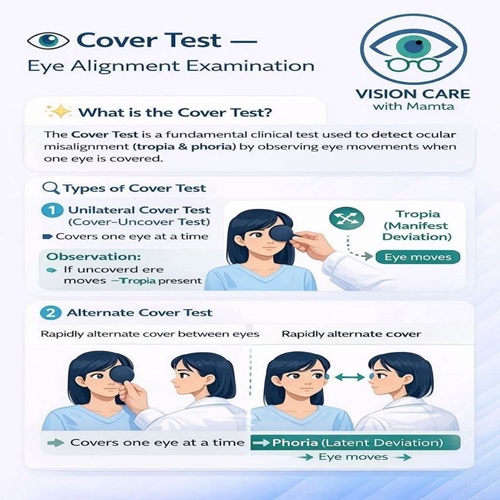
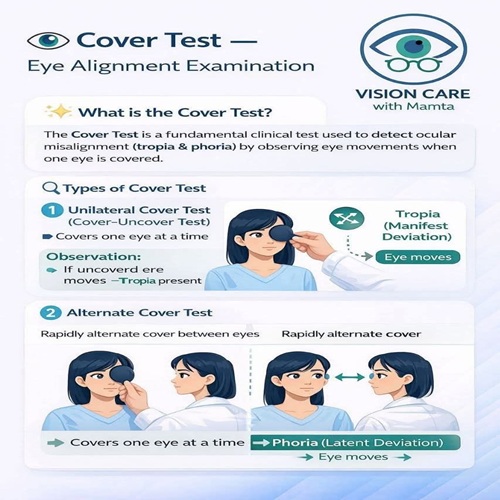
The cover test is a basic clinical examination used to detect eye misalignment (both manifest and latent strabismus) by observing eye movement when one eye is covered.
Why is it important?
Detects manifest deviation (Tropia)
Detects latent deviation (Phoria)
Essential for assessing binocular vision
Helps in early diagnosis of strabismus
Types of Cover Test
Cover–Uncover Test
One eye is covered at a time
Detects manifest strabismus (Tropia)
Observation:
If the uncovered eye moves → a manifest deviation is present
Alternate Cover Test
The cover is rapidly alternated between the eyes
Breaks binocular fusion
Observation:
Movement appearing → indicates a latent deviation (Phoria)
What do we observe?
Eye movement (inward / outward / vertical)
Speed and stability of refixation
Direction of deviation
Presence of suppression
Clinical Note
ESO → the eye moves outward to fixate
EXO → the eye moves inward to fixate
Helps differentiate between esotropia, exotropia, hypertropia, and hypotropia
Important Tip
It is preferable to perform the test at both distance (6 meters) and near (33–40 cm) for a more accurate diagnosis.
For the lecturer M.M. Muhaimin Sameer Arif
University of Al-Mustaqbal – The First and Leading Private University