Scientific Article about The Future of the Brain: Between Biotechnology and Artificial Intelligence
29/03/2026 Share :
The human brain has long been one of the greatest mysteries in science, with researchers striving for centuries to understand its complex structure and functions. Today, the world stands at the threshold of a new era—one that goes beyond merely understanding how the brain works, to actively enhancing its capabilities and directly connecting it with technological systems. This rapidly evolving intersection between neuroscience and engineering is known as the “Future of the Brain,” a field rich with both immense potential and profound challenges.
First: Brain-Computer Interfaces (BCI) – The Digital Bridge
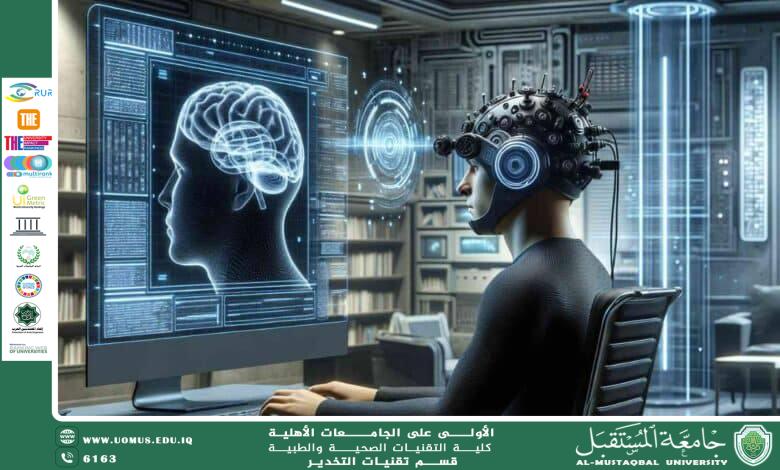
Brain-Computer Interfaces represent one of the most significant innovations in this field, aiming to establish a direct connection between neural cells and computer systems.
Currently, this technology focuses on assisting individuals suffering from paralysis or loss of speech by translating neural signals into digital commands that can be converted into words or movements.
In the future, research is expected to expand toward enhancing cognitive abilities, potentially enabling humans to access digital information at the speed of thought, thereby opening unprecedented possibilities for human-machine interaction.
Second: Digital Storage and Artificial Memory
A central scientific question arises: Can memories be stored or enhanced using digital technologies?
Current experiments indicate the possibility of developing “memory prosthetics,” which rely on stimulating the hippocampus to enhance memory formation, particularly in patients with conditions such as Alzheimer’s disease.
In the future, the ability to store or retrieve memories digitally may become a practical reality—not only as a medical treatment but also as an advanced educational tool that could revolutionize learning methods.
Third: Personalized Medicine and Genetic Editing
The future of neurological medicine is moving toward the concept of “precision medicine,” which is based on the unique genetic profile of each individual.
By analyzing genetic maps, physicians may be able to predict the likelihood of developing neurological disorders such as Alzheimer’s and Parkinson’s years before symptoms appear, allowing for early intervention and prevention.
Additionally, gene-editing technologies promise the potential to correct genetic mutations responsible for hereditary neurological diseases at early stages, fundamentally transforming treatment approaches.
Fourth: Ethical Challenges – The Major Dilemma
Despite its promising potential, these advancements raise complex ethical concerns, including:
• Cognitive Privacy: With the possibility of extracting neural data, questions arise regarding data ownership and protection.
• Social Inequality: Limiting cognitive enhancement technologies to certain groups could create a new biological divide among humans.
• Personal Identity: Integrating technological components into the brain raises deep philosophical questions about the nature and boundaries of human identity.
Conclusion
The future of the brain extends beyond treating neurological disorders to redefining human capabilities themselves. We are moving toward an increasingly close partnership between biology and technology—one that holds tremendous promise for improving quality of life, yet requires clear ethical and regulatory frameworks.
Amid this transformation, the fundamental responsibility remains to ensure that humans—with their consciousness and creativity—remain in control, with technology serving as a tool for empowerment rather than a replacement for human essence.
Dr. Ahmed Neama
Al-Mustaqbal University
The First University in Iraq