Biomedical Engineering students successfully design and manufacture an artificial larynx for laboratory applications
29/03/2026 Share :
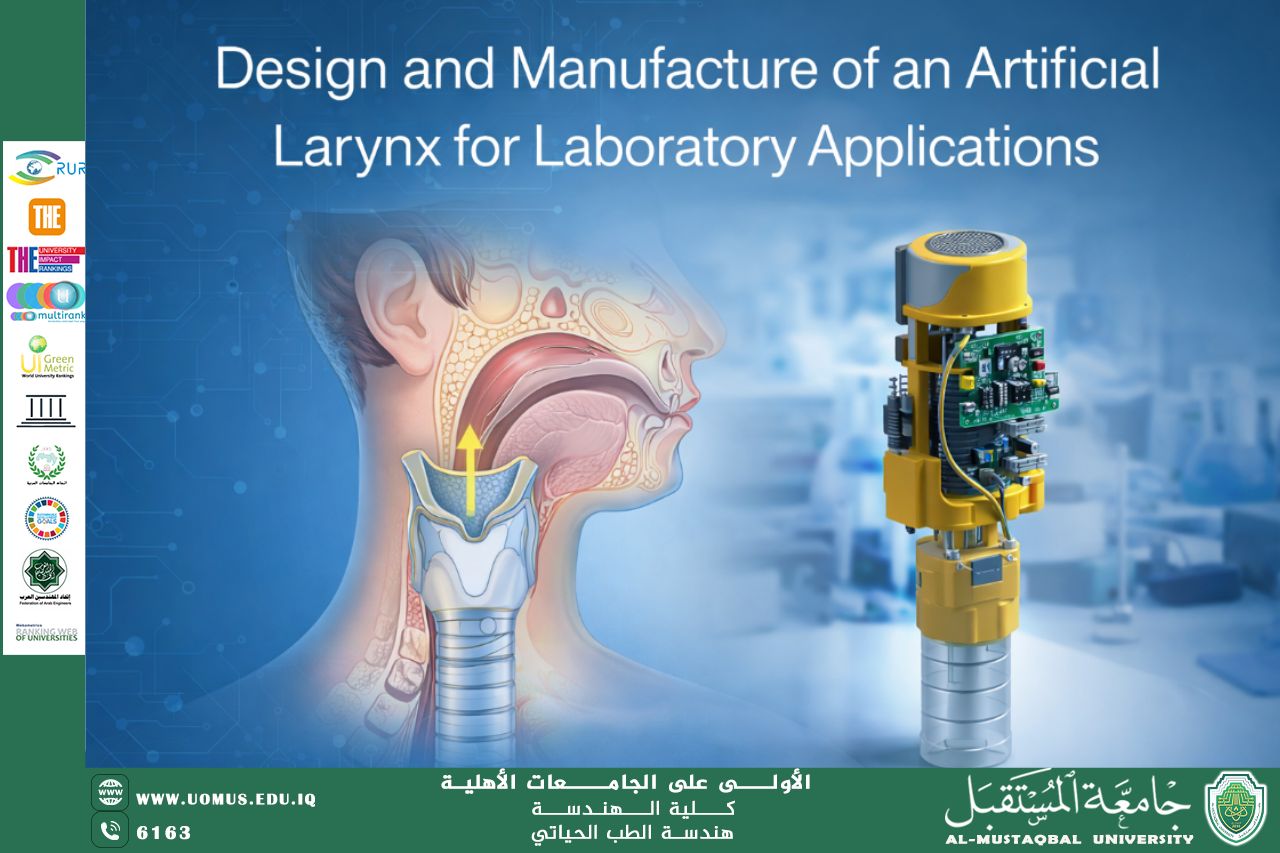
In an engineering achievement serving rehabilitation and healthcare, a research team of students from the Biomedical Engineering Department at Al-Mustaqbal University, under the supervision of Professor Dr. Ibrahim Abdullah Mardas, designed and developed a low-cost electronic "artificial larynx" system.
Project Significance and Objective:
The project, completed by students Muqtada Najm Abdul Zahra, Sama Fadhil Sharif, and Zahraa Ayed Mohammed, aims to provide practical solutions for laryngectomy patients, helping them regain basic speech abilities by generating digital artificial voice signals that mimic natural human speech.
Methodology and Technical Innovation:
The project relied on integrating software simulation with hardware implementation according to the following steps:
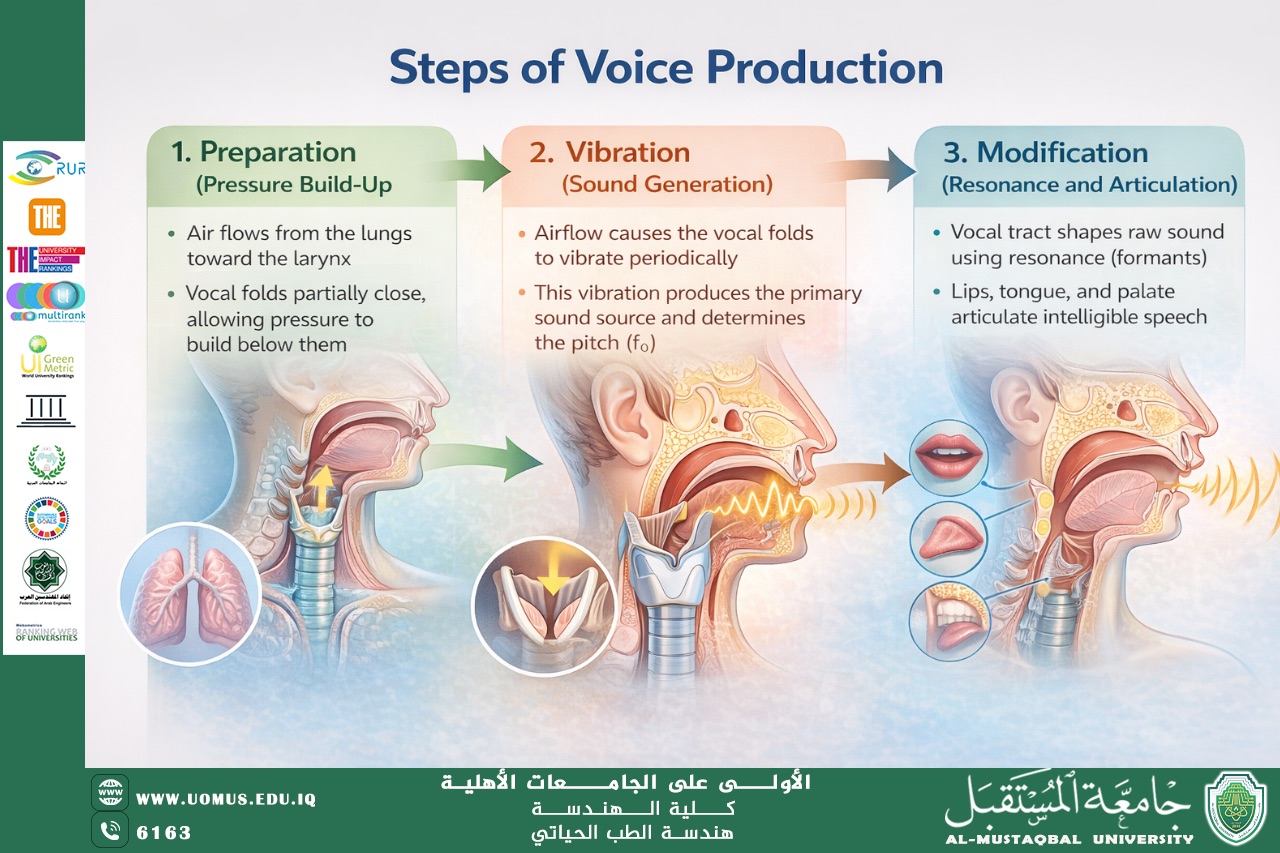
• Simulation: Using MATLAB software to generate hybrid excitation signals based on sine, sawtooth, and Rosenberg waves to simulate natural speech.
• Processing: Applying digital filters (formant-based filtering) to ensure the clarity of basic articulation (such as /a/, /i/, /u/). • Implementation: The system was built using an STM32F401 microcontroller, integrated with a digital-to-analog converter (PCM5102 DAC), and an amplifier (PAM8403) to transmit the signal to a dynamic amplifier.
Results and Sustainable Development:
The developed system demonstrated high efficiency in producing stable audio signals with acceptable sound quality and clear articulation, providing a practical and cost-effective solution for speech rehabilitation. This innovation contributes to the Sustainable Development Goals (SDGs), specifically:
• Goal 3 (Good Health and Well-being): by helping patients communicate and participate in society.
• Goal 9 (Industry and Innovation): by developing locally-based embedded system