
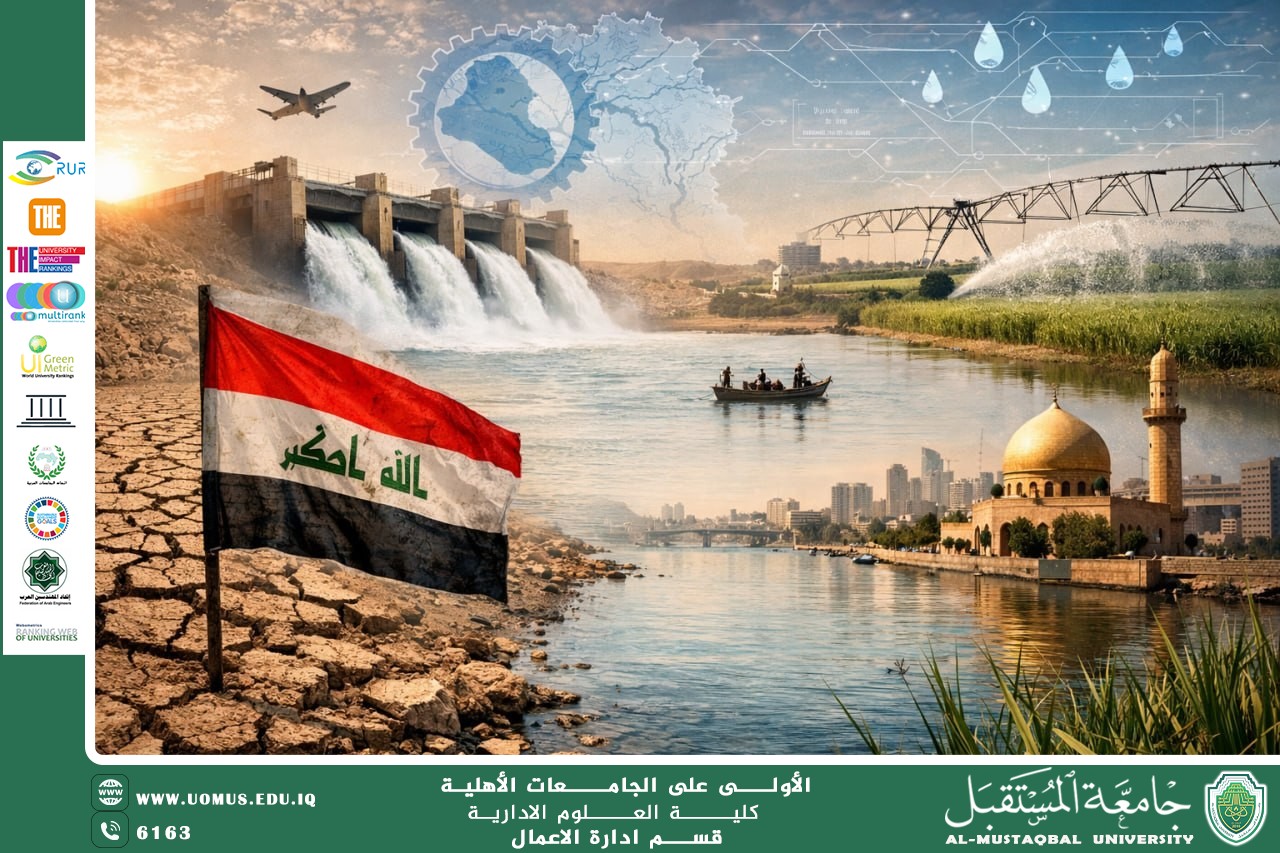
Water Management in Iraq: Contemporary Challenges and Strategies for Achieving Sustainability and Water Security
30/03/2026 Share :
Prepared by Professor Dr. Amjad Hamid Majeed
College of Administrative Sciences
Water management is considered one of the most critical issues in Iraq, given its direct impact on various aspects of economic, social, and environmental life. Iraq relies primarily on the Tigris and Euphrates rivers as its main water sources, which makes it vulnerable to challenges related to climate change and the water policies of upstream countries, in addition to problems of waste and poor domestic usage.
The importance of water management in Iraq lies in its role as a fundamental pillar for achieving water security, which in turn forms the basis of economic and social stability. Water is a vital element for the agricultural sector, which is one of the most important economic sectors in the country, contributing to food supply and employment opportunities. Without effective water resource management, this sector faces the risk of decline, potentially leading to increased poverty and unemployment rates.
Water management also plays a significant role in supporting sustainable development by achieving a balance between meeting the needs of present generations and preserving resources for future generations. Rational water use and the adoption of modern irrigation technologies can help reduce waste and improve consumption efficiency, in addition to mitigating water pollution, which poses a threat to public health and the environment.
Furthermore, the importance of water management is highlighted by the environmental challenges facing Iraq, such as rising temperatures and decreasing rainfall, which increase pressure on water resources. Therefore, adopting modern strategies such as integrated water resources management and the use of smart technologies to monitor consumption has become a pressing necessity.
On the other hand, water management represents an important field for applying business administration principles through improving resource efficiency, planning water-related projects, and strengthening partnerships between the public and private sectors. Effective administrative policies can also contribute to achieving fairness in water distribution among different regions and sectors.
Thus, water management in Iraq is not merely an environmental issue; it is a strategic matter that affects national security, economic development, and social stability. Hence, there is a growing need to adopt sustainable water policies, develop infrastructure, and enhance public awareness of the importance of preserving this vital resource.
جامعة المستقبل