
The Role of the Arabic Language in the Development of Scientific Research (Asst. Prof. Sarab Abbas Jasim)
16/04/2026 Share :
Language is a fundamental tool for producing and transmitting knowledge. No scientific activity can progress without a language capable of expressing concepts and terminology with precision. The Arabic language holds a distinguished position among world languages due to its rich linguistic heritage and long-standing scientific tradition. However, its role in modern scientific research faces several challenges that require careful consideration and analysis.
Body:
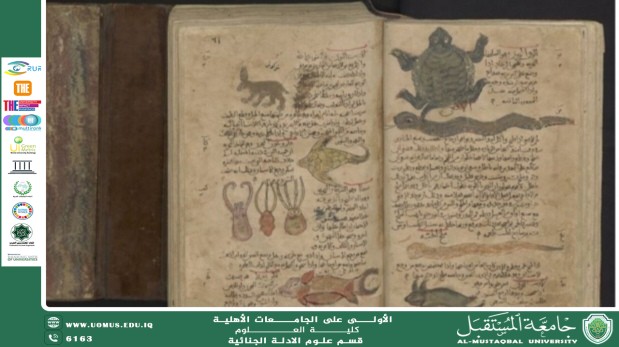
During the flourishing periods of civilization, particularly in the Abbasid era, Arabic served as the primary language of science and knowledge. Numerous works in medicine, astronomy, philosophy, and mathematics were written in Arabic. The translation movement at that time played a vital role in transferring knowledge from other civilizations into Arabic, which was then further developed and expanded, making Arabic a global language of science.
In the modern era, Arabic still possesses characteristics that qualify it to function as a language of science. It is a rich language with extensive vocabulary and strong derivational capabilities, enabling it to accommodate modern scientific terminology. Additionally, its clear grammatical and morphological system allows for precise scientific expression.
Despite these strengths, the role of Arabic in scientific research has declined. Many researchers rely on foreign languages, particularly English, to write and publish their studies. This can be attributed to several factors, including the scarcity of peer-reviewed scientific journals in Arabic, weak translation and Arabization efforts, and the global dominance of English in academic publishing.
Moreover, limited proficiency in Arabic among some students and researchers negatively affects their ability to produce well-structured academic writing, leading them to avoid using it in their research. The absence of strong language policies supporting Arabic in academic institutions further exacerbates this issue.
To enhance the role of Arabic in scientific research, several measures should be taken. These include strengthening translation and Arabization efforts, encouraging academic publishing in Arabic, and modernizing language teaching methods to meet contemporary needs. It is also essential to establish reputable Arabic-language scientific journals and provide academic incentives to motivate researchers to publish in Arabic.
Conclusion:
In conclusion, the Arabic language has significant potential to serve as an effective medium for scientific research. However, activating this role requires coordinated efforts from educational and research institutions. Preserving and promoting the use of Arabic in the scientific domain is not merely a cultural choice but a civilizational necessity to ensure intellectual independence and sustainable development in the Arab world
Al-Mustaqbal University – the first university in Iraq.