
A scientific article for teaching assistant teacher Zainab Jawad Kazem entitled(Bioactive glasses)
14/10/2022 Share :
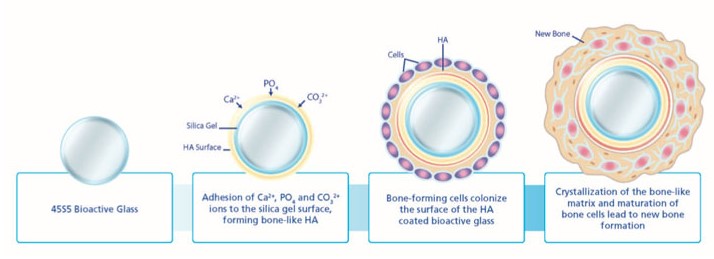
Bioactive glasses: are a group of surface reactive amorphous ceramic biomaterials, that exhibit biocompatibility and bioactivity led them to be used as implant devices in the human body to repair and replace diseased or damaged bones.<br />Most bioactive glasses are silicate based glasses that have degradability in body fluids and can act as a vehicle for delivering ions necessary for healing. <br />High bioactivity is the main advantage of Bioglass, while its disadvantages includes mechanical weakness, low fracture resistance due to amorphous 2-dimensional glass network. The bending strength of most Bioglass is in the range of 40–60 MPa, which is not enough for load-bearing application. Its Young's modulus is 30–35 GPa, very close to that of cortical bone, which can be an advantage. Bioglass implants can be used in non-load-bearing applications, for buried implants loaded slightly or compressively.<br />The activation mechanism, that enable integration of bioactive glass with bone and forms a new bone tissue illustrated in figure below.