A scientific article by the teaching assistant teacher, Marwan Hisham Muhammad, entitled (Biometry for Intra-Ocular Lens (IOL) Power)
28/12/2022 Share :
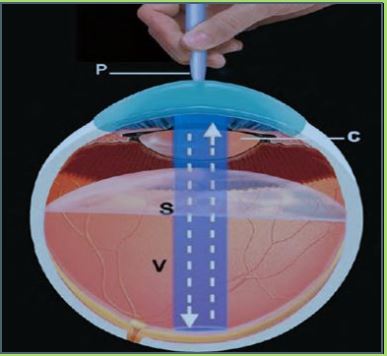
Biometry is the method of applying mathematics to biology. The term was originally used by Whewell in<br />the 1800s for calculating life expectancy. The refractive power of the eye primarily depends upon the<br />cornea, the lens, the ocular media, and the axial length of the eye. When planning for cataract surgery,<br />in order to achieve the desired post-operative refraction, the required power of the intraocular lens<br />(IOL) implant can be calculated if the corneal refractive power, media type, and axial length are known.<br />4 keys to biometry<br />1. It is a painless test.<br />2. Pupil dilation is not necessary<br />3. You must not wear contact lenses for 48 h beforehand.<br />4. Test duration: 15 minutes.<br />What diseases can be diagnosed?<br />This test is necessary for:<br />Cataract and presbyopia surgery (lenses replacing the aging lens).<br />In surgery correcting refractive defects (myopia, hyperopia, astigmatism, etc.) with Phakic lenses<br />(that do not replace the lens).<br />The power of the lens to be implanted is calculated based on its results.<br />Biometry for Intra-Ocular Lens<br />(IOL) Powerhow can we use the Biometry test?<br />Ocular biometry is a test that measures the dimensions of the eyeball: the axial length (distance<br />between the anterior and posterior parts of the eye) and the depth of the anterior chamber (the part<br />between the cornea and the iris and lens). It is also used to measure the thickness, curvature, and<br />diameter of the cornea.<br />This test determines the precise dimensions of the eye where an intraocular lens is to be implanted.<br />The test must be performed extremely precisely, as it will be used to determine the exact measurement<br />of the intraocular lens to be implanted in the eye<br />How is it performed?<br />Ocular biometrics are performed according to two techniques:<br />• Ultrasound biometry (ultrasound emitted into the cornea, requiring contact with the cornea<br />and anesthesia. It is invasive for patients and takes longer to perform by specialists)<br />• IOL MASTER optical biometry (uses infrared laser light, is not invasive for patients who feel<br />nothing, and no anesthetic or dilating eye drops are required).<br />Optical biometry is the most used at present, as it provides a more precise calculation except in very<br />specific cases (very opaque lenses).