
A scientific article by the teacher, A. L. Muhaymen Samir Arif, entitled (Myopia)
06/10/2023 Share :
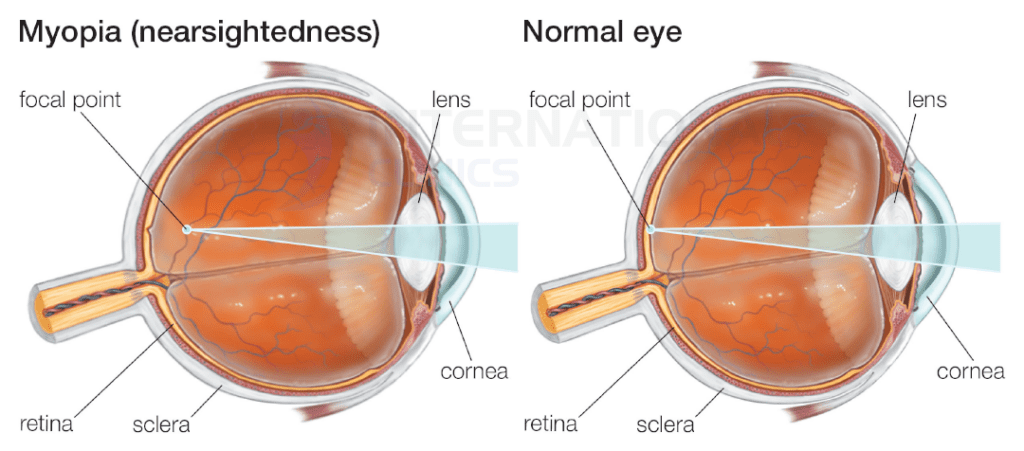
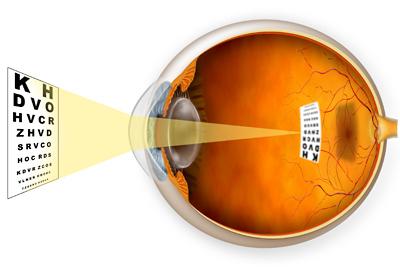
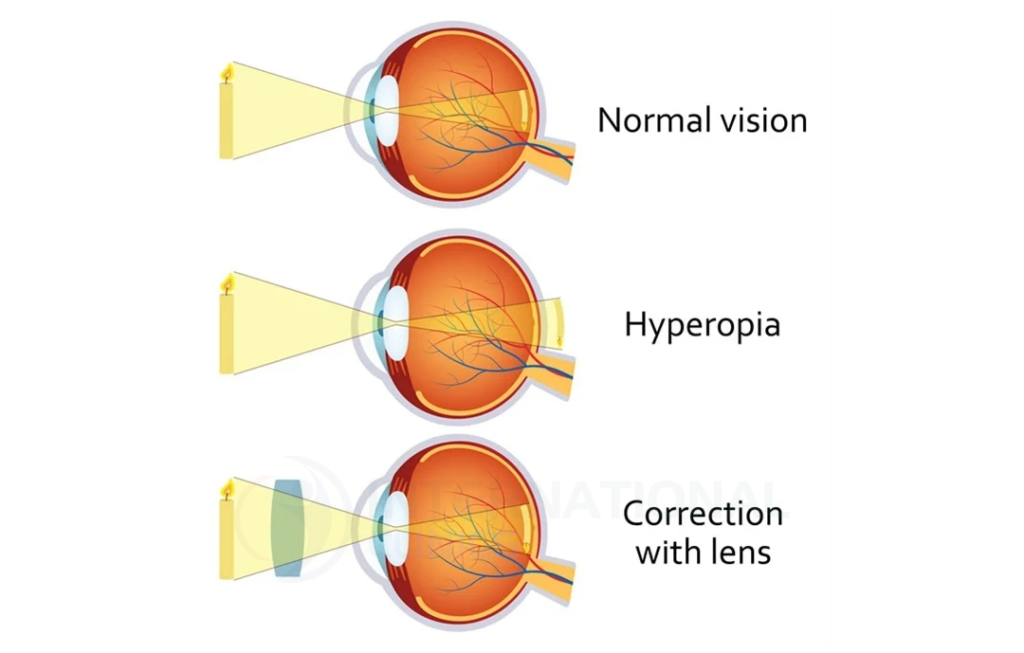
Myopia is a refractive error that affects the eye, which makes the affected person unable to see distant objects clearly, but he can see near objects clearly as a result of the rays falling in front of the retina instead of falling on the retina.<br />There are reasons that do not affect humans, and they are congenital, meaning whether they were created with them or came to them as a result of a genetic factor or something else.<br />The reasons are:<br />1- Axial myopia, meaning the diameter of the eye is greater than normal. It is known that the normal diameter of the eye is 24 mm at puberty<br />2- Refractive myopia, i.e. the refractive index of the eye lens is greater than normal<br />3- Convex myopia, i.e. a challenge to the cornea or lens in excess of what is normal<br /><br />These reasons led to an increase in the refractive power of the eye and it became more than 60 diopters, because in nature the eye’s 60 diopters are divided into:<br />18 diopter eyepiece<br />42 corneal diopters<br />The increase occurs as a result of an increase in the length of the eye ball, and it became, for example, 25 instead of 24 mm. Here, the corresponding increase is that every 1 mm equals 3 diopters.<br />treatment:<br />He is treated with a negative, concave, ray-scattering lens that causes light rays to gather at a point on the retina instead of gathering at a point in front of the retina. The function of the lens here is to compensate for the extra numbers and return the eye to its normal position, and through the lens he can see clearly near and far.<br />Contact lenses, like contact lenses, treat myopia using negative concave, radiation-diffusing lenses.<br />Surgical operations are to correct myopia by reshaping the surface of the cornea to return to its natural shape instead of excessive convexity.<br />As a simple example of it<br />It is as if you were holding the phone, opened the camera, and zoomed in larger than normal<br />You will have a magnified view of near and far that is not clear or non-existent<br />The reason is that the strength is greater than normal<br />If we return to the law of power =<br />100/distance in cm<br />If we want to calculate the distance at which a myopic patient can see<br />Distance = 100/force<br />= 100/3 = approximately 33 cm<br />That is, a nearsighted patient who has minus 3 diopters sees his maximum clear vision at a distance of 33 cm. Unlike hyperopia, this is the distance that he cannot see clearly, but he sees the far distance clearly as a result of the deficiency in eye power.<br /><br />A negative lens is two prisms facing each other at the head and the light is in the direction of the base. Therefore, it disperses the rays. Everything I explained about myopia is the opposite of farsightedness in the causes, symptoms and treatment.<br />As for the safest method of treatment, the only cost is glasses<br />Contact lenses require good quality and safe quality + healthy eyes free of infections, dry eyes, and any eye diseases.<br />It requires good continuous hygiene + a good climate while wearing it and not bathing or sleeping in it<br />There are many risks due to its proximity to the eyes<br />As for operations, it is a wrong choice<br />Because of the complications related to vision correction operations, which lead to the person suffering from dry eyes throughout his life, and he uses lubricating drops and artificial tears, as well as the symptoms related to vision return to what they were, and he is also infected with floating flies and floaters.<br />It is not seeing clearly as a result of things appearing in the vision, such as spiders and other poor vision.