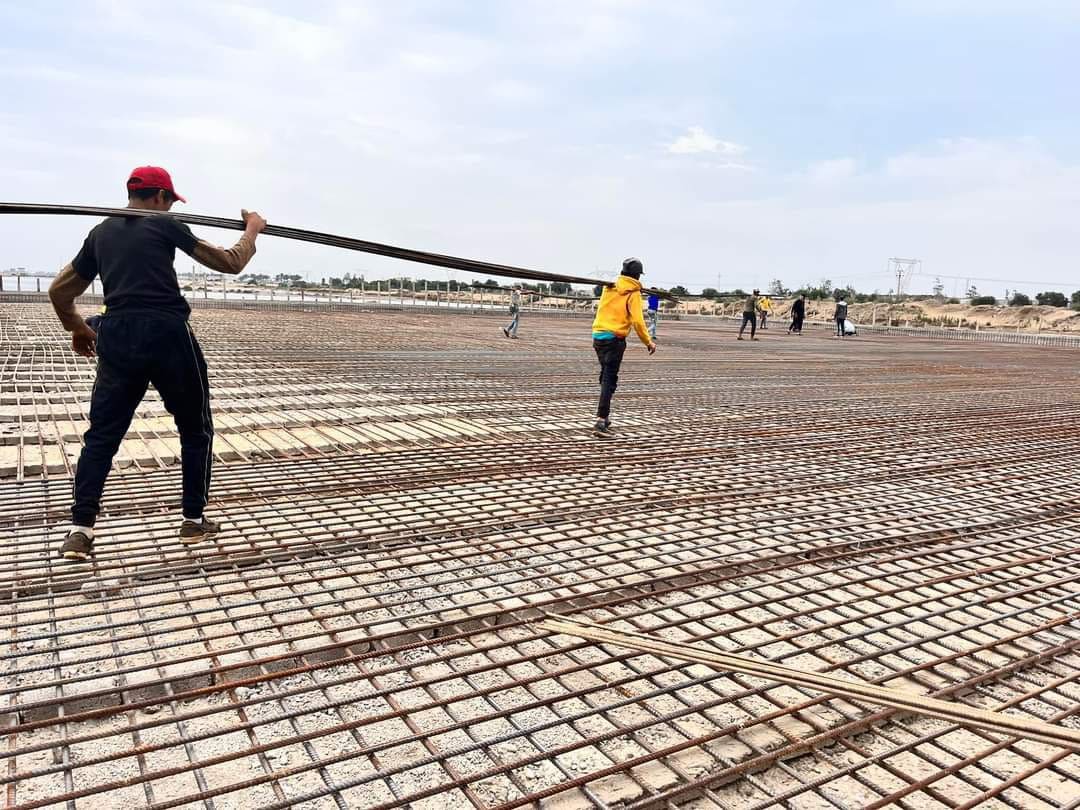
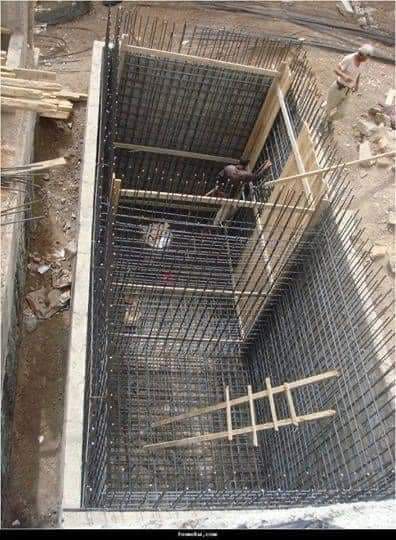
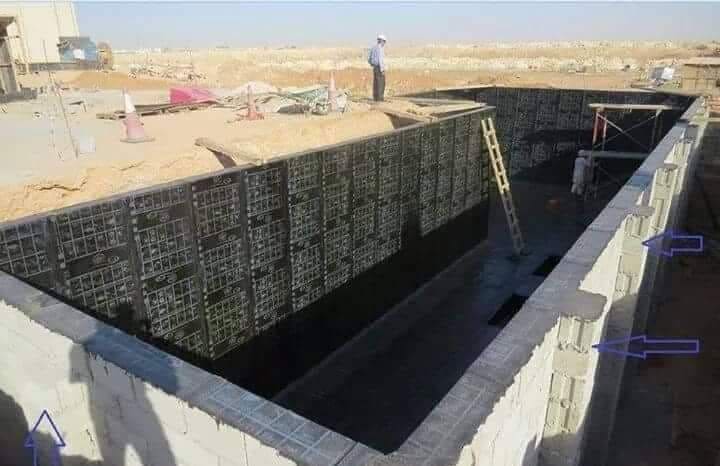
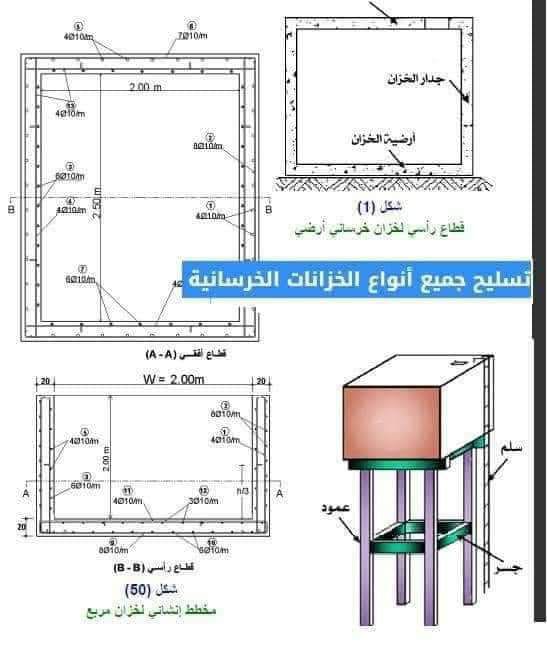
Ground water tanks
01/01/2024 Share :
Lec. Dr. Riyadh Abd Al-Abbas<br />1- Site requirements: A- It must be as far away as possible from all sources of pollution, such that the distance is not less than (10) meters from any source of pollution, such as analysis and collection tanks, sewage pits, or manholes.<br />B- The location of the tank must not be low so that rainwater laden with dust and dirt does not submerge it and lead to pollution of the water inside it. It must also be high above the location of the sewage drains, allowing the direction of surface water to flow from the tank to the drain and not vice versa, and the level must be The ground water tank is at least 50 cm higher than the level of pollution sources, if any.<br />C- If the ground water level is high, a subterranean drainage must be made around the ground water tank in order to prevent leaching into the tank.<br />D- When constructing ground water tanks, it should be taken as close as possible to the entrance fence. In the case of constructing ground tanks inside residential buildings, it should be taken as close as possible to the building entrance for easy filling or external maintenance.<br />2- Insulation requirements: The walls and bottom of ground tanks must be completely sealed to prevent leakage and so that they are not susceptible to contamination. This is done by plastering the bottom and walls of the tank from the inside and outside with cement plaster, adding an anti-leaching material, which must not be a toxic substance, and covering the bottom and walls of the tank from the outside with insulating layers. moisture both horizontally and vertically.<br />3- Calculating the capacity of the ground water tank: The capacity of the ground water tank must be proportional to the number of apartments and beneficiary residents, and must suffice the residents for at least two days. It is estimated on the basis of a rate of no less than (100) liters/person/day, and the tank capacity must not be less than (10 m3). ) so that the following is taken into account: A - In small establishments (independent housing “villa” - a building consisting of two residential units whose building area does not exceed 500 m2), it is recommended that the capacity of the ground tank be 12 m3, with an addition of 3 m3 for each residential unit or for every additional 150 m2 of building area. .<br />B- For large buildings: 1- The water consumption rate is determined according to the nature of the building’s use, according to the N.P.C (National Plumbing Code).<br />2- The feed pipes are designed on the basis that the water speed does not exceed 8 ft/s for the water mains and 5 ft/s for the subsidiary pipes.<br />3- The tank capacity is estimated on the following basis:<br />A - Sufficient storage capacity to supply water for 3 days for population consumption.<br />B - Determine the type of building in terms of its degree of exposure to fire according to N.F.P.A (National Fire Protection Association), and accordingly fire-fighting systems are determined.<br />Based on this, the amount of water needed to fight a fire can be determined as follows: - The amount of water required to be stored for the sprinkler network, if any, = (500-750) gallons/minute for a period ranging from 30-60 minutes.<br />- The amount of water required to be stored for internal and external fire hoses = 100 gallons/minute for 30 minutes.<br />C - Ground tank capacity = the amount of water required for the fire (sprinklers + fire hoses) + the amount of water required for public consumption.<br />4- Accessories that are installed on the ground water tank:<br />The ground water tank is provided with the following pipes:<br />A - The tank’s feeding pipe is from the public network and a float valve is installed on it.<br />B- A pipe that draws water from the tank using the pumping group to raise it to the upper tank and install a locking valve on it.<br />C- Overflow pipe and laundry drain lines with locking valves, noting that the iron pipes adjacent to the water should be painted with an anti-rust, non-toxic substance.<br />- Install a ventilation pipe (about 2 inches in diameter) on the roof of the tank with an elbow down at the end and a wire mesh to prevent insects from entering.<br />- Marine ladders are installed inside ground water tanks made of rust-resistant and non-toxic materials to facilitate entry into and exit from the tanks to perform periodic maintenance and disinfection work.<br />5- Implementation and testing requirements: Sulfate-resistant cement (type (V) cement) is used in the construction of these tanks according to the Saudi standard specifications and the American classification (ASTM).<br />The walls and floors of tanks are coated with epoxy or other materials used to prevent water leakage.<br />Water insulators and partitions to prevent leakage shall be placed between all building joints, and all plumbing openings and openings used in construction shall be tightly blocked.<br />If the floor slab is located more than one meter above the ground water level, it shall be established on a layer of well-tamped rubble, and a moisture-proof layer shall be placed on top of it. However, if the floor slab is located below the expected ground water level or close to it, this slab and all the external faces of the tank must be covered. With at least two layers of insulating membranes impregnated with asphalt.<br />The internal insulating layers in the tank are tested after completion of its implementation and before external insulation and backfilling, by filling the tank with water for 48 hours, and treating the causes of any leakage or seepage that is found to exist before starting the external insulation and backfilling. Then the external insulation is tested after its implementation, after the tank is completely emptied of water. And leave it to dry.<br />6- Backfills: Materials of the structural backfill type (selected) are used in backfilling around the tank in accordance with the American Standard Specifications for Roads (AASHTO) No. (A-1) or (A-2) or their equivalent. Backfilling is done in layers, the thickness of each of which does not exceed 20 cm. Compact each layer mechanically until a density of not less than 95% of the maximum dry density is achieved, provided that this density is measured by the modified Proctor test method. The implementation of the backfilling process must be supervised by a specialized technician with experience in these works, and all necessary field tests must be conducted to ensure The quality of the backfill and recording its results regularly.<br />7- Design requirements: A- Technical principles must be taken into account when designing reinforced concrete for floor slabs and floor tank walls, and when implementing them, a water seal is used between the different pours, especially between the floor slab and the vertical walls, and also care is taken of the vertical iron connections of the walls and the horizontal iron connections of the floor slab and vertical walls so that they perform well. Sound and secure under the influence of the expected loads on the tank during its life, such as horizontal soil pressure, water pressure, and any other expected loads, taking into account making a connection between the different castings, especially between the bottom and the vertical walls.<br />B- The walls and floor of the tanks are reinforced with two reinforcement nets and secured with hooks and chairs.<br />C- Reinforcing bars with small diameters, such as 10mm, 12mm, or 14mm in diameter, are used in reinforcement to resist cracks.<br />D- Floor tanks shall be provided with openings with covers made of cast iron and of the airtight type to prevent water from leaking into the tank, with the installation of a protection net made of a material that is resistant to rust and corrosion. It is necessary to raise the level of the openings and their covers above the surface level of the tanks to avoid rainwater or washing water leaking into the tank. Protect tanks and take precautions to ensure that children do not tamper with them or fall inside them, while requiring engineering and consulting offices, when preparing designs for ground water tanks, to have their covers in accordance with the plans and models prepared for them.<br />E- Care must be taken in designing the roof slab of the ground tank under the influence of the expected loads on it, such as the weight of the soil layers above it, as well as any expected live loads.<br />F- The path of the pipe line that feeds the ground tank from the public network, as well as the pipes emerging from it, must be chosen away from all potential sources of pollution, and the necessary precautions must be taken to isolate these pipes.<br />F- A small depression must be made at the bottom of the tank, with a size of no less than (50 cm x 50 cm) and a depth of (25 cm) in the area below the pipe for drawing water from the tank.<br />G- There should be a slight outward slope at the back of the tank roof for easy drainage of rainwater.<br />H- The pump room attached to the tank (if it is at its level) shall be provided with a room for collecting water leaking from the connections, with dimensions of 0.5 x 0.5 x 0.35 m, and it shall be provided with a submersible water pump to drain this water.<br />I- It is recommended to paint the tank from the inside with an approved material that prevents the formation of algae, bacteria and fungi inside the tank.<br />J- Installing safety ladders under the covers of ground water tanks<br />8-Regular maintenance requirements:<br />A- Repairing ground tanks in the event of any damage to them and treating leaks if any leaks appear by emptying the tank of water, drying it, and performing the necessary treatment to prevent water leakage.<br />B- Taking care of the floats, valves and their accessories, cleaning them, removing blockages from salts and sediments, and changing them if they are damaged.<br />C- Taking care of the tanks and closing them tightly so that they are difficult to open or tamper with.<br />D- Inspection and testing of pumps (transmission parts, motors, control devices, and electrical connections).<br />E- If the ground tank works as a fire water tank, a permanent source of fire water must be provided during the maintenance process.