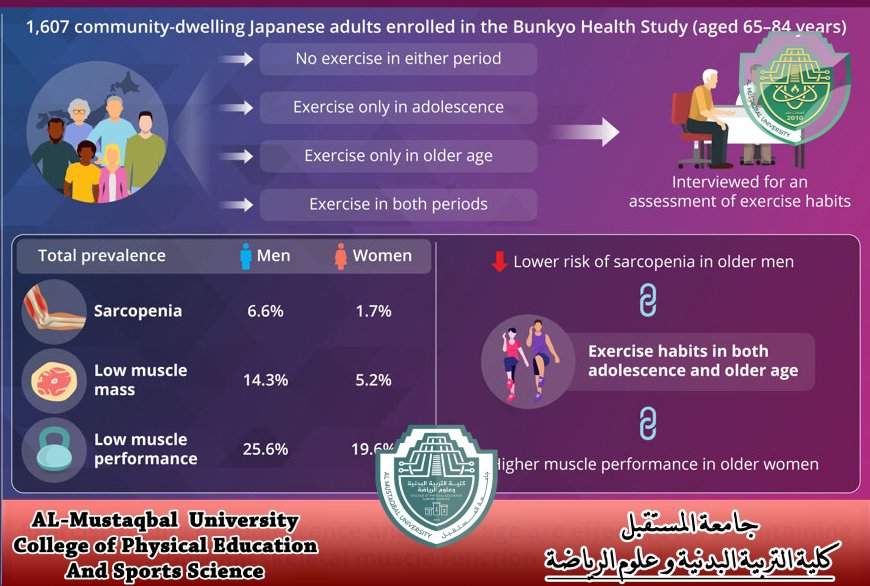
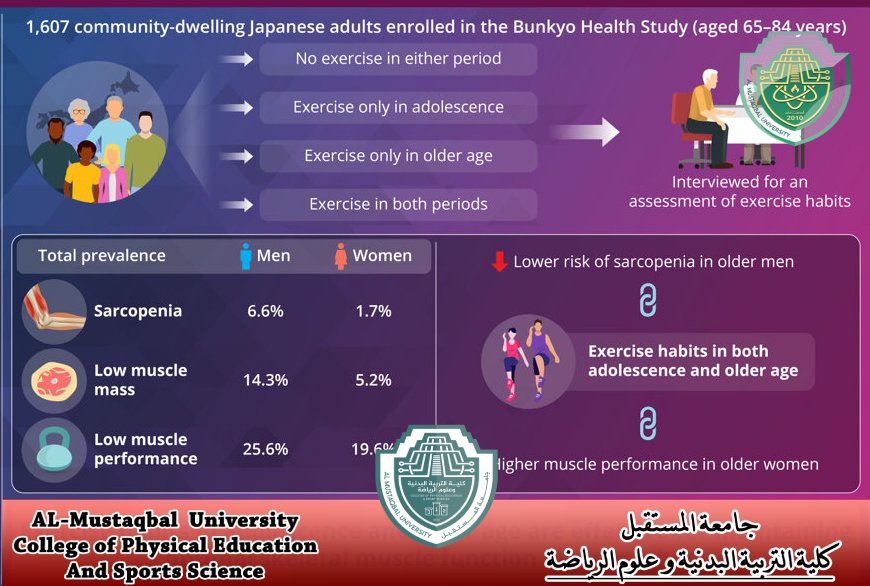
A scientific article by Lecture (Belal Abdalhamza Azeez ) entitled “ The effect of exercise on sarcopenia ”
09/01/2024 Share :
The effect of exercise on sarcopenia<br />Belal Abdalhamza Azeez<br />[email protected]<br />College of Physical Education and Sport Sciences - AL-Mustaqbal University<br /><br />muscle atrophy<br />Sarcopenia is an inevitable component of aging. It is officially recognized as a muscle disease with an ICD-10-MC diagnosis code which can be used to pay for care in some countries. Sarcopenia can be classified into primary or age-related secondary atrophy. This condition is referred to as secondary muscular dystrophy when no other comorbidities are present in conjunction with aging. Secondary sarcopenia is more common than primary sarcopenia and requires special attention. Exercise interventions may aid our understanding and prevention of muscular dystrophy with specific morbidity . Glomerular filtration rate Exercise improves muscle mass, quality, or physical function in elderly people with cancer, type 2 diabetes, kidney disease, and lung disease. In this review, we summarize recent research that has examined the effect of exercise in patients with secondary muscular dystrophy, specifically those with a single comorbid condition. We did not detect any exercise intervention specifically for people with secondary muscular dystrophy (with one comorbidity). Although there is a strong case for using exercise to improve muscle mass, quality, or physical function in people with cancer, type 2 diabetes, kidney disease, lung disease, and many others, very few studies have reported baseline evaluations of muscular dystrophy. Based on the trials summarized in this review, we would suggest but not conclude that resistance exercise, aerobic exercise, balance, or even walking can be beneficial in people with secondary muscular dystrophy with only one comorbidity due to the limited number of trials. This review is important because it reveals the need for large-scale research initiatives including patients with secondary sarcopenia and highlights a major research gap in the field of secondary sarcopenia .<br /><br />Muscle atrophy begins gradually and is often unnoticed because it does not cause any pain, but physical strength steadily decreases. Its symptoms begin to appear when you notice the inability to perform previous daily tasks as they were done before. Climbing the stairs becomes difficult, as does carrying things. This serious health problem requires attention and monitoring of the body before it worsens. These problems can be confronted through exercise and healthy nutrition .<br />Sports scientist Professor Jurgen said Gissing , from the University of Koblenz-Landau in Germany, said that it is important to know that muscle mass decreases starting around the age of 30. People over the age of 70 lose about 3% of their muscle strength annually, which increases for those who stay in bed for a long time, for example during a hospital stay. In such cases, patients are often too weak to stand on their feet .<br />Sick conditions<br />Conditions such as cancer, chronic obstructive pulmonary disease, and chronic heart and kidney disease can also cause loss of muscle mass and strength. Sports scientist Professor Sebastian Gellert , from the German University of Hildesheim , explained that this can affect young and elderly patients alike. However, the biggest risk factor for muscle atrophy is old age .<br />In addition to age-related development in the muscles, inactivity, lack of movement, and some bad habits, such as lack of protein intake through food, often help the disease appear .<br /><br />Muscle strengthening exercises<br />Gellert stressed the importance of eliminating physical inactivity to combat muscle atrophy, through targeted muscle strengthening exercises. With endurance sports, such as swimming or cycling, strength does not increase significantly .<br />Gissing pointed out that muscle-strengthening exercises do not require a lot of effort, and it is not necessarily related to lifting weights either, and exercises such as squats or shoulder presses can effectively enhance muscle building .<br />Gissing emphasized that three one-hour training units per week are sufficient and good. It is important to do the exercises slowly and correctly, and it is preferable to do them under the supervision and guidance of a specialist .<br />Nutrition rich in proteins<br />In addition to exercise, it is also important to follow a diet rich in proteins; Proteins are necessary to build, maintain and repair muscles. Gellert said that a common problem with older people is that they feel less hungry and therefore consume relatively few calories, and this can quickly lead to malnutrition .<br />Protein-rich food is essential for elderly people, not only in daily life, but also especially after doing muscle-strengthening exercises, so they should drink a cup of milk, or a protein shake immediately after exercise .<br />In general, elderly people who suffer from muscular dystrophy should consume 20 to 40 grams of protein per main meal, provided that there are no kidney problems .<br />It has also been proven that omega- 3 fatty acids have a positive effect in maintaining muscle. The same applies to the amino acid creatine, which is found almost exclusively in animal foods. Omega- 3 fatty acids are found in flaxseed oil and fatty fish such as salmon .<br /><br /><br />Exercises can help treat muscular dystrophy<br />The study, which was published in the journal, said eLife , Some exercises can help treat muscular atrophy .<br />The researchers noted that zebrafish are an effective test model for muscular dystrophy, or muscular dystrophy, due to the molecular similarity between zebrafish muscles and human muscles. Zebrafish can also be bred with a mutation resembling Duchenne muscular dystrophy , a severe type of muscular dystrophy that affects young boys .<br />The researchers used a process called neuromuscular electrical stimulation (NMES) , which stimulates specific nerves to stimulate muscle contraction. The researchers designed four systems and named them after four common weightlifting routines .<br />The study found that each of the weight lifting procedures in NMES affected zebrafish neuromuscular junction morphology, swimming and survival differently .<br /><br />” says Dr. Elizabeth Kilroy , first author of the study who conducted the research for her doctoral degree at the University of Maine eNMES Through high-frequency, low-effort pulses, which are similar to the high-repetition, low-weight exercises we do in the gym .<br /> Reducing resistance training maintains muscle strength<br />She added: The long-term consensus in the field of muscular dystrophy is that reducing resistance training maintains muscle strength and mass because it reduces the risk of muscle damage .<br />She continued: However, our data suggest that some level of activity induced by NMES is actually beneficial for overall muscle health .<br />The study suggested that the right type of resistance training may be beneficial for human patients with muscular dystrophy, noting that there is also potential for NMES to improve mobility and strength in muscular dystrophy patients, although little is known about applying the technology in this way .<br />Exercising your mid-body muscles is an important part of a comprehensive fitness program. Some people may do abdominal strengthening exercises and push-ups from time to time. But core exercises are often overlooked. However, it's important to make your core muscles, which are the muscles surrounding your torso including your pelvis, feel better. Continue reading the article to find out why.<br />Core exercises improve your balance and stability<br />Your midsection is the central part of your body. It includes the pelvis, lower back, hips and stomach. The stomach muscles are sometimes called the abdominal muscles. Core exercises strengthen the core muscles of the body so that they work in coordination. This leads to improved balance and alignment, or what is known as body stability. This stability is important whether you are playing on a sports field or engaging in regular activities. In fact, most sports and other physical activities depend on the stability of the middle muscles of the body.<br />Core exercises do not require equipment or a gym membership<br />Related information<br /> <br />Bridge exercises<br />Any exercise that requires coordinated use of your abdominal and back muscles is a core workout. For example, using free weights while keeping your core stable can help train and strengthen many muscles, including your core.<br />Traditional core exercises work to stabilize and strengthen the center of the body. It includes planking, abdominal exercises , and fitness ball exercises.<br />Another example of a traditional core muscle exercise is the bridge exercise. To do the bridge, lie on your back with your knees bent. Keep your back in a neutral position, not arched and not stuck to the floor. Avoid tilting your hips. Tighten your stomach muscles. Lift your hips off the floor until they are in line with your knees and shoulders. Stay in this position for three deep breaths without changing the position.<br />Core muscle exercises help tone your abdominal muscles<br />Do you want more defined abs? Exercises for the middle muscles of the body are important. While burning stomach fat requires aerobic exercise, core exercises can help strengthen and tighten the muscles in that area.<br />The strength of the body's muscles facilitates the performance of most physical activities<br />The strength of the trunk muscles makes it easier to perform many activities. When your core muscles are strong, it becomes easier to swing a golf club, pick up a cup from the top shelf, or bend over to tie your shoes. Strong core muscles also help athletes, such as runners. This is because weak core muscles can lead to more strain, decreased endurance, and increased susceptibility to injury.<br />Weak core muscles may make you more susceptible to poor posture, lower back pain and muscle injuries. Strengthening your core muscles helps relieve back pain and reduce the risk of falling.<br />Core muscle exercises can help you achieve your fitness goals<br />Most fitness programs include aerobic and strength training. But core muscle exercises are important for a comprehensive fitness program.<br />A fitness program that includes core muscle exercises can help you achieve your fitness goals. Whether you're new to fitness or a long-time professional athlete trying to improve your results, plan a comprehensive fitness program.<br /><br />a summary<br />Background: Muscular dystrophy has been recognized as an inevitable part of aging. However, its severity and the age at which it begins cannot be predicted by age alone. The condition can be classified into primary or age-related sarcopenia and secondary sarcopenia . Sarcopenia is diagnosed as primary when there are no other identifiable causes. However, secondary atrophy occurs if other factors, including malignancy or organ failure, are present in addition to aging. The prevalence of secondary sarcopenia is much greater than that of primary sarcopenia and requires special attention. Nutrition and exercise have so far proven to be the best ways to combat this disease. The effect of exercise on people with muscular dystrophy with certain comorbidities deserves examination for understanding and prevention. Therefore, the purpose of this review is to summarize recent research that has investigated the effect of exercise in patients with secondary muscular dystrophy, specifically with a single comorbidity. Methods: Pubmed , Web of Science , Embase , and Medline databases were searched comprehensively with no time limit for randomized controlled trials . The literature was specifically searched for clinical trials in which sarcopenic subjects with only one comorbidity were involved in the exercise intervention. The most prominent comorbidities identified and used in the research were lung disease, kidney disease, heart disease, type 2 diabetes, cancer, neurological diseases, osteoporosis, and arthritis. Results: A total of 1752 studies were identified that matched the keywords. After removing duplicates, 1,317 articles remained. We extracted 98 articles for full screening. Finally, we included 21 relevant papers that were used in this review. Conclusion: Although there is strong rationale for the use of exercise to improve muscle mass, quality, or physical function in people with cancer, type 2 diabetes, kidney disease, lung disease, and many others, assessment of baseline sarcopenia has been reported in very few trials. The limited number of studies does not allow us to conclude that exercise can improve muscle atrophy in patients with other comorbidities. This review highlights the necessity of large-scale research initiatives including patients with secondary sarcopenia<br /><br />