Soil Structure Interaction of Mechanically Stabilized Earth Walls
20/03/2024 Share :
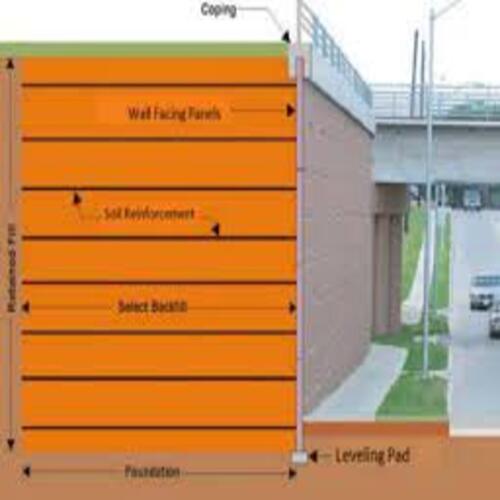
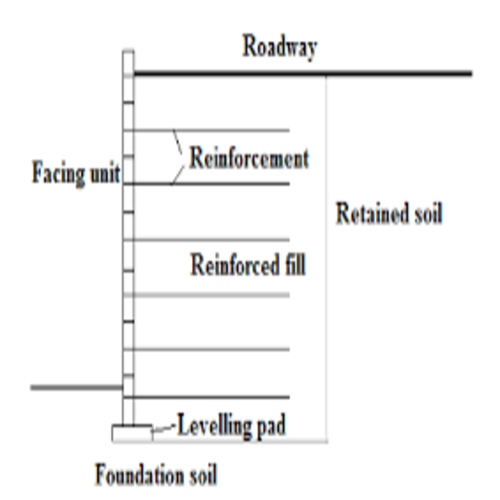
Prepared by<br />Dr. Mayadah W. Falah<br />1.1. Mechanically Stabilized Earth Components<br />The mechanically stabilized earth components consist of many components as <br />showed below (Morsy & Thakeb, 2022; Weldu et al., 2015): <br /> Soil.<br /> Geosynthetic Reinforcement (Geotextile or Geogrid).<br /> Masonry Block Facing Units.<br /> Drainage System.<br /> Leveling Pad. <br />Figure shows the components of MSE wall. <br /><br />1.2. Advantages of MSE walls<br />Advantages in terms of economy, ease of construction and rapid and speedy <br />construction with minimum disturbances to traffic and other services makes MSE <br />walls one of the most favorites and preferred retaining wall system. A variety of <br />materials and customization options in terms of design and construction made it one <br />of the most popular earth retaining system (Khan, 2014). The fascia elements, the <br />back-fill, and the reinforcing system combine to form a gravity retaining structure <br />that relies on the self-weight of the reinforced soil mass. This self-weight resists the <br />lateral pressure from the earth and the service loads, seismic loads, and hydro static <br />pressure (Lamis, n.d.; Morsy & Thakeb, 2022). The main advantages of MSE wall <br />including:<br /> They can be designed to take extremely heavy loads like bridge abutment <br />footings, crane loads, service loads, etc.<br /> MSE walls can resist seismic and dynamic forces and transfers the bearing <br />pressure to a wide area.<br /> Faster construction than conventional retaining walls.<br /> Less site preparation is required and can be constructed in confined areas <br />where other retaining walls are impossible to construct.<br /> There are no supports, finishes and curing time.<br /> The fascia walls are lightweight and are precast and conveyed to the site and <br />lifted using simple lifting equipment. These walls can be made to any height <br />and can resist unequal settlements.<br /> They can be customized to any geometry and the construction process is very <br />simple. They do not need any heavy types of machinery and specialized <br />workers.<br /> The fascia can be customized for designs and logos and gives superior and <br />elegant finished and aligned walls.<br /> Any obstructions inside the back filled areas can be managed by adjusting the <br />angle of the reinforcing elements.<br /> They possess a very good service life in extreme loading and complex <br />applications.<br />1.3. Disadvantages of MSE retaining walls.<br /> MSE retaining walls require granular material in huge quantities. Areas where <br />there is a scarcity of granular material the construction cost increase and make <br />the structure uneconomical.<br /> The corrosion of reinforcement and deterioration of geo-grids on exposed to <br />sunlight has to be addressed. The reinforced component must be designed to <br />withstand erosion and corrosion processes which can highly deteriorate the <br />mechanical behavior of the composite structure.<br /> The granular back filling enables free drainage of water through the exposed <br />panel joints and reduces hydro static pressure.<br /> A proper drainage system should be provided.<br /> The wall must obtain a minimum width in order to acquire adequate stability.<br />1.4. Applications of Mechanically Stabilized Earth Walls<br />Mechanically stabilized earth barriers may be employed in a variety of scenarios, <br />depending on the location, including (Balunaini et al., 2009; Elias et al., 2001; <br />Sankey & Soliman, 2004):<br /> Abutments for bridges.<br /> Creating storage space.<br /> At building locations with problematic soil.<br /> In regions with a lot of earthquake activity.<br /> Along the wings.<br /> As temporary buildings during road construction.<br /> Use as dams or structures for soil retention.<br /> Around oil tanks as containment structures.<br /> Walls of containment surrounding gas storage tanks.<br /> Adding height to levees and building dams increases storage capacity