Stone Mastic Asphalt (SMA)
02/04/2024 Share :
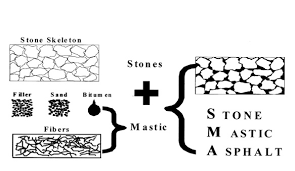
م.م احمد حسن عاشور <br />As an abstract: Stone Mastic Asphalt (SMA), also called stone matrix asphalt, was developed in Germany in the 1960s and the first SMA pavements were laid in 1968 near Kiel. It is a deformation-resistant, durable pavement material suitable for heavy traffic roads. SMA has a high content of coarse aggregates that bond to form a stone frame that is resistant to permanent deformation. The frame is filled with stone mastic of bitumen and a filler to which fibers have been added to ensure adequate stability of the bitumen and prevent binder runoff during transport and placement. A typical SMA composition consists of 70-80% coarse aggregate, 8-12% filler, 6.0-7.0% binder and 0.3% fiber. The SMA deformation resistance results from the coarse stone frame providing greater stone-to-stone contact than conventional Dense Granular Asphalt (DGA) mixes<br />➢ Production: Stone mastic asphalt The SMA is blended and<br />placed in the same unit as a conventional hot mix. In batch plants, the fiber additive is added directly to the mill using individually wrapped press bags or bulk dosing equipment. The mixing time can be increased to ensure an even distribution of the fiber throughout the mixture, and the temperature can be controlled to avoid overheating or damage to the fiber. In drum kits Care must be taken to ensure that both the additional filler content and the addition of fiber are included in the mixture without undue loss through the dust extraction system. Filling systems that add filler directly to the drum rather than filler are preferred. Granular fibers can be added using systems designed to add recycled materials<br />➢ Materials (edit): The aggregates used in SMA must be of high quality - good shape, crush resistance and suitable polishing resistance. Binders used in SMA include: Grade 320 bitumen - Used in many general applications. General Purpose Binder Used to improve performance at high traffic levels. Polymer-modified binder - increasingly used in heavy traffic conditions to provide additional rutting and flushing resistance. Cellulose fiber is the most commonly used SMA in Australia. Other types of fibers, including fiberglass, mineral wool, polyester and even natural wool, have proven to be suitable, but cellulose fiber is generally the most economical