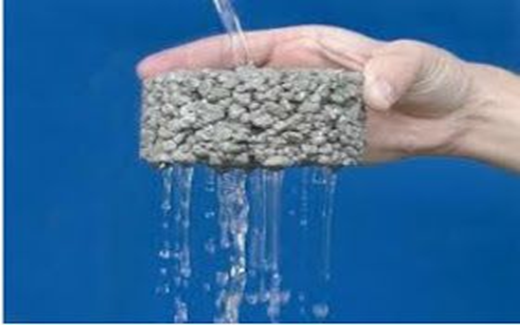
Pervious Concrete
05/04/2024 Share :
قسم هندسة تقنيات البناء والانشاءات<br />م.دعاء فلاح <br /> <br />Pervious concrete is a special type of concrete with high porosity. consisting of Portland cement, coarse aggregate, little or no fine aggregate, admixtures, and water.<br />The combination of these ingredients will produce a hardened material with connected pores ranging in size from (2 to 8 mm), that allow water to pass through easily.<br />The void content can range from 15 to 35%, with typical compressive strengths of (2.8 to 28 MPa). The drainage rate of pervious concrete will vary with aggregate size and density of the mixture.<br />ADVANTAGES<br />1- It reduces the storm water runoff.<br />2-Allows more efficient land development.<br />3- Natural runoff allows rainwater to drain directly to sub-base.<br />4- Keeps pavement surfaces dry even in wet situation, such as green houses.<br />5- Natural aeration and watering for trees and deep-rooting plants when used in landscaping.<br />6- Quality acoustical properties when used in sound barriers.<br />7- Thermal insulation when used in walls.<br />8- A textured surface that prohibits slipping or falling.<br />9- The porous concrete act as a filter for the stormwater. The dirt gets trapped into the voids, and hence only clear water reaches the stream, pond, or lake.<br />Application<br />Since pervious concrete is weaker than traditional concrete, its uses are more limited.<br />It's generally only suitable for Road pavement, Parking areas, Areas with light traffic, Residential streets, Pedestrian walkways, External Walls, Greenhouses.<br />It's not strong or durable enough to use as structural concrete for foundations<br />