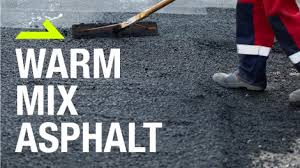
WARM MIX ASPHALT
16/04/2024 Share :
Lec. Ahmed Hassan <br />As an Abstract : Warm Mix Asphalt (WMA) technologies have potential to reduce the<br />application temperature of Hot Mix Asphalt (HMA) and improve workability without <br />compromising the performance of asphalt pavement. This promises various benefits, e.g. a <br />reduction in greenhouse gas emissions, decreased energy consumption and costs improved <br />working conditions, better compaction, extended paving season, higher reclaimed asphalt <br />content, earlier opening to traffic,<br />➢ Energy Use : One of the most significant benefits <br />of WMA is the decrease in energy use. Young<br />(2007) has approximated that for every 6 °C <br />reduction in temperature, fuel consumption is <br />reduced by 2–3%. demonstrates results of <br />thermodynamics calculation of energy<br />consumption based on production temperature <br />and another critical parameter, aggregate<br />moisture content<br />➢ Costs : The use of WMA, can result in both reductions and increases in production expenses, <br />depending on the circumstances. The calculations should be based on several important variable<br />Each specific case must be evaluated to determine if reduced energy consumption will reduce <br />the overall costs of WMA production. Different WMA technologies will require various <br />additional costs depending on the process and existing plant. Increase in costs may arise from <br /> 1-Investment and the depreciation of plant modification.<br /> 2- Costs of the additives.<br />3- Costs for technology licensing<br />➢ Foaming Technologies : Foaming technologies use small amounts of cold water introduced <br />into the hot binder or directly in the asphalt mixing chamber. This can be accomplished by<br />using foaming nozzles, by adding zeolite, or by introducing a portion of wet aggregates The <br />water rapidly evaporates and is encapsulated in the binder, producing large volume of foam <br />which slowly collapses before the binder reverts to its original characteristics The foaming<br />action in the binder temporally increases its volume and lowers its viscosity, which improves <br />coating of aggregates and enhances mix workability. In the foaming processes enough water <br />must be added to cause foaming action, without adding too much to cause stripping .The <br />properties of the foamed bitumen can be characterized by two parameters <br />1- Expansion ratio—ratio of maximum volume of foamed bitumen to the original volume of <br />bitumen.<br />2- Half-life—time measured in seconds for the foamed bitumen to subside from its maximum <br />volume to half of the maximum volume.<br />