Mechanically Stabilized Earth (MSE) Walls
02/10/2024 Share :
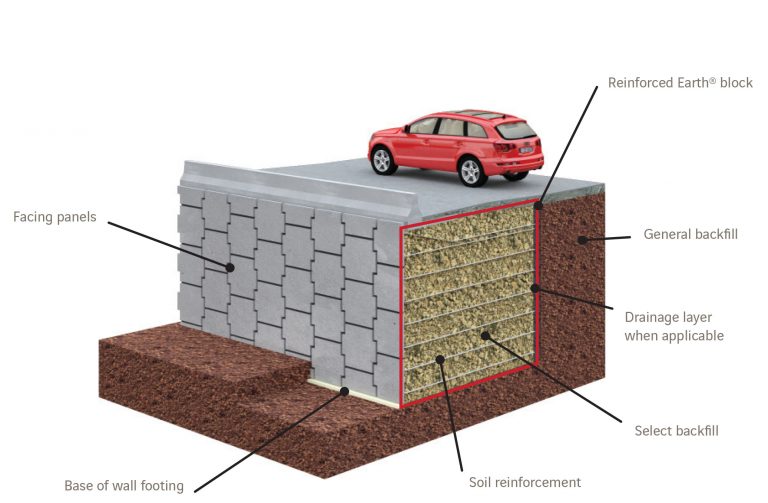
Mechanically Stabilized Earth (MSE) walls are retaining structures that use layers of reinforcements placed within compacted soil to enhance its stability and strength. They are widely used in infrastructure projects such as highways, bridges, railways, and embankments due to their flexibility, cost-effectiveness, and ability to accommodate differential settlement.<br />1. Components of an MSE Wall<br />• Backfill Material: The soil used to construct the wall, usually granular material with good drainage properties. It is placed in layers and compacted around the reinforcement.<br />• Reinforcements: These are typically made of materials such as steel strips, geotextiles, geogrids, or welded wire mesh. They provide tensile strength to the soil, allowing it to act as a coherent mass.<br />• Facing Elements: The visible part of the wall, which can be made of various materials like precast concrete panels, modular blocks, gabions, or wrapped geotextiles. The facing elements help maintain the shape of the wall and protect against erosion.<br />• Drainage System: Essential for managing water infiltration, a drainage system typically includes drainage pipes, gravel, or geosynthetic drainage mats to prevent water buildup behind the wall.<br />2. Working Principle<br />The stability of an MSE wall comes from the interaction between the soil and the reinforcement layers. As the soil tries to move or slide, the reinforcements resist this movement through friction and tension. This creates a composite structure that behaves like a single, internally reinforced mass, capable of withstanding external loads such as soil pressure, traffic, and other forces.<br />3. Advantages of MSE Walls<br />• Cost-Effective: MSE walls are generally more economical than traditional concrete retaining walls, especially for taller structures.<br />• Flexibility: They can accommodate differential settlement, making them suitable for areas with poor soil conditions or seismic activity.<br />• Ease of Construction: MSE walls are constructed using modular components, which makes them relatively easy and quick to assemble, even in challenging site conditions.<br />• Aesthetic Variety: The facing elements come in various designs, textures, and colors, allowing for customized and visually appealing structures.<br />4. Applications of MSE Walls<br />• Highway and Railway Embankments: MSE walls are commonly used to support elevated roadways and rail lines.<br />• Bridge Abutments: They provide stable support for bridge structures and allow for rapid construction with minimal disruption.<br />• Slope Stabilization: Used to stabilize steep slopes, prevent landslides, or create terraces in hilly terrains.<br />• Retaining Walls in Urban Areas: Ideal for retaining soil in tight urban spaces, where traditional retaining wall systems may not be feasible.<br />5. Design Considerations<br />• Internal Stability: Involves ensuring that the reinforcement layers provide adequate resistance to internal failure modes, such as pullout, rupture, and sliding.<br />• External Stability: Involves analyzing the overall stability of the wall against modes of failure such as overturning, sliding, bearing capacity failure, and global stability.<br />• Drainage: Proper drainage design is essential to prevent water pressure buildup behind the wall, which can compromise stability.<br />6. Common Types of MSE Walls<br />• Geosynthetic Reinforced Walls: Use geogrids or geotextiles as reinforcement, suitable for applications where corrosion resistance and flexibility are important.<br />• Metallic Reinforced Walls: Use steel strips or welded wire mesh, offering high strength and durability but may be susceptible to corrosion over time.<br />• Segmental Retaining Walls (SRWs): These are gravity walls with individual blocks interlocked, often reinforced with geogrids to increase stability.<br /><br />Challenges and Limitations<br />• Corrosion: Metallic reinforcements can be prone to corrosion, especially in aggressive soil environments, requiring protective coatings or galvanized materials.<br />• Quality of Backfill Material: The performance of an MSE wall depends heavily on the quality of the backfill material. Poor-quality backfill can lead to settlement or loss of strength.<br />• Seismic Performance: Although MSE walls can handle seismic activity better than rigid walls, they still require careful design to withstand large earthquake-induced forces.<br /><br />Conclusion<br />MSE walls provide a versatile, cost-effective, and structurally efficient solution for retaining wall applications. With proper design, construction, and maintenance, they offer a durable and adaptable option for infrastructure projects, accommodating various site conditions and requirements.<br />Dr. Mayadah W. Falah