
Laser Ablation (LA)
16/02/2021 Share :
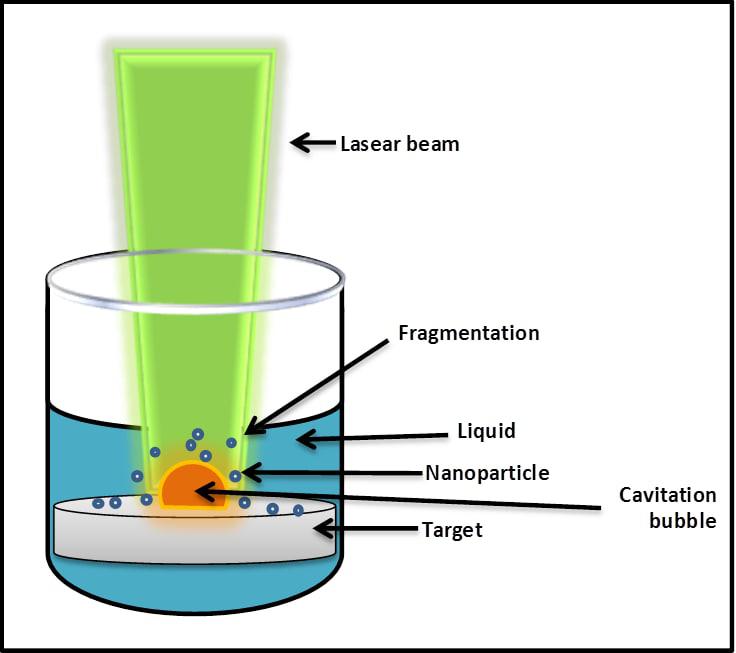
Laser ablation (LA) is the process of removing material from a solid (or occasionally liquid) surface by irradiating it with a laser beam. At low laser flux, the material is heated by the absorbed laser energy. At high laser flux, the material is typically converted to plasma. Usually, laser ablation refers to removing material with pulsed laser ablation (PLA). Nevertheless, if the laser intensity is high enough it is possible to ablate material with a continuous wave laser beam. When the reaction accrued in water or organic liquids medium the method called laser ablation in liquid (LAL) as shown in below Figure. LAL is simple and accessible. Additionally, it considered high purity and non-wasting method when it is carried out in the water. Comparing to traditional methods that require chemicals to maintain the stability of nanoparticles, LAL considered a high stability method. As well, it is a green and safe preparation method, unlike the traditional methods that produce unwanted residual chemicals which considered harmful to the environment and pollution to synthesized nanoparticles. Besides, LAL is able to produce small size nanoparticles with narrow distribution and weak agglomeration, hence it is suitable to synthesize metal nanoparticles. As for the laser ablation of solid targets in the liquid medium, it can be realized to fabricate nanostructures with different compositions (alloys, metals, carbides, oxides, hydroxides, etc.) and morphologies (nanorods, nanoparticles, nanocomposites, nanotubes, etc.).<br />In another hand, the post-laser irradiation of suspended nanomaterials can be applied to further modification for their size, shape, and composition. Such fabrication and modification of nanomaterials by laser irradiation in liquid media has become a fast-growing field compared to other usual chemical methods. Nowadays, the LAL has been developed to prepare a series of nanomaterials with special morphologies, microstructures, and phases. It is used as a one-step formation of different functionalized nanostructures to obtain novel properties and applications in optics, display, detection, and biological fields