Hormesis in Medical Physiology
27/11/2024 Share :
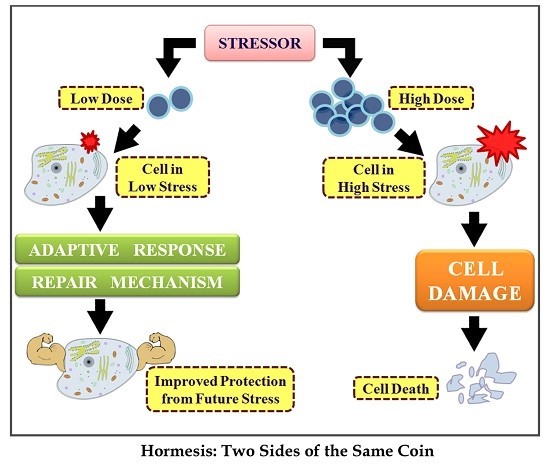
Hormesis in medical physiology refers to the adaptive responses of cells and organisms to low doses of stressors, which can enhance resilience and promote health. This phenomenon is underpinned by various molecular mechanisms that facilitate beneficial effects from initially harmful stimuli. The following sections outline key aspects of these mechanisms.<br />Stress-Responsive Signaling Pathways<br />Hormesis activates stress-responsive pathways that enhance cellular fitness, such as those involved in neuroplasticity and neuroprotection (Mattson & Leak, 2024). Low doses of stressors can stimulate antioxidant enzyme production, counteracting oxidative damage and promoting cellular health (Meiliana & Wijaya, 2020).<br />Molecular Interactions<br />Hormetic responses often involve protein interactions, where low doses of a competitor enhance the binding of substrates to protein homo-multimers, leading to beneficial outcomes (Greenwood et al., 2022). For example, the interaction of proliferating cell nuclear antigen (PCNA) with uracil DNA glycosylase illustrates this mechanism (Greenwood et al., 2022).<br />Autophagy and Cellular Maintenance<br />Autophagy plays a crucial role in hormesis by degrading damaged cellular components, thus promoting survival under stress (Moore, 2020). The mechanistic target of rapamycin (mTOR) pathway regulates autophagy, and its inhibition can trigger hormetic responses beneficial for treating diseases (Moore , 2020). While hormesis generally promotes health, excessive or inappropriate stress exposure can lead to detrimental effects, highlighting the delicate balance required for optimal physiological responses (Stephen & Bondy.2023).<br /> <br />Witten by: <br />Assistant Professor Dr. Aqeel Handil Al Jothery (PhD UK, Physiology)<br />Anesthesia Techniques Department, College of Health and Medical Technologies, Al Mustaqbal University, Hilla, Iraq<br /><br />Bibliography <br />Mark, P., Mattson., Rehana, K., Leak. (2024). The hormesis principle of neuroplasticity and neuroprotection.. Cell Metabolism, doi: 10.1016/j.cmet.2023.12.022<br />Anna, Meiliana., Andi, Wijaya. (2020). Hormesis in Health and Disease: Molecular Mechanisms. The Indonesian Biomedical Journal, doi: 10.18585/INABJ.V12I4.1315<br />Sharon, N., Greenwood., Regina, G., Belz., Brian, P., Weiser. (2022). A Conserved Mechanism for Hormesis in Molecular Systems. Dose-response, doi: 10.1177/15593258221109335<br />Michael, N, Moore. (2020). Lysosomes, Autophagy, and Hormesis in Cell Physiology, Pathology, and Age-Related Disease. Dose-response, doi: 10.1177/1559325820934227<br />Stephen, C., Bondy. (2023). The Hormesis Concept: Strengths and Shortcomings. Biomolecules, doi: 10.3390/biom13101512<br /><br /><br />