Oxidative Stress and Aging
26/11/2024 Share :
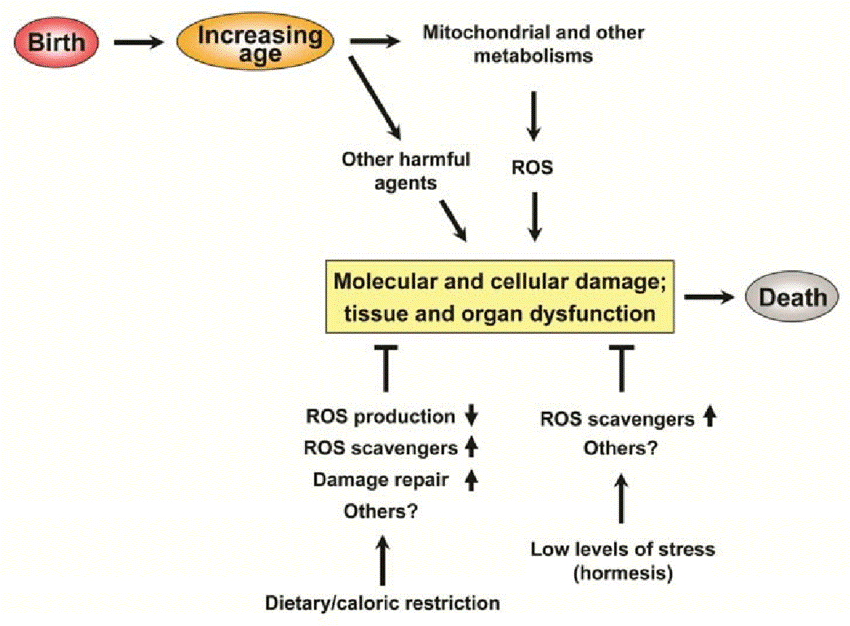
The oxidative stress theory suggested that the generation of free radicals is positively correlated with rate of O2 consumption (metabolic rate), and that damage caused by these radicals accumulates with age, hence causing cell death (Harman, 1956; John R Speakman & Selman, 2011). Many studies performed on birds are consistent with this idea (Alonso-Alvarez et al., 2004; De Block & Stoks, 2008; Wiersma & Verhulst, 2005). However, the experiments performed on mammals demonstrated that the relationship between metabolic rate and mitochondrial ROS production is not straightforward (Barja & Herrero, 2000; Judge et al., 2005; Sanz et al., 2005; Selman et al., 2008; Venditti, Masullo, & Meo, 1999; Wiersma, Selman, Speakman, & Verhulst, 2004).<br />Most free radicals are produced in mitochondria during the oxidative phosphorylation process. However, production of such radicals was found to be driven by the mitochondrial inner membrane potential gradient ((Brand, 2000). The higher the metabolic rate is, the lower the inner potential membrane gradient would be. A lower membrane potential can also be induced directly by activation of uncoupling proteins and other mitochondrial proteins (e.g. adenine nucleotide translocate); enabling protons to be transported back to the mitochondrial matrix without ATP being produced (John R Speakman & Garratt, 2013). <br /><br /><br /><br /><br /><br /><br /><br /><br /><br /><br /><br />Oxidative stress and Aging<br />Witten by: <br />Assistant Professor Dr. Aqeel Handil Al Jothery (PhD UK, Physiology)<br />Anesthesia Techniques Department, College of Health and Medical Technologies, Al Mustaqbal University, Hilla, Iraq<br /><br /><br />References,<br />Alonso-Alvarez, C., Bertrand, S., Devevey, G., Prost, J., Faivre, B., & Sorci, G. (2004). Increased susceptibility to oxidative stress as a proximate cost of reproduction. Ecology Letters, 7, 363–368. http://doi.org/10.1111/j.1461- 0248.2004.00594.x <br />Barja, G., & Herrero, A. (2000). Oxidative damage to mitochondrial DNA is inversely related to maximum life span in the heart and brain of mammals. FASEB Journal, 14, 312–318. Retrieved from http://www.ncbi.nlm.nih.gov/pubmed/10657987 <br />Brand, M. D. (2000). Uncoupling to survive? The role of mitochondrial inefficiency in ageing. Experimental Gerontology, 35, 811–820. Retrieved from http://www.ncbi.nlm.nih.gov/pubmed/11053672<br /> Caldeira da Silva, C. C., Cerqueira, F. M., Barbosa, L. F., Medeiros, M. H. G., & Kowaltowski, A. J. (2008). Mild mitochondrial uncoupling in mice affects energy metabolism, redox balance and longevity. Aging Cell, 7, 552–560. http://doi.org/10.1111/j.1474-9726.2008.00407.x<br />De Block, M., & Stoks, R. (2008). Compensatory growth and oxidative stress in a damselfly. Proceedings. Biological Sciences / The Royal Society, 275, 781–785. http://doi.org/10.1098/rspb.2007.1515<br /> Furness, L. J., & Speakman, J. R. (2008). Energetics and longevity in birds. Age, 30, 75–87. http://doi.org/10.1007/s11357-008-9054-3<br /> Harman, D. (1956). Ageing: a theory based on free radical and radiation chemistry. The Journal of Gerontology, 11, 298–300. <br />Judge, S., Jang, Y. M., Smith, A., Selman, C., Phillips, T., Speakman, J. R., … Sel-, C. (2005). Exercise by lifelong voluntary wheel running reduces subsarcolemmal and interfibrillar mitochondrial hydrogen peroxide production in the heart. American Journal of Physiology Regulatory Integrative and Comparative Physiology, 289, 1564–1572. http://doi.org/10.1152/ajpregu.00396.2005.<br /> Keipert, S., Voigt, A., & Klaus, S. (2011). Dietary effects on body composition, glucose metabolism, and longevity are modulated by skeletal muscle mitochondrial uncoupling in mice. Aging Cell, 10, 122–136. http://doi.org/10.1111/j.1474-9726.2010.00648.x <br />Lemon, W., & Barth RH Jr. (1992). The effects of feeding rate on reproductive success in the zebra finch, Taeniopygia guttata. Animal Behaviour, 44, 851–857.<br />Speakman, J. R. (2005). Correlations between physiology and lifespan--two widely ignored problems with comparative studies. Aging Cell, 4, 167–175. http://doi.org/10.1111/j.1474-9726.2005.00162.x <br />Speakman, J. R., Ergon, T., Cavanagh, R., Reid, K., Scantlebury, D. M., & Lambin, X. (2003). Resting and daily energy expenditures of free-living field voles are positively correlated but reflect extrinsic rather than intrinsic effects. Proceedings of the National Academy of Sciences of the United States of America, 100, 14057–14062. http://doi.org/10.1073/pnas.2235671100<br /> Speakman, J. R., & Garratt, M. (2013). Oxidative stress as a cost of reproduction: beyond the simplistic trade-off model. BioEssays, 36, 93–106. http://doi.org/10.1002/bies.201300108<br /> Speakman, J. R., & Selman, C. (2011). The free-radical damage theory: Accumulating evidence against a simple link of oxidative stress to ageing and lifespan. BioEssays, 33, 255–259. http://doi.org/10.1002/bies.201000132 <br />Wiersma, P., Selman, C., Speakman, J. R., & Verhulst, S. (2004). Birds sacrifice oxidative protection for reproduction. Proc R Soc Lond B Biol Sci., 271 Suppl, S360–S363. http://doi.org/10.1098/rsbl.2004.0171<br />