(Rickets )
27/11/2024 Share :
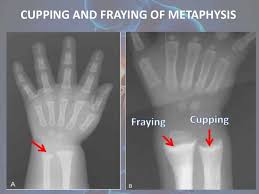
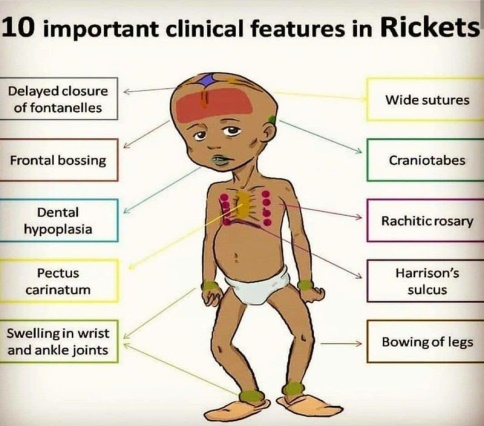
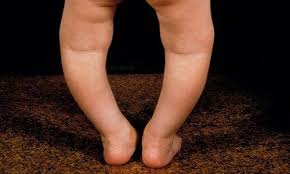
Rickets<br /> is the softening and weakening of bones in children, usually because of an extreme and prolonged vitamin D deficiency. Rare inherited problems also can cause rickets. Vitamin D helps your child's body absorb calcium and phosphorus from food<br />. Vitamin D largely comes from exposing the skin to sunlight, but it's also found in some foods, such as oily fish and eggs.<br />Rickets is different from osteomalacia, which is a similar condition seen in adults. The difference between the two is that rickets happens only in children because their bones are still growing, which causes the classic symptom of bowed or bent bones. Adults’ bones have already finished growing and they don’t have this symptom (unless they had untreated rickets as a child).<br />Risk factors for rickets include the following:<br />1-Age<br />Rickets is most common in children who are between 6 and 36 months old. During this time period, children usually experience rapid growth. This is when their bodies need the most calcium and phosphate to strengthen and develop their bones.<br />2-Diet<br />You have a higher risk of developing rickets if you eat a vegetarian diet that doesn’t include fish, eggs, or milk. You’re also at an increased risk if you have trouble digesting milk or have an allergy to milk sugar (lactose). Infants who are only fed breast milk can become deficient in vitamin D as well. Breast milk doesn’t contain enough vitamin D to prevent rickets.<br />3-Skin color<br />Children of African, Pacific Islander, and Middle Eastern descent are at the highest risk for rickets because they have dark skin. Dark skin doesn’t react as strongly to sunlight as lighter skin does, so it produces less vitamin D.<br />4-Geographic location<br />Our bodies produce more vitamin D when they’re exposed to sunshine, so you’re more at risk for rickets if you live in an area with little sunlight. You’re also at a higher risk if you work indoors during daylight hours.<br />5-Genes<br />One form of rickets can be inherited. This means that the disorder is passed down through your genes. This type of rickets, called hereditary rickets, prevents your kidneys from absorbing phosphate.<br />. This involves the removal of a very small section of bone, which will be sent to a laboratory for analysis.<br />6-Children are born to women with a vitamin D deficiency<br />7-Children never go outside without sunscreen<br />8-Children are with disorders of the intestine, liver or kidneys that prevent the body from absorbing vitamin D or converting it into its active form<br />9- Children are with disorders that reduce digestion or absorption of fats, as vitamin D is a fat-soluble vitamin<br />10-premature birth. Babies born before their due dates tend have lower levels of vitamin D because they had less time to receive the vitamin from their mothers in the womb-<br />11-Medications. Certain types of anti-seizure medications and antiretroviral medications, used to treat HIV infections, appear to interfere with the body's ability to use vitamin D11-<br />The role of vitamin D<br />Our body needs vitamin D to help it absorb calcium and phosphorus. These minerals are essential for the growth and development of strong, healthy bones. Lack of vitamin D reduces the body’s ability to control the levels of these vital minerals and increases a child’s risk of developing rickets.<br />About 90 per cent of our vitamin D comes from exposure to the sun. When direct sunlight hits our skin, the ultraviolet radiation converts a skin substance called 7-dehydrochlestrol into vitamin D. There are also very small amounts of vitamin D in some foods. However, food<br /> sources alone are usually not enough to maintain the levels of vitamin D that our body needs. <br />Once vitamin D is made in the skin or absorbed from food through the intestine, it is changed into its active form – a hormone – by the liver and kidneys. It is then available to help our body build strong bones and teeth, through the process of ‘mineralisation’.<br />Symptoms Of Rickets<br />1-Reduced growth and short height 2- pathological fracture in bones 3- softening of bones 4- pain in the bones of arms ,legs ,and spin 5- Deformities in teeth(delayed dental eruption and defective of enamel )<br />6-Deformities in the skeleton like bowlegs( tibial bowing due to widening of the tibial physes and protruding breastbone.(rachitic chest) enlargement of costochondral junction 7-Delay in walking and waddling walking <br />Radiographs:-AP and lateral view for affected bone <br />1- physeal widening 2- metaphyseal cupping 3-decreased bone density 4- looser s zone<br />5- pseudo fracture on the compression side of bone 6- rachitic rosary 7-codfish vertebra<br />8- prominence of rib heads of costochondral junction 9-lower extremity bowing (genu varus) 10- cat back ( dorsal kyphosis)<br />Diagnosis<br />1- physical examination. They will check for tenderness or pain in the bones by lightly pressing on them and weakness of the muscles .<br />2- blood tests to measure the levels of calcium ,phosphate and parathyroid hormone in the blood<br />3-bone X-rays to check for bone deformities 4- bone scan 5- bone biopsy <br /> Treatment of rickets<br />1-improved sunlight exposure 2-Improved diet with calcium and vitamin D <br />3-oral vitamin D supplements – these may need to be taken for about 3 months<br />4-special forms of vitamin D supplements – for people whose bodies can’t convert vitamin D into its active form<br />5-If the child has a rare inherited disorder that causes low amounts of phosphorus, supplements and may be prescribed<br />6-treatment for any underlying disorder 7-For some cases of bowleg or spinal deformities, A doctor might suggest special bracing to position your child's body appropriately as the bones 8-surgery to correct more- sever skeletal deformities<br /> Child's doctor will medication monitor child's progress with X-rays and blood tests.<br />د. طالب جيجان