
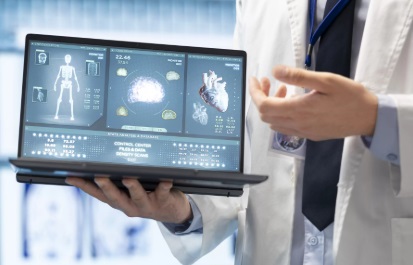
AI Services for Radiologists: Transforming Modern Medical Imaging. by Haider Abdul Karim Majeed
29/11/2024 Share :
Artificial Intelligence (AI) has become a cornerstone in the evolution of<br />healthcare, particularly in radiology. By analyzing medical images with<br />unprecedented speed and accuracy, AI complements the expertise of<br />radiologists, allowing them to provide faster and more accurate diagnoses. Its<br />applications are vast, from disease detection to workflow optimization, making<br />AI an indispensable partner in modern medical imaging.<br />Key AI Capabilities in Radiology<br />1. Image Analysis<br />AI algorithms excel at identifying patterns and anomalies in medical<br />images. For example, deep learning systems can detect<br />microcalcifications in mammograms, fractures in bone X-rays, or even<br />early-stage lung nodules that may indicate cancer.<br />2. Data Integration and Insights<br />AI can combine imaging data with electronic health records (EHRs) to<br />provide a comprehensive view of a patient’s condition. This integration<br />aids radiologists in offering more holistic diagnostic insights.<br />3. Real-time Diagnostics<br />In emergency settings, such as trauma or stroke units, AI-powered tools<br />can provide instant analyses of critical imaging studies, ensuring that<br />patients receive immediate attention.<br />4. Predictive Analytics<br />By identifying subtle changes over time, AI helps predict disease<br />progression, aiding in preventative care and treatment planning.<br />5. Automated Reporting<br />AI systems can generate preliminary reports based on imaging findings,<br />saving radiologists time while ensuring standardized documentation.<br />Benefits of AI Integration for Radiologists<br />1. Enhanced Efficiency<br />Routine tasks such as measuring lesion sizes, tracking tumor progression,<br />or comparing historical images can be automated by AI, reducing the<br />workload of radiologists.<br />2. Error Reduction<br />Fatigue and human error are common challenges in radiology. AI<br />provides a consistent and objective second opinion, reducing the chances<br />of misdiagnosis.<br />3. Access to Remote Areas<br />AI-powered tools bridge the gap in regions with limited access to skilled<br />radiologists. Cloud-based AI platforms enable remote diagnostics,<br />bringing expert analysis to underserved areas.<br />4. Improved Patient Outcomes<br />Faster diagnosis and more accurate treatment recommendations lead to<br />better patient outcomes, reduced hospital stays, and optimized use of<br />resources.<br />5. Scalable Solutions<br />AI can handle large volumes of imaging data, making it ideal for largescale public health screenings, such as tuberculosis or breast cancer<br />detection programs.<br />Examples of AI Systems in Radiology<br />1. Chest X-ray Analysis<br />AI models such as CheXNet and similar tools have been trained to detect<br />conditions like pneumonia, tuberculosis, and even COVID-19-related<br />lung abnormalities.<br />2. Oncology Support<br />AI-powered software, such as IBM Watson Health or PathAI, assists in<br />detecting cancerous lesions, tracking tumor growth, and predicting<br />treatment responses.<br />3. Fracture Detection Systems<br />Applications like Aidoc and Zebra Medical Vision are capable of<br />detecting subtle fractures or bone lesions, helping in orthopedic<br />diagnostics.<br />4. Stroke Detection<br />AI tools can identify ischemic or hemorrhagic strokes in CT scans within<br />minutes, significantly improving time-sensitive interventions.<br />5. Mammography Interpretation<br />AI solutions like iCAD’s ProFound AI support breast cancer screening by<br />identifying suspicious areas in mammograms with high sensitivity.<br />Challenges in AI Adoption in Radiology<br />While AI has demonstrated its immense potential, several challenges remain:<br />1. Data Bias and Quality<br />AI models require training on diverse datasets to ensure equitable and<br />accurate performance across all demographic groups. A lack of diversity<br />in data can lead to biased results.<br />2. Integration with Clinical Workflow<br />For AI to be effective, it must integrate seamlessly into radiologists’<br />existing systems without disrupting workflows or causing delays.<br />3. Interpretability and Trust<br />Radiologists must understand how AI reaches its conclusions. Black-box<br />algorithms, which lack transparency, may face resistance from healthcare<br />professionals.<br />4. Regulatory Hurdles<br />AI tools must undergo rigorous testing and approval by regulatory bodies<br />like the FDA or EMA to ensure their safety and reliability.<br />5. Cost and Infrastructure<br />The implementation of AI systems requires significant investment in<br />software, hardware, and training, which may not be feasible for all<br />institutions.<br />The Evolving Role of Radiologists in the AI Era<br />Rather than replacing radiologists, AI is reshaping their role. Radiologists are<br />transitioning from image interpreters to data managers and decision-makers. AI<br />handles routine analyses, while radiologists focus on complex cases, patient<br />interaction, and multidisciplinary collaboration.<br />Additionally, radiologists are increasingly involved in the development and<br />validation of AI models, ensuring these tools meet clinical needs and standards.<br />Future Prospects<br />The future of AI in radiology is bright and holds promising advancements:<br />• Integration with Wearable Devices: AI could analyze data from<br />wearable health monitors alongside imaging studies, offering real-time<br />health insights.<br /> Personalized Medicine: AI might enable tailored treatment plans by<br />correlating imaging findings with genetic and molecular data.<br /> Enhanced Collaboration: AI could facilitate better communication<br />between radiologists and other specialists by providing shared platforms<br />for analyzing and discussing cases.<br />Conclusion<br />AI is not merely a tool but a transformative force in radiology. By enhancing<br />accuracy, efficiency, and accessibility, AI empowers radiologists to deliver<br />higher-quality care. While challenges exist, ongoing advancements and<br />collaborations between radiologists and AI developers will continue to refine<br />these systems, ensuring they become an integral part of modern healthcare.<br />