A scientific article by the teaching assistant (Hanin Hani) entitled "How are nebulae formed?"
26/01/2025 Share :
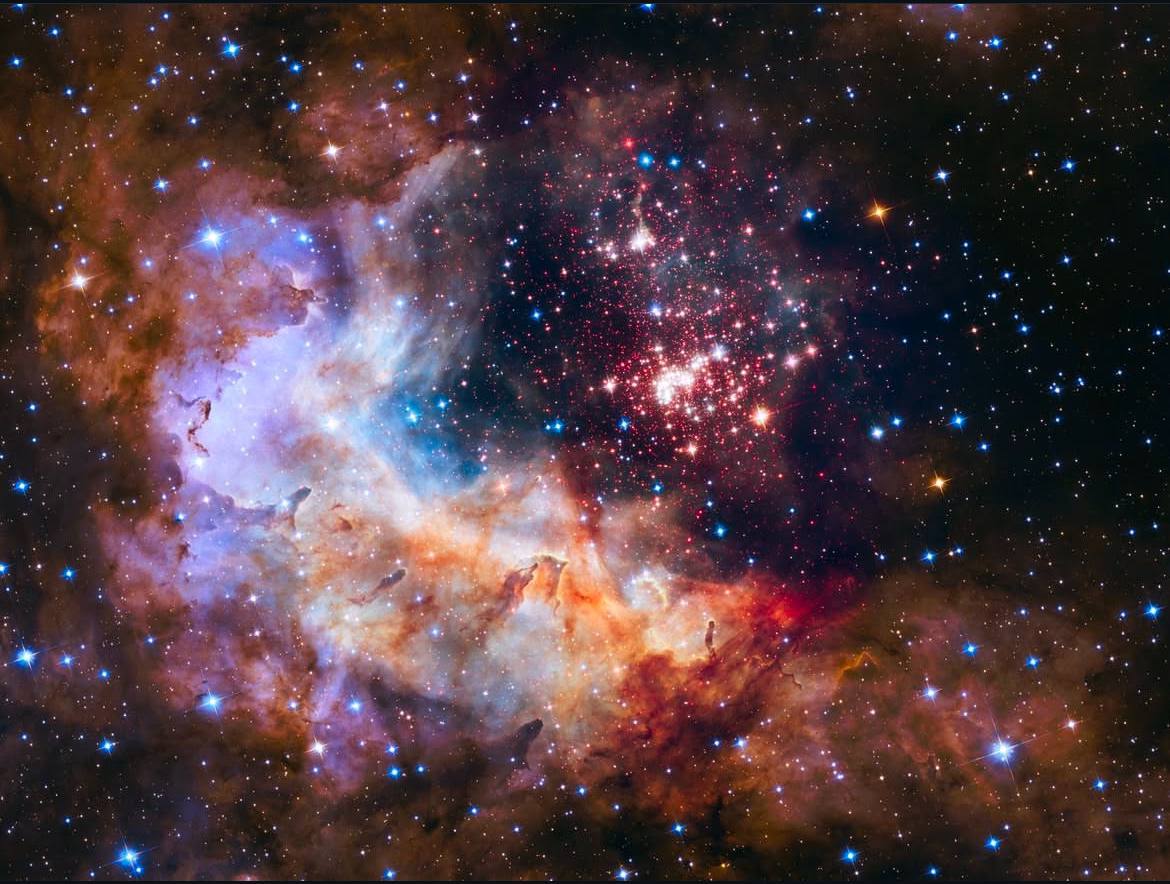
Introduction<br /><br />Nebulae are among the most beautiful and awe-inspiring phenomena that can be seen in space. They are known as massive clouds of gas and dust that spread throughout the space between stars. Some nebulae are considered stellar nurseries, where stars are born, while others are remnants of massive stellar explosions. Nebulae play a vital role in the life cycle of stars and galaxies, making them an essential component for understanding the evolution of the universe.<br /><br />Definition of Nebulae<br /><br />Nebulae are massive collections of gas (mostly hydrogen and helium) and cosmic dust. Their sizes range from a few light-years to hundreds of light-years, and they sometimes glow due to the nearby stars or radiation emitted from within them.<br /><br />Types of Nebulae and How They Form<br /> 1. Dark Nebulae<br /> • How do they form?<br />They are made up of dense clouds of gas and cosmic dust. These nebulae block the light coming from stars or objects behind them, making them appear dark.<br /> • Examples: Horsehead Nebula.<br /> 2. Reflective Nebulae<br /> • How do they form?<br />They reflect the light of nearby stars, without emitting any light of their own.<br /> • Examples: Pleiades Nebula.<br /> 3. Luminous (Emission) Nebulae<br /> • How do they form?<br />They contain ionized gases (mostly hydrogen) that glow due to radiation emitted from nearby hot stars.<br /> • Examples: Orion Nebula.<br /> 4. Planetary Nebulae<br /> • How do they form?<br />These nebulae form when a star of medium mass (like the Sun) explodes at the end of its life, leaving behind a glowing gas shell around a small dense core known as a white dwarf.<br /> • Examples: Ring Nebula.<br /> 5. Supernova Remnant Nebulae<br /> • How do they form?<br />These nebulae are produced by massive stellar explosions known as supernovae, where stellar material is expelled into space.<br /> • Examples: Crab Nebula.<br /><br />Basic Stages of Nebula Formation<br /> 1. Gathering of Gas and Dust:<br />Nebulae begin when large amounts of gas and dust accumulate due to gravity.<br /> 2. Ionization or Reflection:<br />If there are nearby stars, their radiation may ionize the gas or reflect light onto the nebula, making it visible.<br /> 3. Star Formation:<br /> • In dense nebulae, the gas may begin to collapse under gravity, leading to the birth of new stars.<br /> • These regions are known as “stellar nurseries.”<br /><br />Importance of Nebulae in the Universe<br /> 1. Star Factories:<br />Nebulae are fundamental regions for star and planet formation.<br /> 2. Cosmic Material Cycle:<br />Nebulae help recycle cosmic materials from old stars to new ones.<br /> 3. Enriching the Universe with Heavy Elements:<br />Nebulae are the result of stellar explosions that spread heavy elements (like carbon and oxygen) across space.<br /><br />Conclusion<br /><br />Nebulae are cosmic wonders that combine both beauty and essential functions in the life cycle of stars. Through them, we can gain a deeper understanding of the universe and its history, as they tell us about the birth and death of stars.