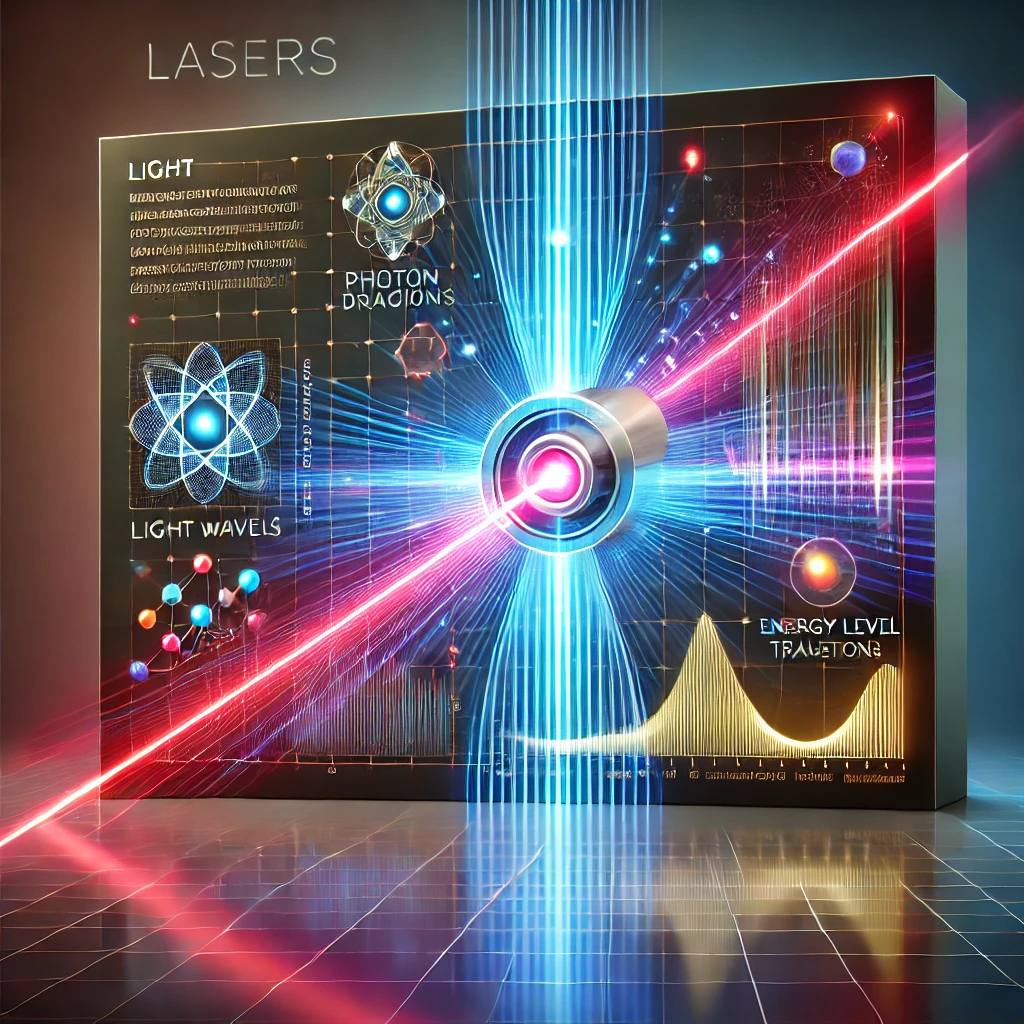
A scientific article by the assistant professor (Mohammed Abdel Zahra) entitled "How the laser works: A journey from theoretical physics to technology"
01/02/2025 Share :
Lasers are a fascinating invention based on precise physical principles, revolutionizing numerous fields, from communications and medicine to industry and scientific research. In this article, we’ll take you on a journey to understand how lasers work, starting with the theoretical basics and progressing to their practical applications.<br /><br />The Physics Behind Lasers<br /><br />The word “laser” stands for Light Amplification by Stimulated Emission of Radiation. To understand how lasers function, we need to explore three key concepts:<br /><br />Stimulated Emission:<br /><br />In 1917, Albert Einstein proposed the concept of stimulated emission, where photons (particles of light) are emitted when certain atoms or molecules are stimulated.<br /> • When a photon passes through an excited atom, it can trigger the release of another photon with the same wavelength and direction, leading to the amplification of light.<br /><br />Energy Levels:<br /><br />Atoms have discrete energy levels. When an atom absorbs energy (from light, heat, or electricity), its electrons jump to higher energy states.<br /> • In lasers, atoms are stimulated to remain in high-energy states for a short time before releasing identical photons.<br /><br />Population Inversion:<br /><br />To achieve laser action, more atoms must be in an excited state than in their lower-energy state. This is achieved through a process called pumping.<br /><br />Components of a Laser<br /><br />A laser device consists of several essential components:<br /><br />Laser Medium:<br /> • This is the material that emits photons. It can be a solid (e.g., ruby), liquid, or gas (e.g., carbon dioxide).<br /><br />Pump Source:<br /> • Provides the energy needed to excite the atoms. This can be light, an electric current, or a chemical reaction.<br /><br />Mirrors:<br /> • Two mirrors are placed on either end of the laser medium: one is fully reflective, and the other is partially transparent.<br /> • These mirrors reflect light back and forth to amplify the photons.<br /><br />Output Coupler:<br /> • The partially transparent mirror allows some of the amplified light to escape as a focused laser beam.<br /><br />How a Laser Works<br /> 1. Pumping:<br />Energy is supplied to the laser medium, raising atoms to higher energy levels.<br /> 2. Spontaneous Emission:<br />Some atoms return to lower energy states, releasing photons randomly.<br /> 3. Stimulated Emission:<br />The emitted photons stimulate other excited atoms to release identical photons, amplifying the light.<br /> 4. Amplification and Reflection:<br />The photons bounce between the mirrors, becoming more concentrated with each pass.<br /> 5. Emission:<br />A portion of the light escapes through the partially transparent mirror as a focused laser beam.<br /><br />Characteristics of Laser Beams<br /> 1. Monochromatic:<br />A laser beam consists of a single wavelength or color, making it distinct from ordinary light.<br /> 2. Directional:<br />Laser beams travel in a straight line in one direction with minimal spread.<br /> 3. Coherent:<br />The photons in a laser beam are in phase, moving uniformly.<br /> 4. High Intensity:<br />The concentrated energy makes lasers much more powerful than ordinary light.<br /><br />Applications of Lasers<br /><br />Medicine:<br /> • Eye surgeries (vision correction), hair removal, and cancer treatments.<br /><br />Industry:<br /> • Cutting, welding, and engraving metals and other materials.<br /><br />Communications:<br /> • Optical fibers rely on lasers for high-speed data transmission.<br /><br />Scientific Research:<br /> • Used in precision studies, such as interference and diffraction experiments.<br /><br />Everyday Devices:<br /> • CD/DVD players, laser printers, and distance-measuring tools.<br /><br />Conclusion<br /><br />The laser is one of the greatest innovations of the 20th century, combining theoretical physics with practical technology. Understanding how lasers work allows us to appreciate their significant role in our daily lives and their contribution to scientific and industrial progress. Thanks to lasers, the future looks brighter—and more focused.