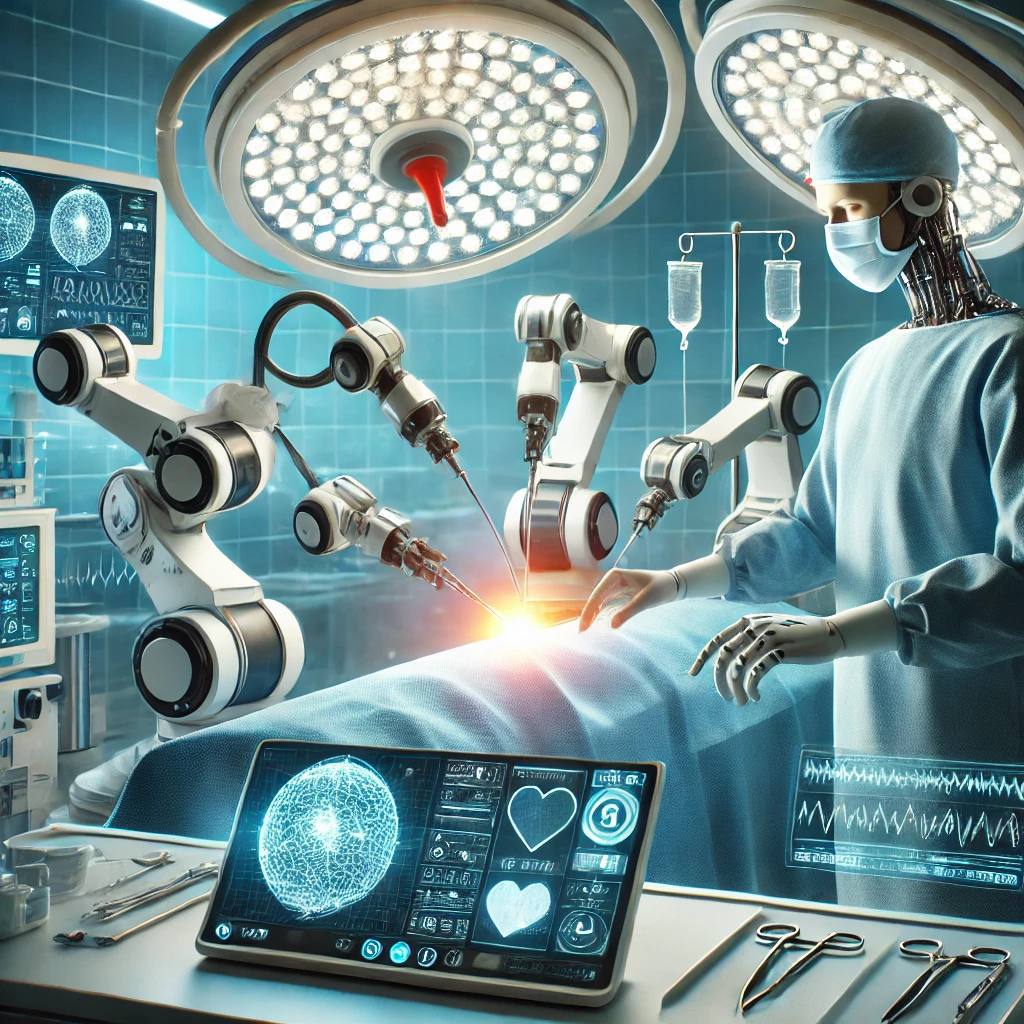
A scientific article by the teaching assistant (Zahraa Bassem) entitled "Robots in Medicine: Precise Surgeries with a Robotic Hand"
01/02/2025 Share :
Robotics in Medicine: Precise Surgeries with a Robotic Hand<br /><br />The technological development in the modern era has led to a revolution in the field of medicine, and one of its most notable achievements was the use of robots in surgical operations. This advanced technology has become a vital tool used to perform precise and complex surgeries, improving the quality of health care and reducing the risks associated with traditional surgery.<br /><br />What is robotic surgery?<br /><br />Robotic surgery is a modern technology in which advanced robotic systems are used to help surgeons perform surgeries with high precision. The human hand controls the robot through a control unit, while the robot performs movements with extreme precision, exceeding the capabilities of the human hand.<br /><br />How does robotic surgery work?<br /><br />Robotic surgery relies on an advanced system consisting of:<br />1. Control unit: The surgeon sits in front of a control unit equipped with 3D screens to see the internal organs clearly.<br />2. Robotic arms: The arms are connected to small and precise surgical tools that can reach narrow places.<br />3. 3D camera: Provides a magnified and high-resolution view of the surgical area.<br /><br />The most important uses of robots in medicine<br /><br />1. Cardiac surgery:<br />• Robots are used in operations such as heart valve repair, as these surgeries require great precision and reduced risks.<br /><br />2. Cancer surgery:<br />• Robotic surgery is an ideal option for removing cancerous tumors, especially in sensitive areas such as the prostate and kidneys.<br /><br />3. Orthopedic surgery:<br />• Robots are used to guide tools precisely during joint replacement or correct bone deformities.<br /><br />4. Neurosurgery:<br />• They are used to remove tumors from the brain, as robots can work with micrometric precision that reduces damage to healthy tissue.<br /><br />5. Digestive surgery:<br />• Such as gallbladder removal or hernia repair, as robots facilitate access to internal organs without large surgical incisions.<br /><br />Benefits of robotic surgery<br />1. High accuracy:<br />• Robots are able to make very precise movements, which reduces the risk of surgical errors.<br /><br />2. Reduced pain and scarring:<br />• Thanks to the small incisions, patients suffer less pain and are left with small scars compared to traditional surgery.<br />3. Shorter recovery period:<br />• Robotic surgery reduces tissue damage, which speeds up the recovery process.<br /><br />4. Reduced risk of infection:<br />• Small incisions reduce the risk of infection during and after surgery.<br /><br />Challenges associated with the use of robots in medicine<br />1. High cost:<br />• Robotic surgery systems are expensive, making them not available in all hospitals.<br />2. Requirement for intensive training:<br />• The use of robots requires advanced skills and long training for surgeons.<br />3. Technical failures:<br />• Although rare, technical failures may occur during surgery, which causes additional challenges.<br />4. Over-reliance on technology:<br />• May lead to a reduction in surgeons’ skills in traditional operations.<br /><br />Future prospects for robotics in medicine<br />1. Autonomous surgery:<br />• Researchers are working to develop robotic systems capable of performing operations independently without human intervention.<br />2. Artificial intelligence:<br />• It will help improve the accuracy of robots by analyzing medical data during surgery.<br />3. Nanorobot Technologies:<br />• The future of surgery may include very small robots used to access precise locations within the body and perform repairs at the cellular level.<br />4. Expansion in medical specialties:<br />• Over time, robots will become part of most medical specialties, from cosmetic surgery to the treatment of chronic diseases.<br /><br />Conclusion<br /><br />Medical robots have become one of the pillars of modern medicine, contributing to improving the accuracy of surgical operations and reducing risks to patients. With the continuous developments in this field, medicine is expected to become more efficient and comprehensive, making robots an indispensable partner in our journey towards improving healthcare.