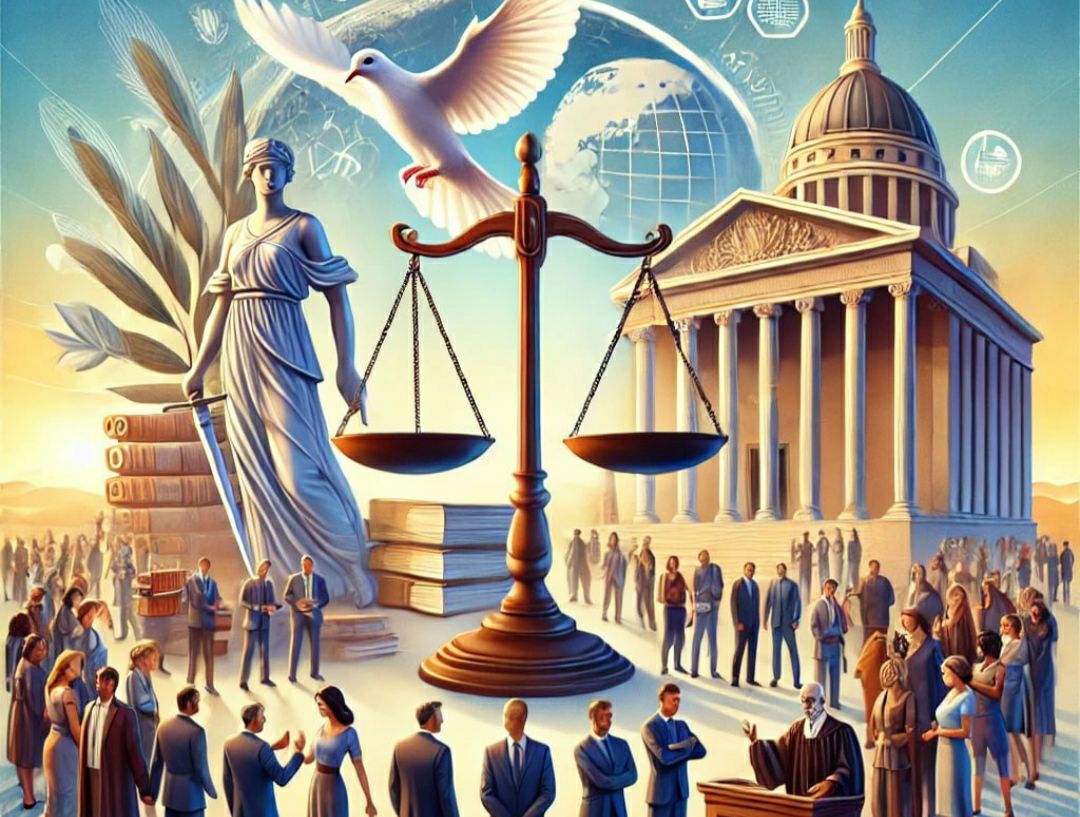
The article titled "Goal 16 of the Sustainable Development Goals: Peace, Justice, and Strong Institutions for a Sustainable Future" by Professor Hassanine Alaa Mohammed Yasari.
08/02/2025 Share :
The Sustainable Development Goals (SDGs) launched by the United Nations in 2015 serve as a global roadmap to achieve a more sustainable and just future by 2030. Peace and justice are among the key pillars of sustainable development, as progress and prosperity in societies cannot be achieved without fair systems and strong institutions that protect rights and freedoms. Despite global advancements in human rights, wars, conflicts, and corruption continue to hinder the progress of many countries. So, how can we achieve a peaceful and just society where everyone enjoys equal rights without fear of discrimination or injustice? For this reason, the United Nations has dedicated Goal 16 within the 2030 Agenda for Sustainable Development, which aims to promote peace, end violence, ensure justice, and combat corruption to build safer and more stable communities.<br /><br />What is the goal of peace, justice, and strong institutions?<br /><br />Goal 16 focuses on promoting peaceful and inclusive societies by ensuring justice, fighting corruption, promoting human rights, and building strong and transparent institutions.<br /><br />Key aspects of peace, justice, and strong institutions:<br /><br />Reducing all forms of violence and combating organized crime.<br />Protecting children from exploitation and abuse.<br />Strengthening the rule of law and ensuring access to justice for all.<br />Combating corruption and bribery in public and private institutions.<br />Ensuring freedom of expression, press freedom, and protecting journalists.<br />Promoting transparency and accountability in government institutions.<br />Ensuring legal registration of all individuals (e.g., birth certificates) to secure their rights.<br />Strengthening global partnerships for peace and development.<br />Why is this goal important?<br /><br />Absence of justice leads to violence: Inequality and human rights violations result in political instability, wars, and conflicts.<br />Corruption hinders development: Non-transparent governments waste resources and delay progress.<br />Absence of law affects vulnerable groups: Women and children, for example, may face violence or exploitation.<br />Strong institutions build stable societies: When there are just legal systems, the economy thrives, and living standards improve.<br />Simply put, development cannot be achieved without peace and justice!<br />Reasons for the absence of peace and justice in some countries:<br /><br />Conflicts and wars: Lead to the collapse of governments, widespread violence, and chaos.<br />Government corruption: Undermines citizens' trust in state institutions.<br />Discrimination and inequality: Lead to the persecution of vulnerable groups and deny them their rights.<br />Weak judicial systems: Prevent the achievement of justice for all.<br />Media censorship and restrictions on freedoms: Limit freedom of expression and accountability.<br />How can we achieve peace, justice, and strong institutions?<br /><br />Role of governments:<br /><br />Enacting laws that protect rights and prevent violence and discrimination.<br />Fighting corruption and promoting transparency.<br />Ensuring a fair and independent judicial system.<br />Role of society and individuals:<br /><br />Promoting a culture of peace and tolerance in schools and communities.<br />Rejecting corruption and reporting it.<br />Supporting laws that promote human rights.<br />Respecting others, regardless of religion, race, or gender.<br />Role of institutions and companies:<br /><br />Supporting anti-corruption initiatives.<br />Encouraging a fair work environment that respects rights.<br />Investing in projects that promote peace and development.<br />Conclusion: Peace and justice are not just slogans; they are the foundation of any prosperous and sustainable society. Without strong institutions that protect rights and fair laws applied to all, stability is threatened, poverty and discrimination increase, and development is hindered, leading to the exacerbation of conflicts.<br /><br />Over the past decades, we have seen how peace can transform war-torn societies into advanced and prosperous nations. In countries that have made significant progress, it was not only due to natural resources, but because justice, the rule of law, and transparency were at the core of their institutions. In contrast, countries suffering from corruption and discrimination find themselves immersed in political, economic, and social problems.<br /><br />To achieve this goal, responsibility does not lie solely with governments but with everyone — civil society organizations, the private sector, and individuals. Each person can be part of the solution, whether through promoting a culture of tolerance, fighting corruption, advocating for rights, or enhancing integrity in their environment.<br /><br /><br /><br /><br /><br /><br /><br /><br /><br /><br /><br /><br />