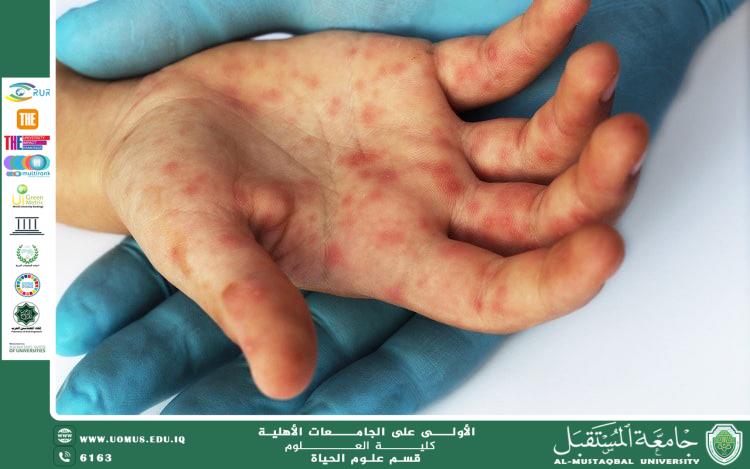
A scientific article by the lecturer (M.M. Zahraa Jawad kadhim) entitled "Foot-and-mouth disease"
22/02/2025 Share :
Foot-and-mouth disease (FMD) is a highly contagious viral disease of livestock with a significant economic impact. The disease affects cattle, pigs, sheep, goats and other cloven-hoofed ruminants. Intensively reared animals are more susceptible to the disease than conventional breeds, and the disease is rarely fatal in adult animals, but mortality is often high in young animals due to myocarditis or when lactating dams become infected and milk production is reduced. FMD is characterised by fever and blister-like ulcers on the tongue, lips, mouth, teats and between the hooves. The disease causes severe production losses; while most affected animals recover, they are often left weak and debilitated. FMD is caused by a virus from the Picornaviridae family. There are seven strains of the virus: A, O, C, 1SAT, 2SAT, 3SAT and 1Asia, endemic in different countries around the world. Each strain requires a specific vaccine to provide immunity to the animal being vaccinated. Foot-and-mouth disease is the first disease to be officially recognized by the OIE as a notifiable disease. Member countries can also apply for official accreditation of their national control programmes.<br />Transmission and spread<br />Foot-and-mouth disease is present in all faeces and secretions of infected animals. These animals exhale large amounts of aerosolized virus that can be transmitted and infect other animals through the respiratory or oral tract. The virus may be present in milk and semen for up to 4 days before clinical signs of the disease appear in the animal.<br />How does the virus reach a healthy animal?<br /><br />- Mixing between infected and healthy animals at watering places, feeders, vaccination sites and markets.<br />- Through animal transport vehicles contaminated with secretions from infected animals.<br />- Artificial insemination from an infected animal.<br />- Infects newborn calves from infected mothers.<br />- Winds carry the virus over very long distances on land or at sea.<br />- Veterinarians and workers can transmit the disease from an infected animal to a healthy one.<br /><br />Symptoms of foot-and-mouth disease in cattle - Symptoms of foot-and-mouth disease in general:<br />- Fever, loss of appetite, weight, and poor milk production.<br />- Blisters appear on the tongue, lips, nose, nipples, hooves, and swelling of the heel.<br />The shape of the blisters gradually increases over 10 days until complete recovery as follows:<br />- Day 1: Blisters with fluid.<br />- Day 2: Beginning of the blisters to burst.<br />- Day 3: All blisters burst, severe redness, and severe pain.<br />- From the fourth to the seventh day: Some ulcers, and the beginning of the healing stages.<br />- From the seventh to the tenth day: Fibrous tissue appears in the affected areas until complete recovery after two weeks from the onset of symptoms, and it is important to take precautions to prevent the appearance of a bacterial infection during the infection.<br /><br />Symptoms of foot-and-mouth disease in sheep and goats<br />- Lameness is the most prominent symptom of infection.<br />- Milk production stops in dairy animals, and sudden death occurs in young lambs.<br /><br />Treatment of animals infected with foot-and-mouth disease<br /><br />- Isolating the infected animal is the first step in treatment, while providing easy-to-chew feed.<br /><br />- Using a fever reducer and an antibiotic to prevent secondary infection.<br /><br />- Treat mouth ulcers with a 4% sodium carbonate solution, and hoof ulcers with a 5% copper sulphate solution.<br /><br />How can we control the disease?<br /><br />- Commitment to periodic vaccination of animals.<br /><br />- It is necessary to inform the Veterinary Medicine Directorate when an infection appears.<br /><br />- Isolate infected animals from healthy ones, with specific individuals assigned to each group for care so that individuals do not transmit the infection.<br /><br />- Prevent mixing with new animals until they are sure that they are free of infection.<br /><br />- New animals are not introduced until after disinfecting the pens in which an infection has previously appeared.<br /><br />- When an infection appears, the dirt floors are cut, and animal waste and feed are disposed of in a healthy manner.<br /><br />- Use acidic and alkaline disinfectants; To disinfect all places and objects that may be contaminated with the virus, it is preferable to use spray motors.<br /><br />Al-Mustaqbal University, the first university in Iraq