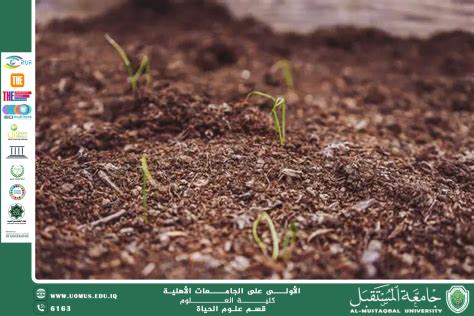
A scientific article by the teaching assistant, Banin Maan Karim, entitled “The role of soil in absorbing chemical pollutants.”
22/02/2025 Share :
Soil plays a critical role in absorbing and mitigating the effects of chemical pollutants in the environment. It acts as a natural filter and buffer, helping to reduce the movement of harmful chemicals into groundwater and surface water. Here is a breakdown of how soil absorbs and handles chemical pollutants:<br /><br />1. Physical absorption and filtration<br />Soil particles: Soil particles, especially clay and organic matter, have the ability to absorb (adhere to) and trap chemical pollutants. These particles have a large surface area and can interact with various chemicals through physical processes such as absorption and desorption. This prevents pollutants from moving freely through the soil and into water sources.<br /><br />Soil texture and composition: The ability of a soil to absorb pollutants depends largely on its texture (sand, silt, or clay content) and composition. For example, clay soils tend to have a higher capacity to absorb pollutants due to their fine texture and large surface area.<br />2. Chemical reactions<br /><br />Ion exchange: Minerals in soil, such as clay and organic matter, can exchange positively charged ions (cations) with contaminants in the soil. This process helps to stabilize contaminants and reduce their mobility. For example, heavy metals such as lead and cadmium can attach to soil particles through ion exchange, preventing them from leaching into groundwater.<br /><br />Chemical precipitation: In some cases, contaminants can react with soil minerals and form insoluble compounds that precipitate out of the soil solution. This process reduces the bioavailability of contaminants and reduces their impact on plant and animal life.<br /><br />3. Biodegradation<br />Microbial activity: Microorganisms in soil, such as bacteria, fungi, and algae, can degrade or detoxify some chemical contaminants through biochemical processes. For example, some bacteria can degrade organic contaminants such as pesticides, petroleum products, and other hydrocarbons through a process called biodegradation.<br />Bioremediation: Some soil organisms can also be used in bioremediation of contaminated soil. This process involves introducing or enhancing natural microbial communities in the soil to speed up the decomposition of contaminants.<br />4. Retention of Nutrients and Heavy Metals<br />Heavy Metals: Soil acts as a sink for heavy metals such as mercury, arsenic, and cadmium. These metals are often trapped in the soil matrix through adsorption or chemical reactions, which can prevent them from leaching into groundwater. However, in some cases, contaminants can still be released back into the environment if soil conditions (such as pH or moisture) change.<br /><br />Organic Contaminants: Organic chemical contaminants, such as pesticides, herbicides, and industrial chemicals, can also be absorbed by soil particles. These contaminants can bind to organic matter in the soil and remain in the soil for long periods, reducing their bioavailability to plants and animals. However, in some cases, organic contaminants can persist and accumulate in the soil, which can lead to long-term environmental problems.<br />5. Soil pH and Pollutant Mobility<br />Effect of pH: Soil pH plays an important role in the uptake and movement of chemical pollutants. For example, in acidic soils (low pH), heavy metals may become more mobile and leach more easily into groundwater. In alkaline soils (high pH), pollutants such as phosphorus can form insoluble compounds and become less bioavailable.<br /><br />Buffering capacity: Soils with higher organic matter content tend to have a higher buffering capacity, meaning they can better absorb and neutralize acidic or basic pollutants before they reach harmful levels.<br /><br />6. Soil contamination and limitations<br />Soil saturation capacity: While soils can absorb and filter many pollutants, there is a limit to how much they can handle. Once soils reach saturation, they may no longer be able to absorb or retain pollutants effectively. This can lead to harmful chemicals leaching into nearby water sources, potentially causing long-term environmental pollution.<br /><br />Bioaccumulation of pollutants: In some cases, plants can absorb soil pollutants and enter the food chain. This is of particular concern with heavy metals, as they can accumulate in plant and animal tissues, posing health risks to wildlife and humans.<br />7. Remediation and Recovery<br />Phytoremediation: Some plants have the ability to absorb and accumulate toxic chemicals, such as heavy metals, from soil. This process, known as phytoremediation, can be used to clean up contaminated soil by growing specific species of plants that can detoxify or stabilize pollutants.<br /><br />Soil Amendments: Adding organic matter such as compost, biochar, or clay to contaminated soil can improve its ability to retain and neutralize pollutants. These amendments can enhance the physical and chemical properties of the soil, and enhance the natural processes of absorption, filtration, and decomposition.<br /><br /><br /><br />AL_mustaqbal University is the first university in Iraq<br />