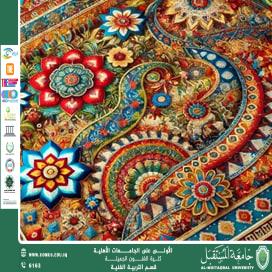
An Article "Indian Textiles: The History of Weaving and Embroidery Arts" by Asst. Lecturer "Hasan Hadi Ensaif ".
01/03/2025 Share :
India has one of the richest traditions in textile production, dating back thousands of years. The country's weaving and embroidery arts showcase a blend of skilled craftsmanship, cultural heritage, and regional influences, making Indian textiles renowned worldwide.<br />History of Indian Textiles<br />The history of Indian textiles can be traced back to the Indus Valley Civilization (2600–1900 BCE), where evidence of cotton use in clothing has been discovered. During the Mughal era, textile production flourished, and India became famous for its luxurious fabrics, such as muslin, Kashmiri shawls, and silk sarees.<br />Types of Indian Textiles<br />Indian textiles vary across regions, each having its unique weaving techniques and materials. Some of the most famous types include:<br />• Muslin: A fine cotton fabric originating from Bengal, once exported to Europe and the Middle East.<br />• Kashmiri Shawl: Made from soft Pashmina wool in Kashmir, known for its intricate patterns.<br />• Saree: Woven from silk or cotton and adorned with various embroidery techniques like Zardozi and Bandhani.<br />• Banarasi Silk: A luxurious silk fabric from Varanasi, decorated with gold and silver threads.<br />Embroidery Arts in India<br />Indian embroidery is an essential element of textile decoration, with diverse regional styles, including:<br />• Zardozi: A gold and silver thread embroidery technique used on royal garments and textiles.<br />• Chikankari: A delicate hand embroidery from Lucknow, featuring floral and geometric motifs.<br />• Kantha: A hand-stitched embroidery from Bengal, used on scarves and quilts.<br />• Phulkari: A vibrant embroidery style from Punjab, commonly found on shawls and traditional clothing.<br />Global Influence of Indian Textiles<br />Indian textiles have played a significant role in global trade for centuries, with exports reaching Europe, the Middle East, and Asia. The Mughal period, in particular, saw a fusion of Persian and Indian textile techniques, leading to the creation of intricate and artistic designs.<br />Conclusion<br />Indian textiles represent a rich cultural and artistic legacy, reflecting the country's diverse heritage. With their exquisite craftsmanship and unique designs, these fabrics continue to hold an important place in the world of traditional and contemporary fashion. <br /><br />The above article contributes to promoting sustainable development goals, especially the fourth goal, “Quality Education.”<br /><br />Almustaqbal University, the number one university in Iraq.<br /><br /><br />