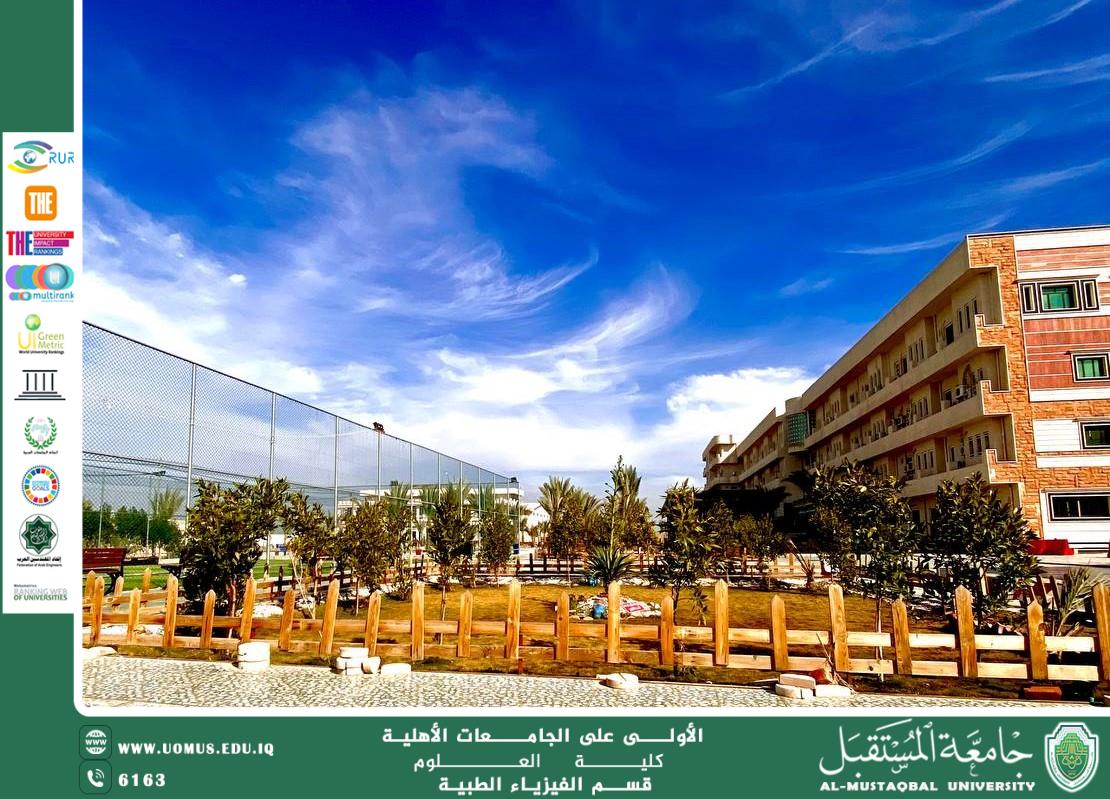
Good Deeds for a More Beautiful Environment – A Scientific Article by Dr. Du’aa Jaafar Diaa
03/03/2025 Share :
A good deed is an action that benefits both the individual and society. If it does not improve both, it remains merely a "good act" rather than a righteous deed. For example, an employee who attends work is performing a good act in principle, but their work is only considered righteous if they carry out their assigned duties with honesty and integrity, making them a valuable member of society. While we perform many good acts, truly righteous deeds are fewer in number. How many employees are present at their jobs but fail to fulfill their responsibilities towards the community? It is essential to recognize that only righteous deeds ascend to the heavens, as stated in the Holy Qur’an:<br /><br />"But righteous deeds raise it [good words]." (Surah Fatir: 10)<br /><br />Today, we are in dire need of righteous deeds to advance and develop our societies. We must not mistake good acts for righteous deeds, as this misunderstanding can be detrimental. Allah says in the Qur’an:<br /><br />"Then, is one to whom the evil of his deed has been made attractive so he considers it good?" (Surah Fatir: 8)<br /><br />One of the most significant righteous deeds needed today for a clean and beautiful environment is "intellectual cleanliness." Before delving into this topic, it is important to define environment. Linguistically, the word derives from the verb "bawa’a," meaning to settle or reside. It refers to the place where a person lives and establishes their livelihood. In terminology, the environment encompasses everything surrounding humans, including water, air, living organisms, and inanimate objects. It serves as the domain where humans engage in various activities. The environment was created with a delicate and balanced system by an All-Knowing and Wise Creator. However, human actions have disrupted this balance, leading to the destructive phenomenon of pollution, which has affected most environmental elements.<br /><br />Preserving the Environment: A Measure of Civilization<br />The preservation of the environment reflects the progress, culture, and civilization of a nation. To build a better future that begins with a beautiful environment, we must follow key principles of intellectual cleanliness, which include:<br /><br />1. Love<br />Love fosters unity among people, benefiting society and helping to combat pollution. A love for nature and all living beings leads to righteous actions. Love manifests in various ways—for instance, if we love living in green spaces, we must protect trees and benefit from these natural surroundings. The Prophet Muhammad (peace be upon him) said:<br /><br />"If a Muslim plants a tree or sows seeds, and then a bird, a person, or an animal eats from it, it is regarded as a charitable act for him."<br /><br />During his return from the Battle of Tabuk, the Prophet (peace be upon him) said:<br /><br />"This is Taba, and this is Uhud—a mountain that loves us, and we love it."<br /><br />2. Cooperation<br />All societies must collaborate to protect the environment and safeguard human health from pollution. Future generations deserve to be born free from deformities, in a healthy and happy society. Cooperation can be practiced in simple ways—for example, refraining from littering means sparing a sanitation worker the effort of bending down to clean up. Isn't that a righteous deed?<br /><br />3. Cleanliness<br />Cleanliness involves consistent practices that ensure personal and environmental hygiene. A clean environment is essential for good health and reflects an aware and responsible society. Righteous deeds that elevate a believer include clean thinking and a pure heart. The cleanliness of surroundings, speech, and emotions is a testament to righteousness. We can maintain environmental cleanliness through the following actions:<br /><br />Using water wisely and avoiding waste.<br />Proper waste disposal to prevent disease and contamination. Instead of simply discarding leftover bread, why not cut it into small pieces and place it where birds can eat it? This transforms an ordinary good act into a righteous deed.<br />Reducing the use of harmful chemicals and handling them carefully.<br />Combating pollution by engaging in gardening and planting in homes and public spaces.<br />4. Responsible Interaction with the Environment<br />Righteousness requires treating the environment as a living entity. If we establish a mutual relationship with nature, it will reciprocate with beauty and balance. This involves not exploiting natural resources irresponsibly, as they belong not only to us but also to future generations. The environment is a trust that must be protected and maintained.<br /><br />5. Awareness and Education<br />Raising awareness is a key tool for environmental conservation. It involves educating people about the importance of natural resources and how to preserve them. For instance, government agencies often promote electricity conservation to reduce greenhouse gas emissions from power plants.<br /><br />6. Compliance with Environmental Laws<br />Righteous deeds for environmental protection include adhering to laws and regulations set by governments to preserve nature. These laws introduce initiatives and policies aimed at reducing pollution in oceans, forests, and agricultural lands. They also help protect rivers from industrial waste and preserve aquatic life. Furthermore, such laws maintain water quality and safeguard fish populations in rivers and oceans.<br /><br />Conclusion<br />A beautiful and clean environment is a reflection of righteous deeds performed by individuals and society. Through love, cooperation, cleanliness, responsibility, awareness, and law enforcement, we can achieve an environment that is not only sustainable but also harmonious with human well-being. Let us strive for a world where righteous actions uplift both individuals and nature, creating a legacy of beauty and balance for future generations.<br />"AL_mustaqbal University is the first university in Iraq"